
What’s your favorite San Francisco landmark? Let us know in the poll at the bottom of this story or by emailing totalsf@sfchronicle.com, and we might include your response in a future Total SF column.
The decision was unanimous.
Eleven supervisors voted on Sept. 10, 2024, to make Gilbert Baker’s massive 20-by-30-foot Pride flag in the Castro District’s Harvey Milk Plaza an official city landmark, ensuring that it would fly overhead for generations to come.
The resolution, introduced by Supervisor Rafael Mandelman, made far fewer headlines than recent controversies surrounding the Pride symbol. But it arguably means much more. The largest flag in the city is a six-color rainbow standing for love and unity. And though it’s been flying at the intersection of Castro and Market streets since 1997, it’s my new favorite landmark in San Francisco.
The original rainbow flag was designed by Gilbert Baker for the 1978 Pride parade. Two decades later it was placed on a 100-foot pole, part of an art installation encircled by more flags, currently maintained by the Castro Merchants Association.
Since exploring San Francisco and the Bay Area became my full-time job, I’ve been surprised how much the flag has followed me around.
I first noticed it during a profile of Corona Heights Park, where the flag appeared so large behind the park’s community gardens that it felt like a backdrop.
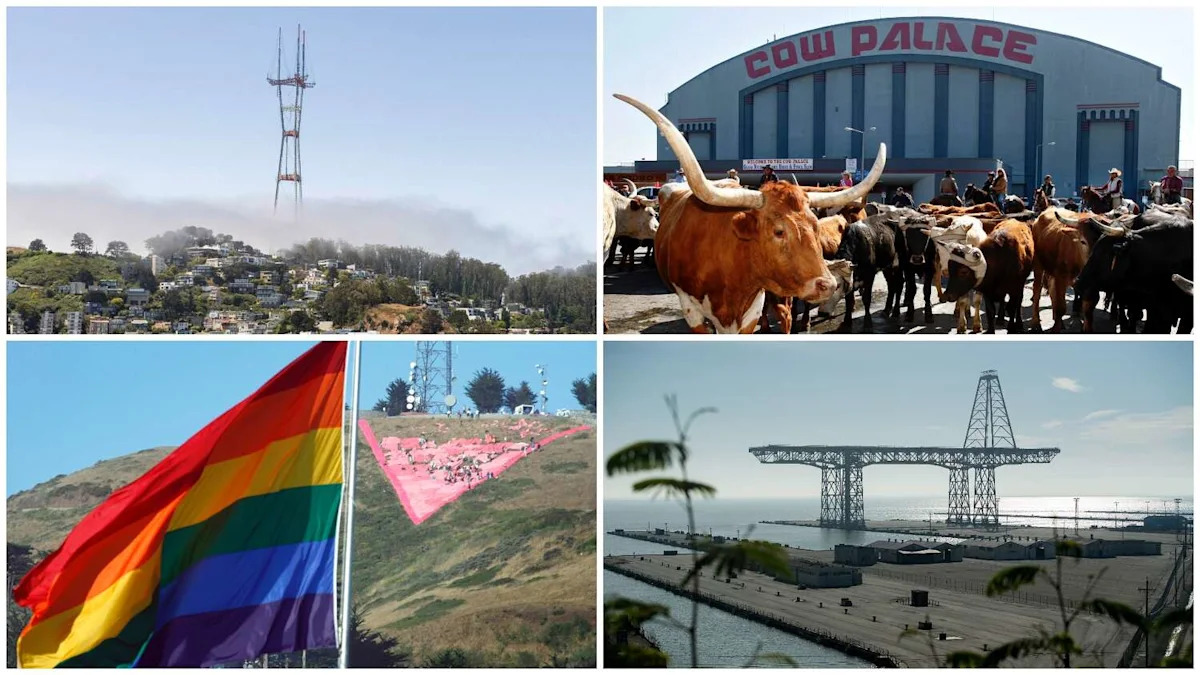
Sutro Tower is how San Franciscans orient themselves in the city’s valleys. But I find myself looking for the Pride flag more and more when I’m on the peaks. The Pride flag is visible from Twin Peaks, Mt. Davidson, underrated Mt. Olympus and (on a clear day) Bernal Heights Park. I’ve spotted the flag from Salesforce Tower and the Transamerica Pyramid and look for it every time I fly in an airplane over the city.
There are strong runners up to Castro’s Pride flag. I’ll always love Sutro Tower, treated with anger, fear-mongering and dread when it was proposed, and now beloved by newer generations who tattoo the silhouette of the TV tower on their bodies, include it on sports team logos and paint it on our streets.
The Hunters Point Crane, a remnant of our shipbuilding past, is the city’s most underrated landmark. The crane with its red and white arch – used to test-launch Polaris missiles – fixed battleships and helped bolster the city’s middle class. It stood sentry over Candlestick Park 49ers and Giants games, and still can be seen from five counties.

Gilbert Baker’s Rainbow Flag installation at Harvey Milk Plaza in 2018. (Liz Moughon/The Chronicle)
And a salute to the Cow Palace, the Bay Area’s working class hero, toiling through the decades with little credit, leaving millions of formative memories in its wake. How many first concerts, first kisses, first tokes of a joint and first experiences of hearing loss were experienced at that wonderful venue?
But the flag has come to represent something more.
It became a joyful welcome to the Castro District, best seen while walking off the F-line historic streetcar or emerging from Muni’s Castro Station. Walking from the subway up the stairs of the plaza, it’s strikingly larger than life, more like a blanket than a banner, ready to comfort anyone who has been made to feel uncomfortable in their own skin.
But I saw it in a different light last month, when a trio of Giants pitchers wrote Bible verses on their caps during the team’s annual Pride celebration game, and President of Baseball Operations Buster Posey squirmed through an abysmal subsequent press conference. A month later, fans are still furious.
The scene reflected on the Giants and Posey. But to me it never reflected on San Francisco.

From left: Jim Soos, Noah Wallace, Matt Foley and a person who gave their initials as J.P. protest outside Oracle Park on June 23, after Giants pitchers wrote Bible verses on their Pride-themed caps during the team’s Pride Night celebration on June 12. (Santiago Mejia/S.F. Chronicle)
We’ve already made our decision on where we stand as a city, voted unanimously by those supervisors in 2024. Posey, for all his World Series heroics, is an at-will employee. The permanence of Gilbert Baker’s swimming pool-sized flag is protected in the city charter.
Throughout that controversy I kept thinking about a line from Bruce Springsteen’s song “Long Walk Home,” which he sang during his recent Chase Center show as the band went all but silent for the final verse:
“Your flag flying over the courthouse.
Means certain things are set in stone.
Who we are, what we’ll do and what we won’t.”
The last part is what struck me the most: What we won’t. We can debate which politicians to elect, which legislation to support and how we honor our LGBTQ+ heroes.
But there are lines in the city of San Francisco that will never be crossed. The right to love who you want to love. The right to celebrate that love and the battles fought to get here. And the knowledge that in this community, those values are not up for further discussion, any more than if those Giants players wanted to debate the tides, the fog or the existence of sea lions.
The massive flag means we’re never going back.
And wherever I travel in the city, I’ll keep looking for it from afar.
Subscribe
There’s more to San Francisco with the Chronicle. Subscribe today for just 25¢.
This article originally published at Move over, Sutro Tower. This is my new favorite San Francisco landmark.