
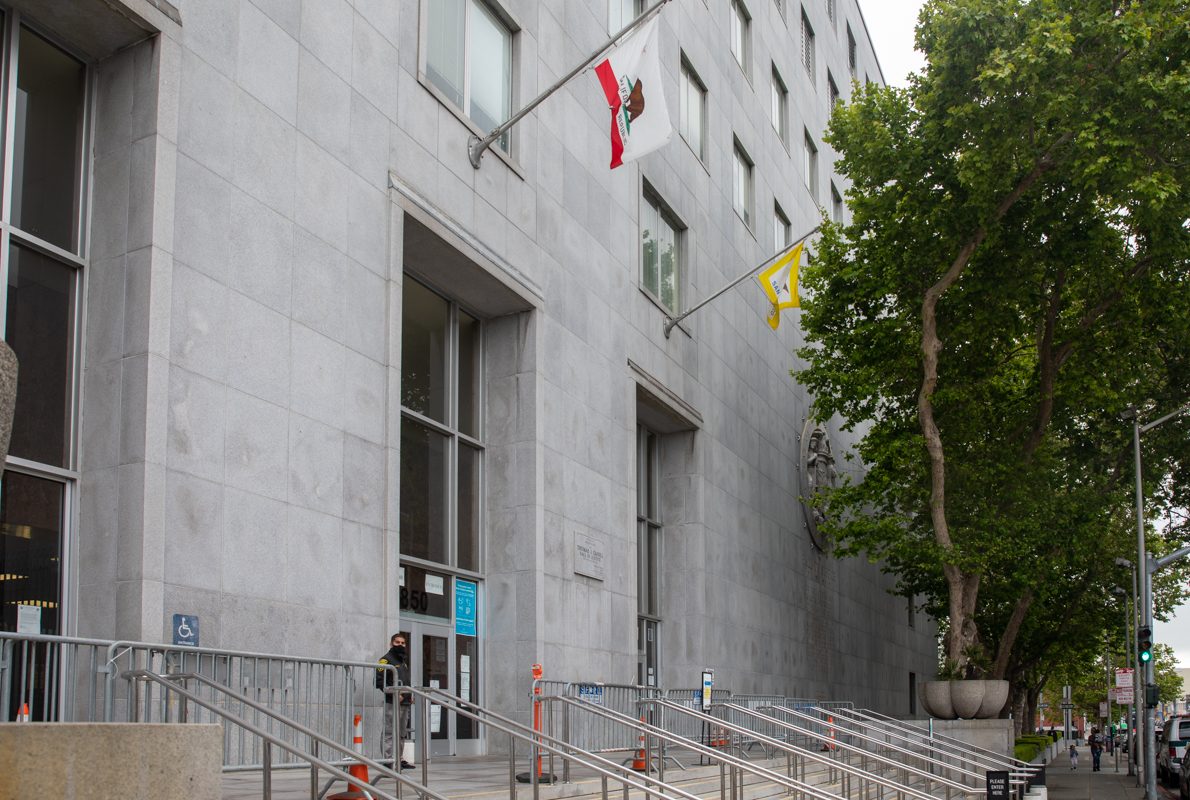
San Francisco Hall of Justice – Photo by David M. Greenwald
SAN FRANCISCO — Tensions flared during closing arguments in San Francisco Superior Court after Deputy Public Defender Debora Awolope accused Deputy District Attorney Andre Guiulfo of displaying disrespect in front of the jury, moments before jurors ultimately rejected the prosecution’s central claim that the accused intended to sell narcotics.
“Did you roll your eyes at me?” Awolope asked Guiulfo as she addressed Judge Teresa M. Caffese and the jury in Department 21 on July 15.
The courtroom atmosphere grew tense as Guiulfo removed his glasses and pinched the bridge of his nose while Awolope continued her closing argument. The exchange came during People v. Davis, a trial centered on allegations that the accused, Patrick Wayne Davis, left the scene of an accident and possessed methamphetamine and cocaine for sale.
“This is a case where you should never judge a book by its cover,” Awolope told the jury, arguing the prosecution sought to portray Davis as a drug dealer based on assumptions rather than evidence. “Taking a brief look at something, then expecting you to fill in the gaps… pay attention to the details the DA failed to mention.”
Throughout the multi-day trial, prosecutors attempted to connect Davis to street-level narcotics sales following a vehicle collision involving a Chevy Tahoe registered in his name. Prosecution witness John Gardner of the Fugitive Recovery Task Force testified he tracked the vehicle using Real-Time Investigation Center camera networks.
Under cross-examination, however, Gardner acknowledged he had no warrant for Davis, witnessed no drug transactions or traffic collision firsthand, and confirmed Davis was fully compliant during his arrest.
Curtis Wong, program coordinator for Safe City Connect, introduced surveillance footage from Eddy Street. During cross-examination, the defense emphasized what it argued was a significant gap in the state’s case: While surveillance captured the alleged hit-and-run, prosecutors produced no video showing any alleged narcotics transactions on the street.
The defense also challenged the thoroughness of the police investigation. Sgt. Warner Moore acknowledged preparing a collision report without photographing either the vehicle or the collision scene and admitted he did not review available body-worn camera footage before completing his report.
Moore’s credibility came under further scrutiny when Awolope played Defense Exhibit B2. After Moore testified witnesses at the scene had been “yelling,” the video showed the witnesses speaking calmly, prompting Moore to withdraw his earlier characterization.
Testimony also established investigators never searched the trunk of Davis’ towed vehicle, did not interview a female passenger who was present at the scene and recovered no scales, unused baggies or cutting agents commonly associated with narcotics sales.
Cross-examination of Officer Kellen Alvarez further challenged the prosecution’s financial theory. Alvarez, who had been with the department for only three months at the time of the incident, repeatedly responded, “I do not recall,” and relied extensively on written reports.
She also acknowledged officers failed to complete mandatory inventory forms documenting cash found in a fanny pack, a procedural lapse Awolope argued undermined the prosecution’s claim that the money was connected to drug sales.
To counter the state’s theory, the defense called Sean Guardlap, described as Davis’ informal employer, who testified Davis earned approximately $200 per week in cash watching his store and regularly cashed approximately $800 Supplemental Security Income checks there.
Defense expert Katherine O’Bryant Baggott, a drug culture specialist, testified the approximately three grams of narcotics recovered from Davis represented a typical three-day personal supply rather than a quantity consistent with distribution.
Baggott testified street-level methamphetamine typically sells for about $10 per gram and explained users often carry cash in fanny packs or pockets while purchasing multiple days’ worth of drugs at one time to reduce the number of street transactions.
Following deliberations, jurors returned a split verdict. They found the accused guilty of Count 1, leaving the scene of an accident.
However, the jury rejected the prosecution’s primary theory that Davis possessed narcotics for sale, acquitting him on Counts 2 through 5.
Instead, jurors convicted the accused of the lesser included offenses of simple possession, consistent with the defense’s argument that the drugs were intended solely for personal use.
To comment please go to one of these social media platforms:
Facebook: https://www.facebook.com/DavisVanguard
LinkedIn: https://www.linkedin.com/company/peoples-vanguard-of-davis-inc/
Instagram: https://www.instagram.com/davisvanguard/
X: https://x.com/davisvanguard
Bluesky: https://bsky.app/profile/vanguardnewsgroup.bsky.social
Subscribe to the Vanguard News letters. To make a tax-deductible donation, please visit davisvanguard.org/donate or give directly through ActBlue. Your support will ensure that the vital work of the Vanguard continues.
Categories: Breaking News Court Watch Northern California Court Watch San Francisco Court Watch Vanguard Court Watch Tags: Court Watch Criminal Justice Reform Drug Possession Due Process jury trial San Francisco Superior Court