
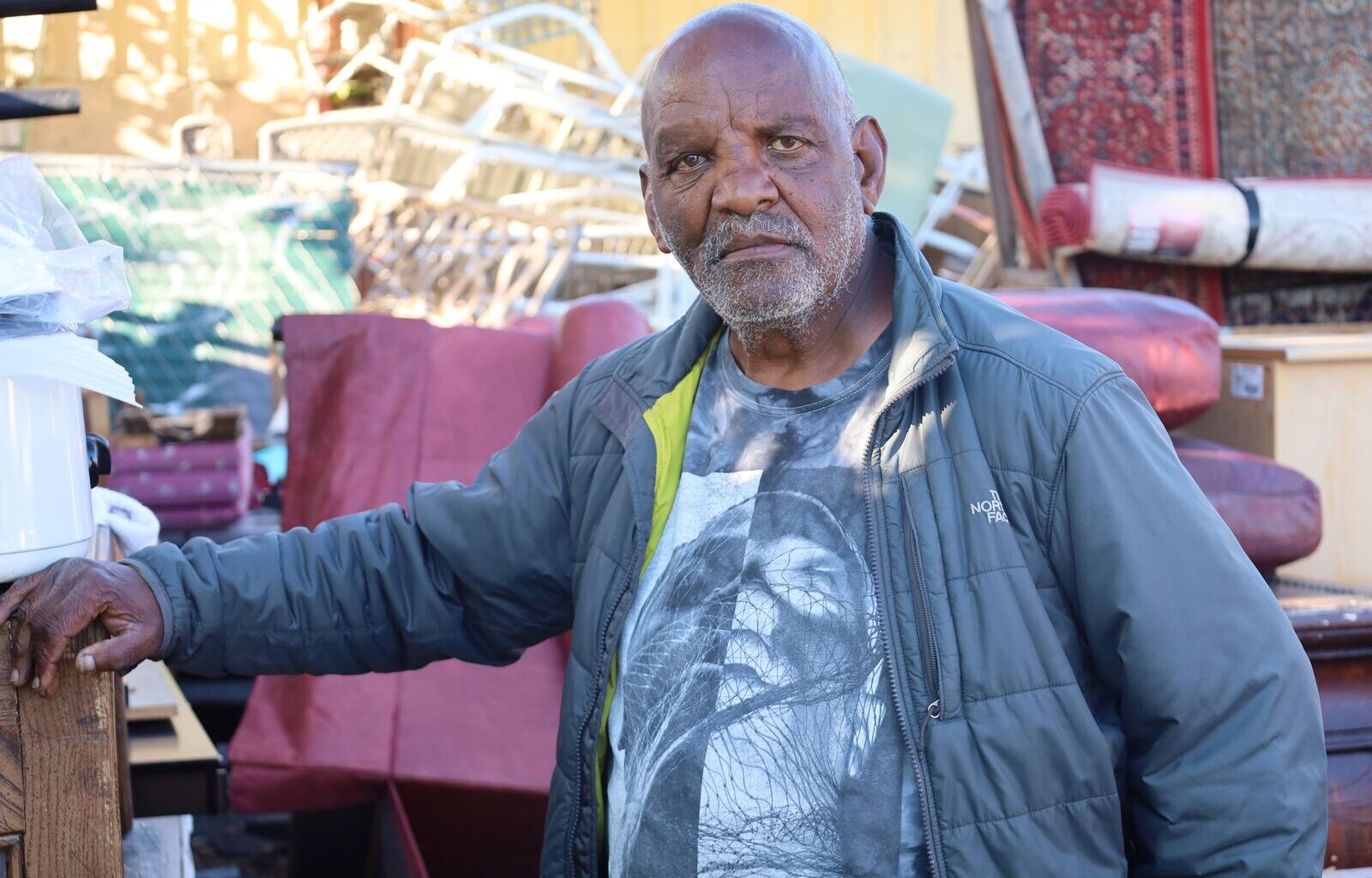
When Karl Omelay and his two sons stepped inside the shop at 63rd Street and San Pablo Avenue on a recent Saturday afternoon, it didn’t take long for the boys to come buzzing back with an old lamp in their hands.
“This is so cool,” said one of the boys holding the rustic steampunk-looking fixture with its green paint peeling. As they inspected its features, the shop owner, Claude Davis, chimed in.
“Before you get too excited, it’s about 90 bucks,” he said, laughing.
“Oh, we can’t get it down,” Omelay said resignedly.
The boys would’ve loved to tinker with the vintage item, but $90 was too high. Even so, Omelay had already succeeded in his goal.
“My job is to make memories for my kids,” said the 62-year-old, long-time Berkeley father. “Them coming here, digging through this stuff, they’re going to remember this in 20 years.”
The San Pablo Flea Market is an L-shaped building bounded by a lime-colored fence, with furniture crowding its yard. Open for decades, the market is a familiar sight for locals and a destination for thrifters who travel from all of the Bay Area and as far away as Los Angeles to explore its mazes of junk.
On Yelp, reviewers praise the market as a “favorite” and “icon.”
But the future of the San Pablo Flea Market isn’t certain. Davis, who’s 76, says he might not be able to run the shop much longer. He wants to retire, but there’s no successor in sight to continue the business.
“When this place closes down, it’s going to be the end of an era,” Omelay said as he stood there with Davis amid the stacks and shelves of items.
“The challenge is to remain motivated, to come open that gate” Davis said.
‘Organized disorganization’
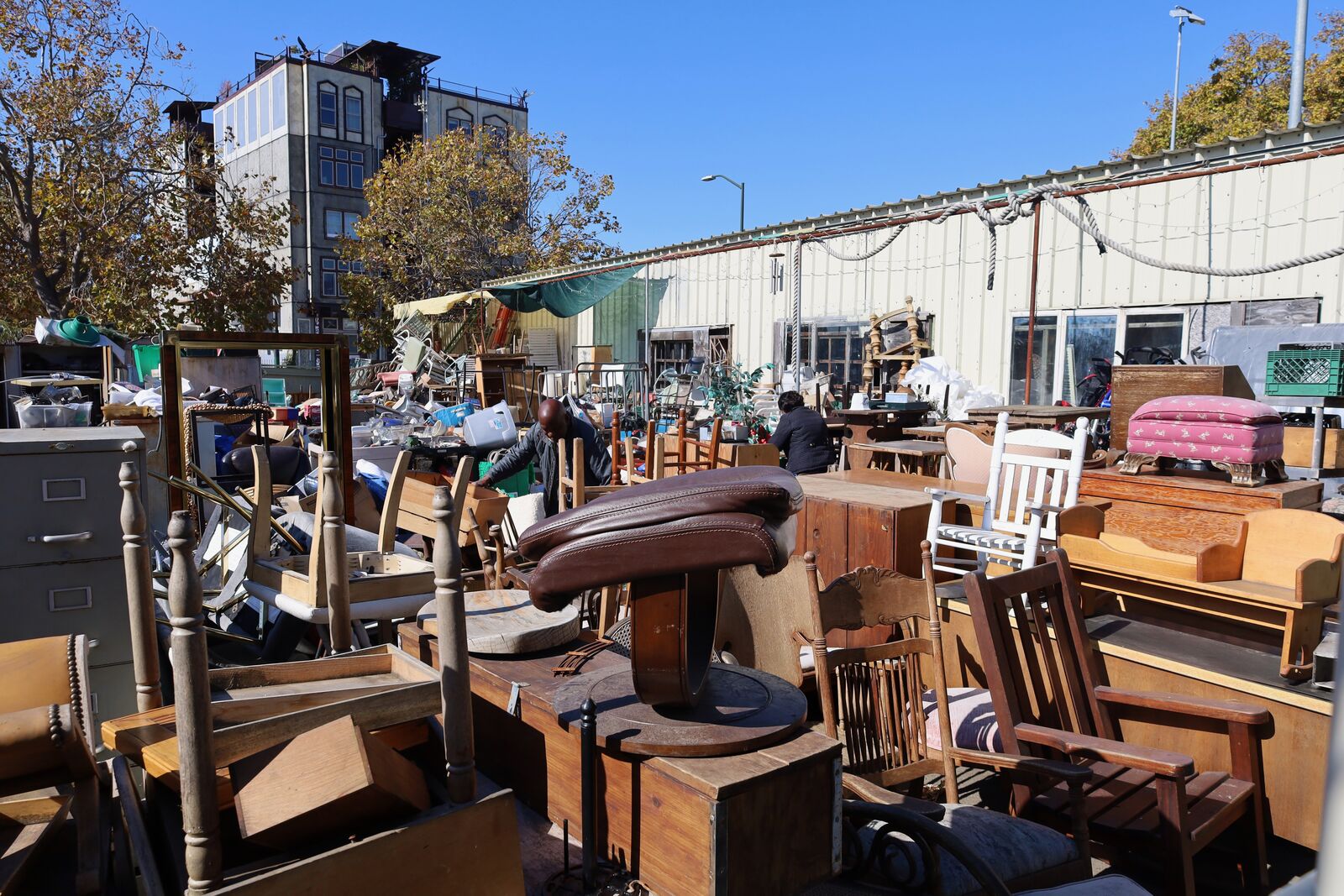 The yard at the San Pablo Flea Market is a maze of chairs, tables, ottomans, file drawers, desks, shelves, and more. Credit: Daniel Ekonde for The Oaklandside
On first glimpse, the flea market seems to be an abandoned warehouse and city lot filled with cast-off furniture and junk left to rot under an open sky. But inside and up close, there are vinyl records stacked high, office chairs, computer monitors, wooden dressers, plants in pots, sofas, cupboards and tables.
“Organized disorganization,” Davis said, explaining the vast collection of stuff. “Things are all over the place. When people need things, I know where they are.”
The corrugated metal building is stuffed with merchandise. This is where Davis keeps some of his best antiques. The entrance looks like a curated living room outfitted with furniture from the 1950s and 1980s. A long corridor is lined on both sides with floor-to-ceiling shelving units packed with collectibles, decorative items, and curiosities, including carved wooden masks, some of which Davis said came from Côte d’Ivoire, and hundreds of eyeglasses stored in transparent boxes from UC Berkeley, which he says the university probably used in its labs.
He estimates he’s opened the doors of the shop at least 10,000 times since he started working there. The market used to be a wholesale hub, supplying goods to resellers from other cities who redistributed them at a markup. One of Davis’s business-to-business clients was Venice antique shop owner Ken Erwin, who made weekend trips to the flea market until he got priced out of his space. When Erwin recently visited the market, he praised Davis as a “brave man” for holding on to the San Pablo location for so long.
The flea market’s halcyon days were around 2000, during the dot-com era, when there was a lot of venture capitalist money. More Oaklanders lived in warehouses, which accommodated industrial-type furniture and furnishings. The economic boom meant that the loft community needed art supplies for their homes and workspaces.
Davis discovered thrifting in the 1980s when, as an accountant working in San Francisco, he sought cheaper, quality second-hand suits and ties at the Berkeley Flea Market, a half-century-old fixture. He joined a friend there to sell on weekends and made up to $1,400 of extra cash. He learned how to pitch to people and convince them to buy, and when he lost his job in 1994, he decided to work at the flea market full-time.
A year later, Davis partnered with another friend who ran the San Pablo Flea Market. They sold their merchandise separately in the shop until his friend retired, and Davis took over.
A lot of his early merchandise was Department of Defense surplus furniture and equipment from military bases that were closed in the 1990s following the end of the Cold War.
Vinyl records, silver spoons, antique chairs
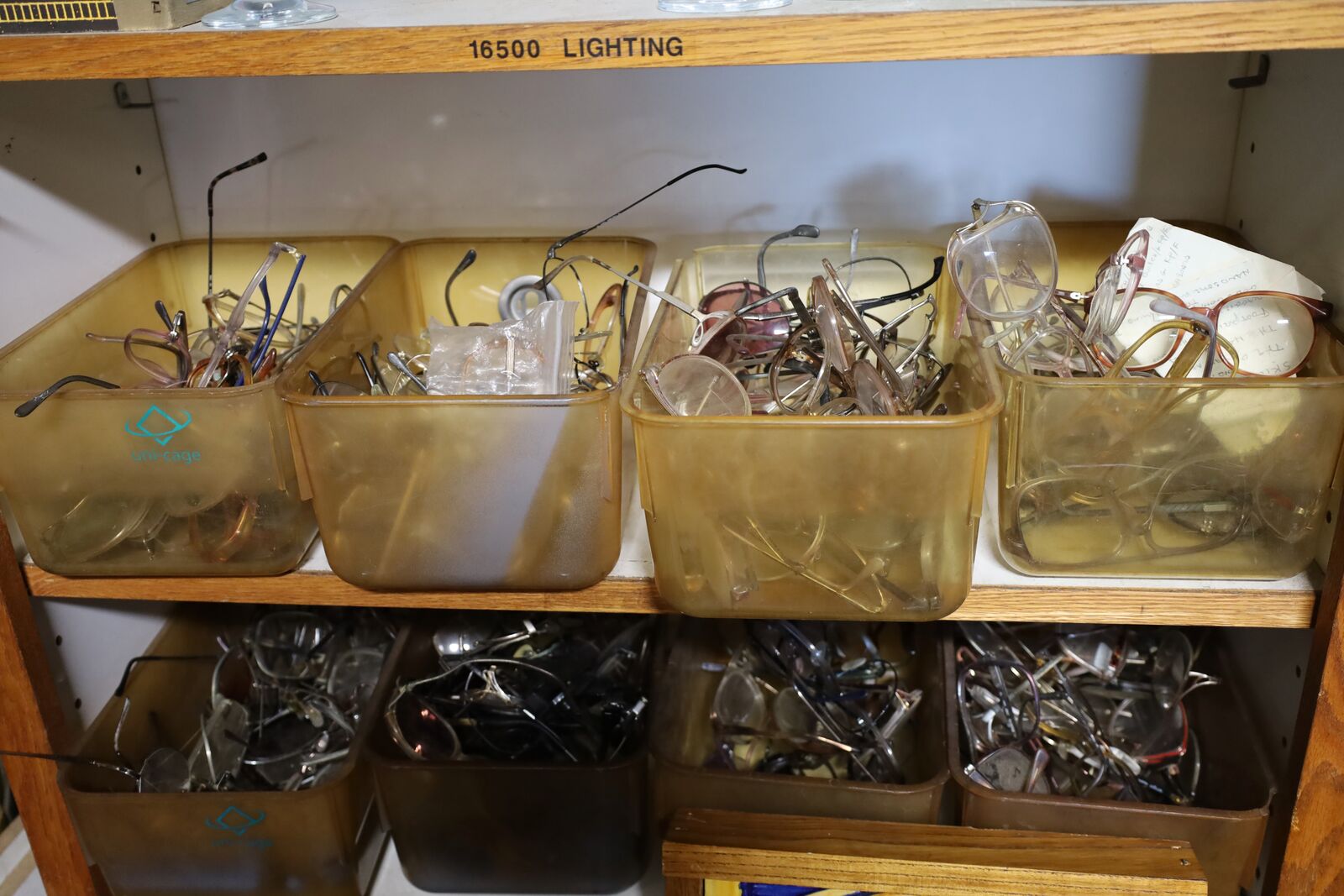 Among the many random collections: bins of eyeglasses. Credit: Daniel Ekonde for The Oaklandside
A woman carrying a box of dinnerware and glasses tells Davis, “I found some things.” He quickly inspects them. “Five dollars for the plate,” he says, referring to the largest ceramic piece.
“You’re gonna sell it to me for more than the price?” the woman asked after turning the plate and seeing a $1 label on the base.
“Yes,” Davis said. “You see, those prices were like 20 years ago.” Davis calculates inflation and accounts for the appreciation of some items in his head.
She gives in, explaining they’re for her daughter’s wedding.
Two more customers, a married couple, present a small white berry crate and two silver spoons. They also ask about a quartet of chairs they’d seen in the yard. Davis says they’re $80. The man explains they only need a pair. Davis insists it’s a set, but two would cost $50. The couple gives up on the chairs and asks about the crate and spoons.
“Two dollars,” Davis says.
“Two dollars!” the woman asks in a skeptical tone. “Claude, you are really a hard bargainer here.”
Unperturbed, Davis breaks down the price. “One dollar for the crate and one dollar for the spoons.”
As the woman pulls out two dollar bills, Davis reassures them: “My prices are the lowest in town.”
Next are a couple from Richmond. The man, David, grabbed piles of vinyl records and a book, “Freud’s Free Clinics.” A retired psychotherapist, David has known Davis for three decades and visits the San Pablo Flea Market every week looking for records.
“It’s one of the last remnants of places where somebody like me, who collects 78 rpm records, can go,” he says.
Items from the past, sold by a man looking forward
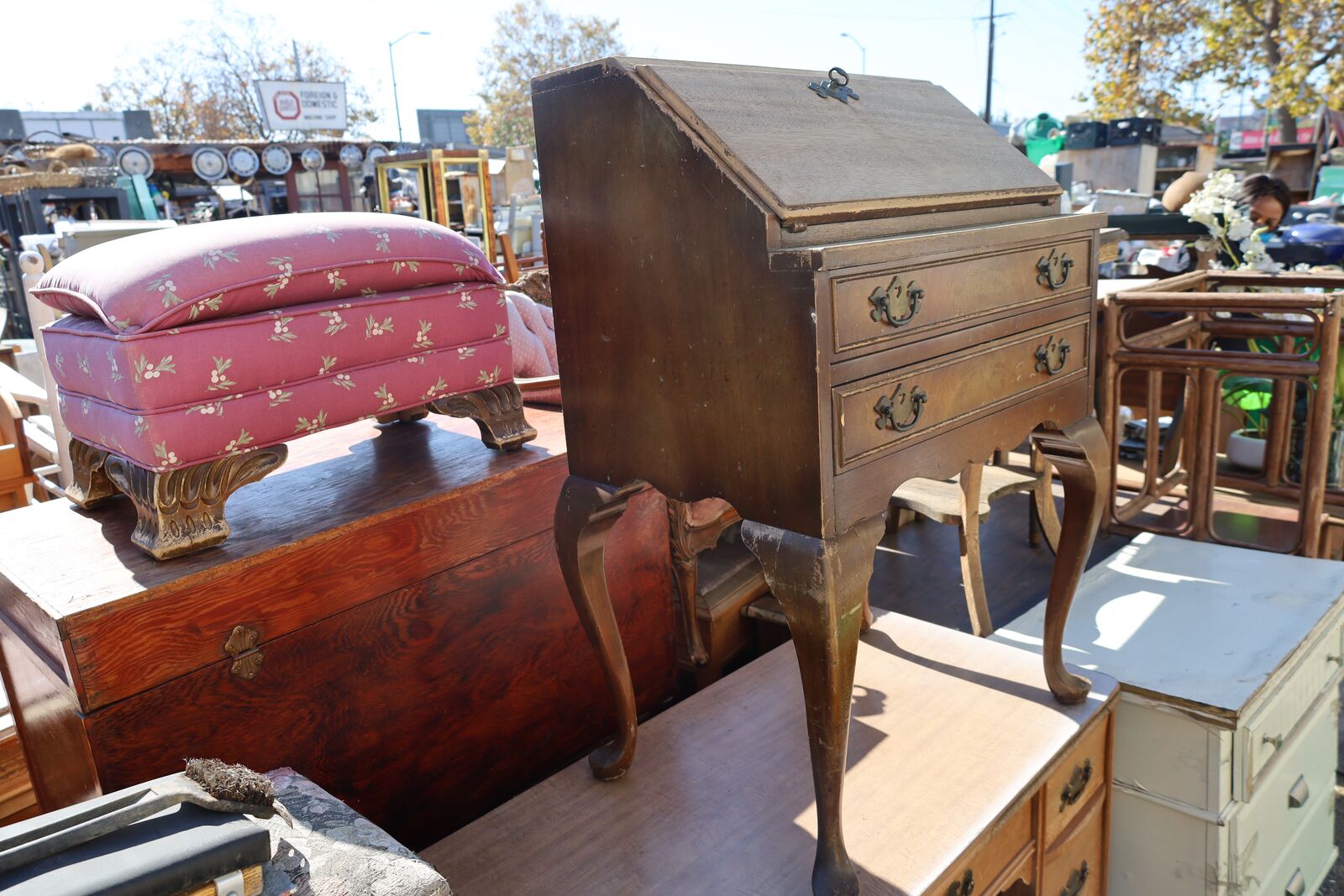 Shoppers seeking old items with character come from across the Bay Area and beyond to browse the San Pablo Flea Market’s inventory. Credit: Daniel Ekonde for The Oaklandside
One afternoon, the shop was still closed during its normal hours. Davis had locked himself out of his pickup truck, leaving shop keys inside.
“I only realized I’d locked myself out when I’d stepped out of the car. Now I’m losing money,” he said.
“You see that building over there?” He points to a new-looking 5-story structure with large rectangular windows on the other side of the road. “A similar one will be here when I’m unable to run this shop.”
Forty minutes later, the locksmith arrives and liberates Davis’ keys from his truck.
Later, a long-time customer and friend, Tom, who is a thrift reseller at the Berkeley Flea Market, shows up looking for something to flip. He stumbles on a framed drawing of a woman, but mildew stains convince him it’s not a good buy. Frustrated, he leaves without buying anything.
“In business, you have to be patient,” Davis says. “I’ve learnt to be patient over the years.”
Next, a customer named Calvin buys an “Oakland” hat for $5. Then he looks at a giant wooden elephant sculpture in the yard: “What do you want for the wood you have in the corner?”
“Don’t say that,” Davis counters in a friendly tone, wanting him to describe the sculpture for what it is.
“That big old wood,” Calvin insists.
“Come on, man,” Davis groans, amusedly.
Calvin makes small robots; he’s looking for raw materials.
Davis’ haggling has sometimes generated negative reviews.
“When you think of Flea Market, you would never think of this dump,” one person commented on Yelp.
Responding to this, Davis said he runs the shop alone and cannot be compared to another that’s managed by several workers. He also shrugs off the negativity. “I never read my reviews,” he said. “I always just continue to work and do good.”
Bryan Thomas, a fine arts professor at the California College of the Arts in San Francisco, views the market as a resource library. He brings his students there regularly to find art pieces, and Davis will explain their origins.
Thomas enjoys “taking something found and putting it on a platform for continued conversation.”
He’d bought an antique cast-iron metal coinbox known as a “still bank,” which caricatured African Americans, from Davis. “I can take those items and put them next to an image of an African American jockey from the same time, and have a conversation about the power of Black representation.”
Thomas describes Davis as a porch person who lets them into a world of arts and culture.
Davis relishes giving context to the items he sells. A heavily-bearded street vendor had come looking for a guayabera shirt to add to his collection, and they’d spent time talking about its background — how it originated in Mexico and Cuba.
That keeps Davis going, at least for now.
But in a way, he’s also ready to pack up. “I think my legacy is bigger than this,” he said one morning as he leaned on the side panel of his truck, opening a pack of tangerines lying on the truck bed.
Originally from Louisiana, he graduated from Grambling State University and moved to California in the 1970s. He worked as an accountant for 15 years at Kransco, a job that enabled him to buy a house in Richmond. He has a daughter and a 27-year-old grandson who have all forged their own unique paths in life.
With no one to take over the market once he leaves, the lime-green fence, metal shed, and yard stuffed with every imaginable home furnishing are likely to disappear. Thrifters, pickers and resellers, builders, and treasure hunters will have one less place to find that special item or part for a project.
Davis feels the shop has served its purpose. He won’t regret shutting it down when he finally decides to retire to Richmond.
“Once I leave,” said Davis, eating a tangerine and pointing at the front of his car from the tailgate, “I’ll be looking in the windshield, forward, to see where I’m going; I’m not going to be looking at the mirror to see where I came from.”
“*” indicates required fields