
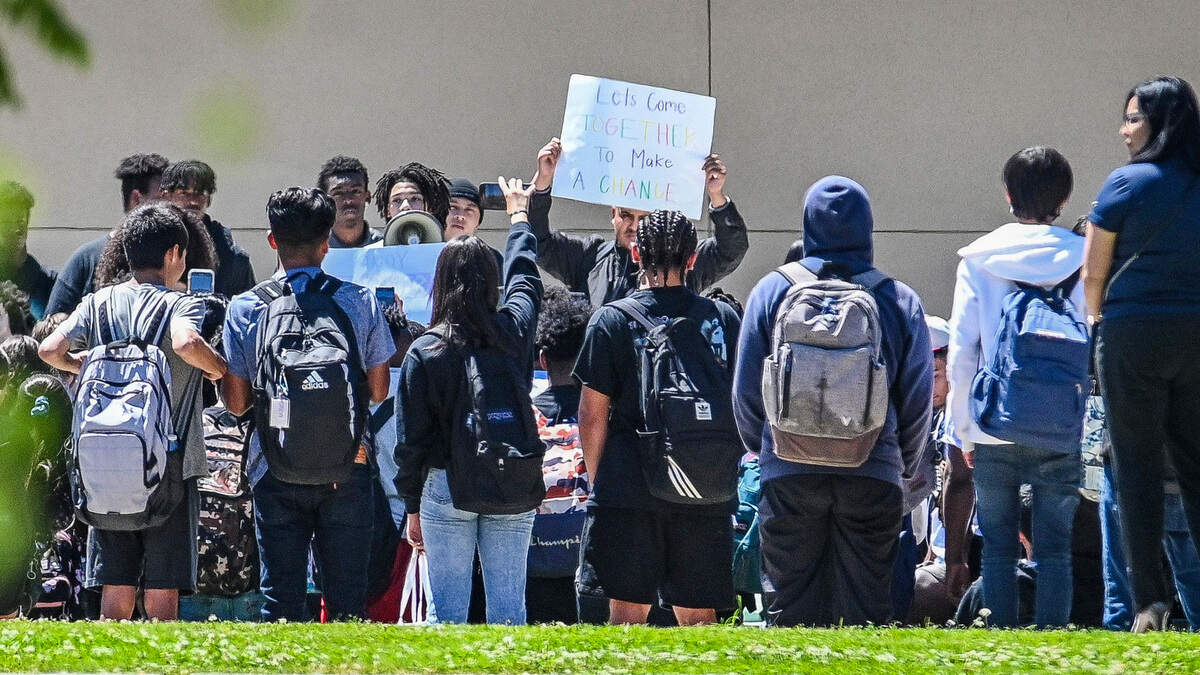
Students gather in the center quad area at Bullard High School during the final period of classes on Friday, May 6, 2022. A social media backlash has been felt across the district when a photo of a Bullard student wearing a mock Ku Klux Klan outfit was shared online. Racist, sexist and anti-LGBTQ jokes in Central Valley classrooms demand action. Schools should enact cultural training, reflect on history and protect students.
CRAIG KOHLRUSS
ckohlruss@fresnobee.com
Imagine homophobic slurs displayed on your classmates’ clothing, an incident that occurred at Visalia’s Redwood High School in February 2026. And imagine heading back to school to find your classmates sharing “humorous” images of themselves in blackface, as happened at Fresno’s Bullard High School in 2019.
Would you feel safe and ready to learn?
Racist, sexist and anti-LGBTQ incidents like these have surfaced in Central Valley classrooms in recent years, and for decades before that. Often dismissed as “just jokes,” this brand of hateful humor causes real harm. It makes students feel unsafe in one of the few places dedicated to their moral and intellectual growth.
I am an education professor at Fresno State, and I also research humor — both its positive and negative aspects. In my 2024 book, I examined the impact of racist humor on Bullard High School, where in May 2022 a “humorous” photograph of a student in Klan attire led to district-wide student walkouts.
One senior said they weren’t surprised; they had witnessed racism within the school before. Another student added that it was a part of the school’s history, as their own grandmother had shared stories about prejudice from her time as a student there.
How do you change a school’s culture? Stop blaming “bad apples.” Confront the culture that produces them.
Reframe incidents as institutional problems
When joking results in scandal, the impacted school and district should take action beyond isolating and punishing individuals.
Schools should ask, “How have we been complicit in enabling the values and ideas that surfaced on our campus?” By understanding local history and engaging in critical reflection, schools can expand professional development and take real steps to reshape their culture.
Address prejudice in curriculum
In 2023, Thomas Stewart, a Fresno-area teen, published an op-ed in this paper calling for education about systemic disparities in our community. He recognized that racism wasn’t an individual issue, but historical, structural and local.
English and social studies teachers are well-positioned to help students examine what makes something funny to some and not others, based on cultural specificity, history, geography, group dynamics and power. Students could learn about research that shows how hateful humor leads to multiple types of harm, including genocide and political violence.
Listen to student demands and act on them
Students give schools a reason to exist, and we must listen to what they say. In the wake of hateful joking scandals, student groups often issue formal demands for cultural sensitivity training, enforcement of antiracist/antisexist resolutions and funding for social justice initiatives. Districts rarely concede.
I urge schools to continue to better meet the demands of students targeted by hateful humor. Time and again, we see organizations more focused on managing controversy than addressing the harm experienced by students.
Ultimately, hateful humor depends on the existence of hate. Our schools reflect the beliefs of the community at large. Becoming more inclusive will require schools to reckon with the fact that hateful jokes do, unfortunately, represent their values.
It’s not enough to point fingers or remove a few bad actors. Schools must dig deep to confront the beliefs, policies and practices that allow hate to grow. Our educational system must be prepared to ask difficult questions and commit to difficult work. If they do not, more hate, scandal and community decay will surely follow.
David E. Low is a professor in the Department of Teacher Preparation at California State University, Fresno. He is the author of the 2024 book “Transgressive Humor in Classrooms,” which earned the Luis C. Moll Book Award. See more at davidelow.com
Related Stories from Fresno Bee