
Thousands of San Diegans who use vouchers to help cover the rent may have to pay significantly more money starting late next year to keep receiving aid.
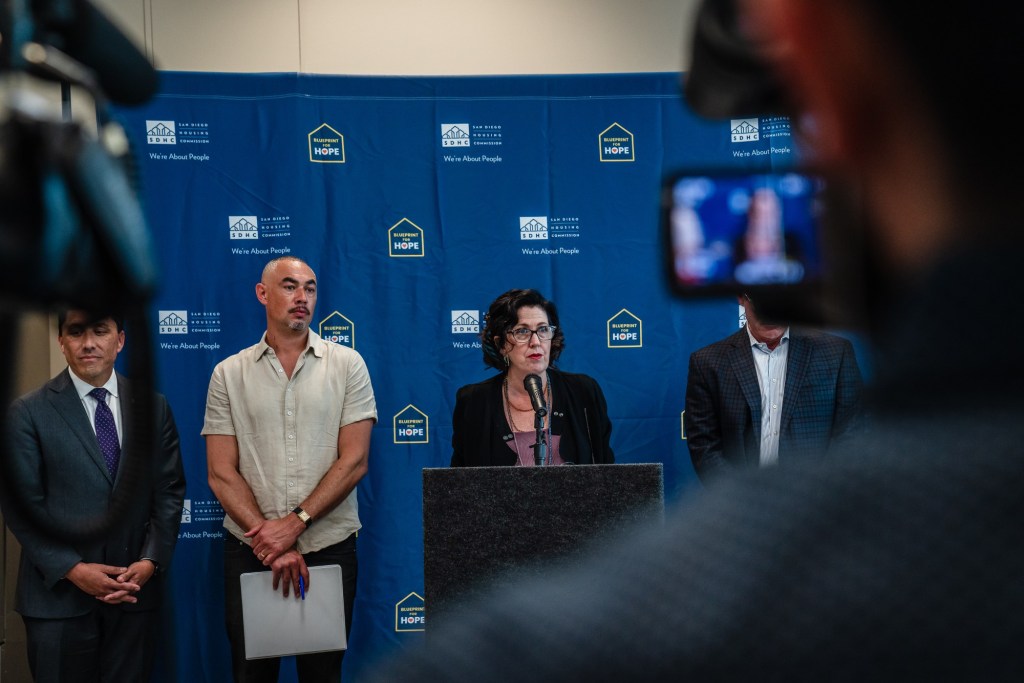
Leaders of the San Diego Housing Commission, which distributes the federally funded vouchers, are proposing to increase how much families chip in amid a budget crisis that’s grown for years.
In some cases, people that have only had to put 24% of their income toward rent will be required to contribute 40%.
Staffers are to present the plan to the agency’s Board of Commissioners Friday. A public hearing about the proposal is scheduled for Nov. 17. The board is expected to vote on the measure Dec. 11.
Around 17,000 households rely on vouchers just in the city of San Diego. Rental aid is seen as a key part of the fight against homelessness, as inflation and rising costs of living threaten to push low-income families onto the street.
Yet those same factors are also weighing on the housing commission. Back in 2020, the agency only had to pay an average of $876 a month to help one household cover the rent. Today, the price tag is closer to $1,500. While the federal government has long failed to fully fund local voucher programs — the commission hasn’t been able to pull anyone off its wait list for more than three years — officials say the problem has worsened under the current administration. Agency staffers now believe their reserves will be wiped out by 2027.
That’s left the commission with two options, according to public records posted to the agency’s website on Thursday.
The first is kick about 1,700 households out of their voucher programs. That would strip rental aid away from approximately 6,000 people, many of whom are likely children. Leaders do not want to do this.
The second option is to ask around 14,500 households to give more.
The exact dollar amount for any given family changes depending on several variables, including how much income is coming in and the number of able-bodied adults in the home.
Under the current system, households making very little money pay what is effectively a flat fee. If there’s only one adult able to work, the family’s portion of the rent is $400 a month. Two or more able-bodied adults pay $650.
The new proposal instead requires one-adult households to give $580 and two-adult families to chip in $1,155. The plan would additionally create a new category of households with three or more working adults that comes with a $1,735 price tag.
Families with bigger paychecks than the previous groups currently send between 24% and 30% of their income toward rent. The new plan bumps everybody up to giving 40%. That would cause several thousand households to owe hundreds more dollars a month, records show. An estimated 59 households could see their monthly bills go up at least $900.
Some voucher recipients are not expected to be affected at all. Anyone who currently pays nothing, perhaps because they are elderly and disabled, would likely continue to get free housing. And certain initiatives like the Veterans Affairs Supportive Housing program, known as VASH, are exempted.
If the housing commission’s board signs off on the measure in December, the plan would still need approval from the U.S. Department of Housing and Urban Development. That could potentially come in February or March of next year. Higher rent payments may then kick in 6 to 9 months later, meaning the changes might take effect around November 2026.
The commission plans to assist voucher recipients with job searches and training. Those facing certain hardships can ask that their increases be delayed.
The proposal additionally notes that the agency is trying to save money by not hiring people to fill open positions as well as ending bonuses and cost-of-living raises for senior staffers.
Editor’s Note: This is a breaking news story and will be updated.