
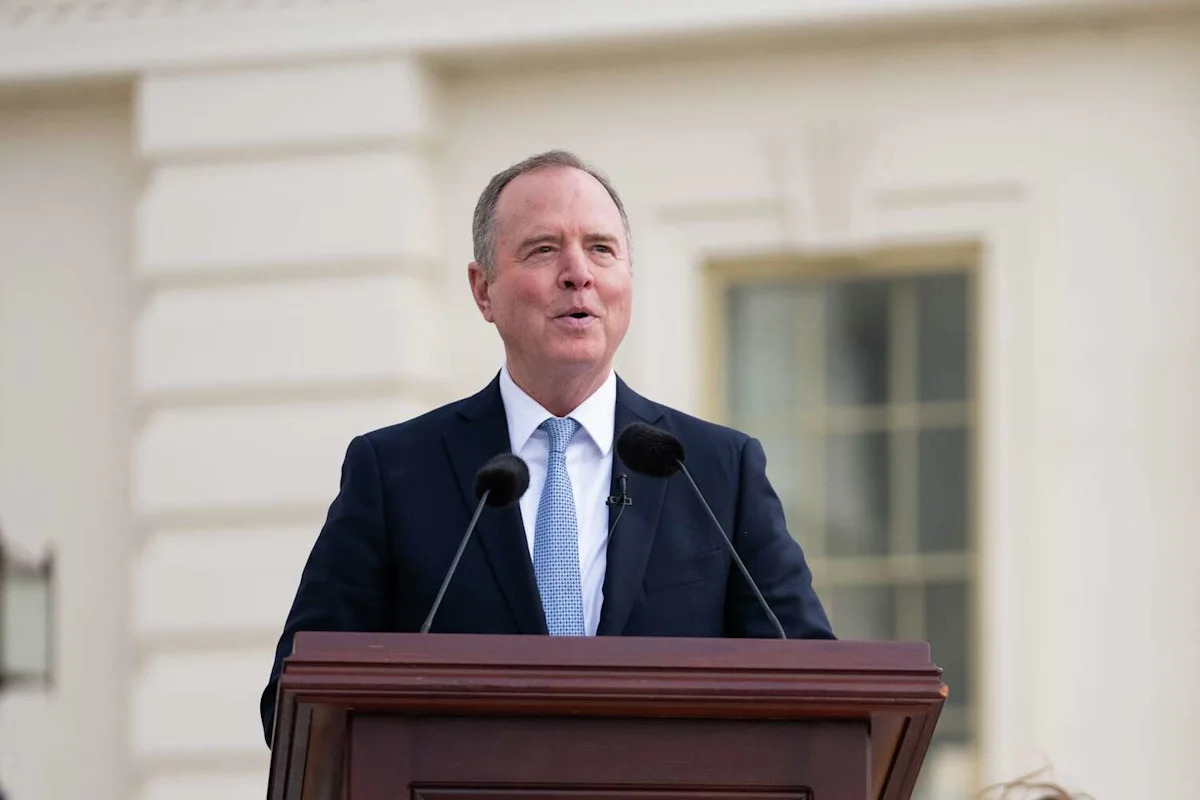
A pair of bills introduced by Sen. Adam Schiff on Monday seek to set stricter boundaries around AI-generated campaign ads, and paid posts from influencers supporting specific political candidates.
Both means of promoting candidates – or discrediting competitors – have become increasingly common.
That became clear in the run-up to California’s June primary, when billionaire Tom Steyer, a Democrat, went all-in on a social media blitz that relied heavily on influencer posts in his campaign for governor and Spencer Pratt, a Republican, regularly shared brazen AI videos to disparage his opponent in his bid to become mayor of Los Angeles. Neither candidate ended up advancing to the November general election.
Schiff’s bills would rein in how social media and AI can be used during campaigns: One would amend a loophole in federal campaign law to require that influencers label posts funded by political committees or candidates. The second would update existing rules to ban the impersonation of candidates to include AI-generated content that use their likeness or voices to misrepresent their positions, campaigns or opinions. It would also remove the requirement that the misrepresentation must be “damaging” or violate the law.
“Our social media feeds must be fixed,” said Rep. Mark Takano, D-Riverside, who is carrying companion legislation in the House on influencer disclosures.
The Promoting Authenticity with Influencer Disclaimers Act – or PAID Act – would make influencers say explicitly when they are paid by politicians. The law mirrors California law, which state lawmakers are currently trying to update. Under the current rules, established in 2023, only influencers have to say when they’ve been paid to promote candidates or their causes. Under new legislation introduced in June, campaigns themselves would also have to disclose the payments.
During Steyer’s failed run for governor, the Chronicle found he paid at least $122,000 to influencers over the course of a month. The overall cost was probably more. Steyer’s campaign paid $2.6 million to digital strategy consulting firm Group Project, but much of the company’s reported third-party payments were for unspecified “online communications.”
“As more and more information in American life is shared through informal communicators like influencers, we need to recognize the risks of proliferating paid political speech without the guardrails that apply to all other forms of political advertising,” Schiff said in a statement. “An influencer can reach far more than a billboard or even a broadcast ad in 2026, but people deserve the same understanding of who is behind that post and if they are paid for it.”
Pratt, a former reality TV star, relied on AI videos made by his supporters in his run for office. One depicted Mayor Karen Bass as the Joker and Pratt as Batman, fighting crime. Another used AI-generated women discussing why they would vote for Pratt after a Pilates class.
Supporters of Schiff’s legislation are especially concerned about “deepfakes” of candidates, which can be difficult for voters to detect.
“AI will transform our lives and our society in many ways, but it can’t be used to mislead voters or undermine our democracy,” said Rep. Ro Khanna, D-Santa Clara, who reintroduced the AI ad bill in the House, where Schiff had first filed it in 2024.
Schiff said fraudulent AI advertising has already run rampant in races across the country and will continue to obscure the line between fact and fiction.
“With November elections around the corner, time is of the essence to rein in false political advertising,” he said.
Subscribe
There’s more to San Francisco with the Chronicle. Subscribe today for just 25¢.
This article originally published at A California lawmaker wants to crack down on paid influencers and AI campaign ads.