
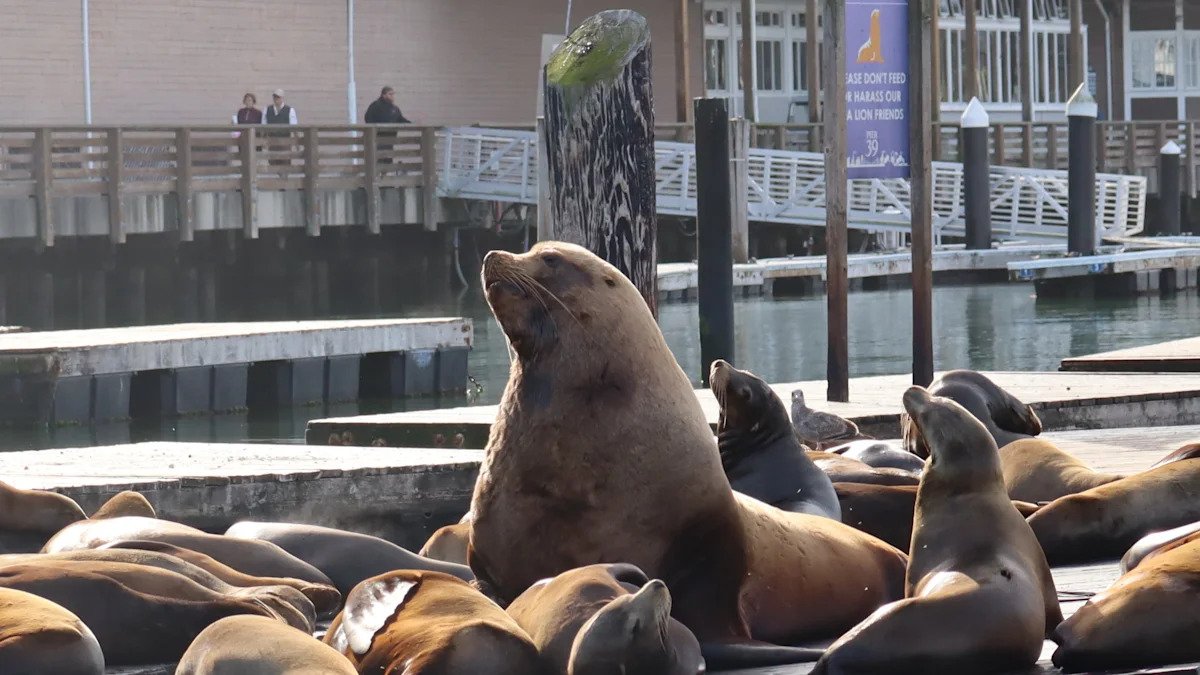
A Steller sea lion named Chonkers quickly became the Bay Area’s biggest (literally) new celebrity. The one-ton animal showed up at Pier 39 in San Francisco sometime in mid-March 2026 and kept coming back well into April, making himself at home on the famous floating docks.
Weighing roughly 2,000 pounds, Chonkers was completely unbothered by the crowds of humans who showed up daily just to watch him. Within days of his first appearance he had a name and a fanbase.
What is a Steller sea lion, and why is one in San Francisco Bay?
Chonkers isn’t your typical Bay Area sea lion. The animals that usually lounge at Pier 39’s famous docks are California sea lions, a familiar and comparatively compact species that has colonized the marina’s floating platforms since shortly after the Loma Prieta earthquake hit San Francisco in October 1989, according to Pier 39’s website.
Chonkers belongs to an entirely different and far larger species which is called the Steller sea lion. They typically live in an arc around the north Pacific from central California to Japan, reported the National Park Service, and they aren’t often seen at Pier 39.
The average male Steller sea lion tips the scales somewhere around 1,200 pounds and stretches close to ten feet in length. According to US National Oceanic and Atmospheric Administration data, they can reach up to 11 feet and 2,500 pounds. Chonkers blows past the average benchmarks.
Marine experts believe Chonkers was drawn south by one very compelling motivation: food. The waters of San Francisco Bay were rich with fish right when he arrived and for an animal of Chonkers’ size, that kind of caloric opportunity is hard to pass up.
The Marine Mammal Center in Sausalito is tracking his movements. Laura Gill, public programs manager with the Marine Mammal Center, confirmed his species identification and noted that while Steller sea lions do occasionally wander through the area, they typically stay only a few days before moving on. Chonkers is clearly happy on the pier.
Sheila Chandor, who has been harbor master at Pier 39 since 1985, told The New York Times that Chonkers has been visiting the pier for about 15 years. However, he only stayed for a day or two before.
“It was quite a spectacle to see this wonderful mammal,” Ms. Chandor said of the first time she saw him.
His last visit was two years ago. This time, he arrived with a younger Steller sea lion in tow, though the juvenile departed after a short stay, leaving Chonkers to hold court alone.
How “Chonkers” got his name and took over the internet
Once locals started noticing the sea lion newcomer, the naming process happened pretty quickly. On March 13, the Pier 39 Instagram account posted a video of the adorable, enormous animal lounging on a dock, and it went viral almost immediately. A San Francisco-based Reddit user named Des Tan then tagged him with a riff on “chonky,” the beloved internet slang used to describe animals of impressive and endearing girth. The name “Chonkers” stuck. A follow-up commenter contributed what may be his official Latin designation: Chonkus Maximus.
From there, the spread of love for Chonkers was unstoppable. Reddit threads tracking his daily movements multiplied. Videos circulated across social platforms showing him launching his full mass out of the water and crashing down onto the docks, sending fellow sea lions flying in every direction. The clips racked up views.
Local and national outlets picked up the story, The Wall Street Journal even observed that San Francisco was “in love” with Chonkers. More and more people became enthralled by the big, beautiful sea lion.
By April, crowds of more than a hundred people at a time were showing up at Pier 39 on any given day to watch a very large sea lion rest, relax, and sleep. To be honest, watching the sea lions at Pier 39 was in my top five favorite things to do last time I visited San Francisco, and I plan to head back there when I return in the fall. If Chonkers is there, I’ll be among the spectators who wait for him every morning, too.
San Francisco’s history with giant sea lions: Chonkers has a famous predecessor
As surprising as Chonkers’ visit may feel, San Francisco has been here before at least once. In the late 1800s, a Steller sea lion known as Big Ben Butler became a fixture at Seal Rocks, the cluster of outcroppings near the western edge of the city close to the Golden Gate Bridge. Big Ben Butler was a local icon in his time, beloved by residents and well known enough that when he died in 1895, his body was preserved and put on public display.
The Pier 39 sea lion colony itself has a storied origin. Shortly after the Loma Prieta Earthquake rattled the Bay Area in 1989, a group of California sea lions discovered the pier’s sheltered, food-rich docks and simply moved in. Boat slip owners were not thrilled. The sea lions were undeterred. Today, the colony can swell to as many as 2,000 animals depending on the season, and the pier has embraced their presence as one of its defining attractions — dedicating 42 custom-built floating platforms specifically for their use. Chonkers, by arriving and staying, is following a long tradition of San Francisco sea lions doing exactly what they want.
Chonkers Has His Own Page at Pier 39
Pier 39 created their own page to keep visitors updated on Chonkers. If you need any help identifying Chonkers, he has a bear-like, blunt, and boxy head like other sea lions of his species. Also, he has a light tan/golden color with white whiskers. He has a bulky neck with long fur, resembling a lion’s main. Chonkers is also two to three times the size of the regular California sea lions, so he is quite easy to spot.
How to see Chonkers at Pier 39 — and when to go
Although Chonkers is no longer currently holding court on the floats at K-Dock at Pier 39 in San Francisco’s Fisherman’s Wharf neighborhood, you can see many other sea lions there. The sea lion docks are free to view and open to the public. While he was there, according to harbormaster Chandor, the best window to catch him was early. He made his appearances between 7 a.m. and 9 a.m. before heading out for the day.
Stephen Arsenault, marina maintenance assistant at Pier 39, told National Geographic, “I usually come into work around 7:30 a.m. and he’s already up and out there on the floating dock. Typically he’ll hang out until about 10 o’clock and then jump in the water and spend the rest of his day in the bay.”
For those who can’t make it to San Francisco in person, Pier 39 maintains a live webcam feed of the docks that had been drawing unusually high traffic since Chonkers settled in. You can now watch many sea lions enjoy the bay each day.
Thank you for reading about Chonkers. I invite you to follow me on Yahoo for more adventures in San Francisco and beyond.