
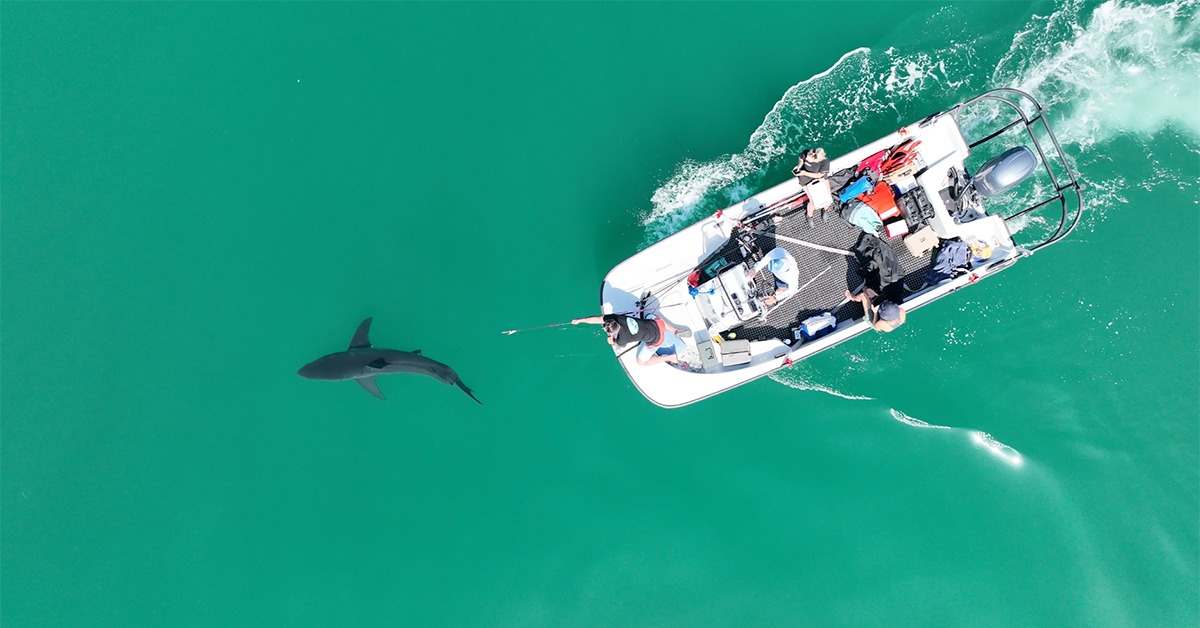
A recent study by researchers at UC San Diego’s Scripps Institution of Oceanography and the Shark Lab at California State University, Long Beach (CSULB) reveals how these juvenile white sharks responded to Tropical Storm Hilary, providing the first direct evidence of the species’ response to an extreme weather event. Using acoustic tags to track the sharks before, during and after the storm, the team found that many temporarily left the nursery as conditions deteriorated but returned soon after the storm passed.
“To our knowledge, this is the first study to document storm-response behavior in white sharks,” said Jack Elstner, a Scripps PhD student and lead author of the paper. “Our data show that many sharks in this nursery temporarily left the area as the storm arrived or just after. These findings provide new insights into how extreme weather events may impact the movements and nursery behaviors of a recovering top predator.”
In Southern California, juvenile white sharks often spend their formative years in shallow coastal habitats, where their early development is supported by warm, calm waters, abundant prey (such as stingrays and small fish), and protection from larger predators. One such nursery lies off the northern San Diego beaches of Torrey Pines and Del Mar, where young sharks aggregate during the summer and fall before eventually moving on to adult habitats.
To study how the tropical storm affected this nursery, researchers tracked 22 juvenile white sharks — 13 females and 9 males — that had been tagged with acoustic transmitters. Two arrays of underwater receivers recorded more than 524,000 detections, creating a detailed record of the sharks’ movements during the storm.
Before Tropical Storm Hilary arrived, researchers consistently detected 16 to 19 tagged sharks in the nursery per hour. During the storm, detected individuals declined by roughly half, dropping to as few as eight sharks before rebounding in the days and weeks that followed. Most sharks returned to the nursery within a few days and nearly every shark had returned within three weeks. Only one individual left as the storm arrived and was never detected again in San Diego that year.
The team was not always able to pinpoint exactly where these sharks went during their temporary departures, but did note a “discernible increase” in pings across La Jolla Cove. The cove is situated next to a prominent submarine canyon, giving sharks quick access to deeper water. The area was also largely protected from the storm’s strong southerly winds.
“We believe this more sheltered habitat may have served as an important nearshore refuge for some individuals,” said Elstner.