
(TNND) — Americans are now carrying $18.59 trillion in debt, according to the New York Fed’s quarterly report on household debt.
That’s a record high, as are four of five subcategories: mortgages, auto loans, student loans and credit cards.
Only home equity borrowing isn’t at a record high.
Total household debt increased by $197 billion, or by 1%, in the third quarter.
Credit card balances rose by $24 billion to reach $1.23 trillion.
Students have $1.65 trillion in loan debt.
WalletHub noted that overall household debt is $990 billion below the 2008 peak when adjusting for inflation.
And Bankrate senior industry analyst Ted Rossman noted that the debt-to-income ratio is still pretty low.
“A lot of this tracks back to that K-shaped economy. The rich get richer, the poor get poorer,” Rossman said. “There’s a lot of inequity the way the economy is right now. Big picture, I’m actually more upbeat than a lot of people are, or certainly than sentiment is.”
Americans are downbeat about inflation and high interest rates, Rossman said.
And households are feeling financial pressures, especially those on the lower or middle portions of the income spectrum.
The job market is weakening, but wages are still growing. And the unemployment rate, at last report, was still a fairly healthy 4.3%.
“So, I understand that it doesn’t feel great. But in some respects, we would expect these (household debt) numbers to grow over time, just because the population grows, the economy grows, something like credit cards, more people are using cards, fewer people are using cash,” Rossman said. “So, I’m not as alarmed as the headline (figure) might have you believe.”
He said delinquencies have tailed off a bit for both credit cards and auto loans since they peaked in the middle of last year.
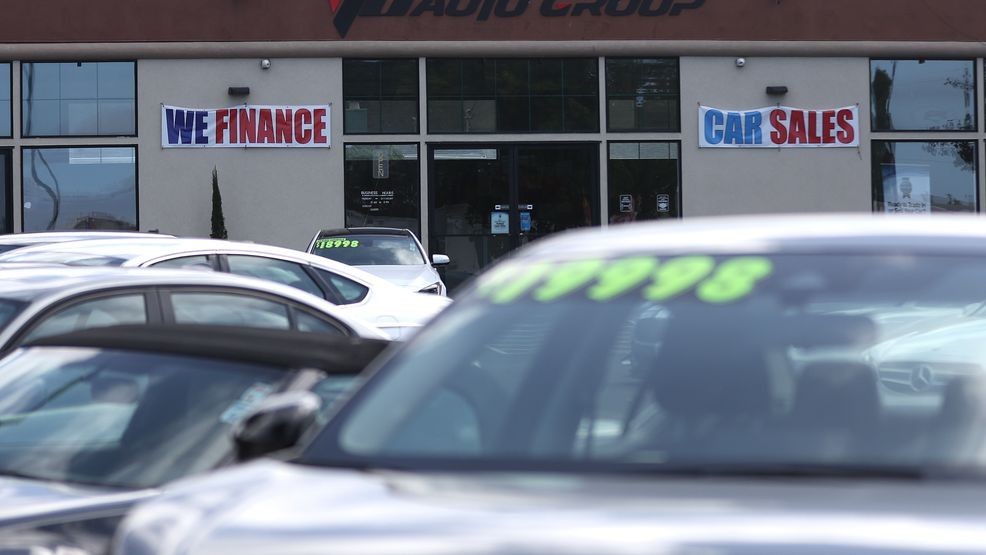
FILE – A car lot is seen Sept. 6, 2023, in Richmond, California. (Photo by Justin Sullivan/Getty Images)
Credit card balances have risen 60% since the beginning of 2021, but Rossman said they were artificially depressed back then because of stimulus money and less consumer spending.
Delinquencies have been low on mortgages, he said.
Student loan delinquencies are lagging behind those for other types of credit, because student loan repayment was paused for several years.
But Rossman said a quarter of federal student loan borrowers are either in default or about to be, and that has a spillover effect on other finances for young people just getting started on their careers.
“Because if you can’t pay the student loans, you might also be at risk of being behind on the car loan or the credit card, or maybe you’re running up more credit card debt because you’re just trying to make ends meet,” he said.

FILE – People walk on the campus of the University of Southern California on March 21, 2024, in Los Angeles. (Photo by Mario Tama/Getty Images)
The New York Fed doesn’t make a distinction in its figures between credit card balances and credit card debt.
“I wish they would do more to distinguish between what’s truly debt carried month to month and what’s paid off right away,” Rossman said. “We know in our research that it’s about half of cardholders pay in full every month. … That is a huge fork in the road.”
Those who pay in full use cards for rewards and convenience. Those who don’t carry really expensive debt.
Rossman had some advice for people who find themselves in credit card debt.
He recommended applying for a 0% balance-transfer card that can pause the interest clock for around two years.
You’ll need to pay off the debt in that window if you want to avoid interest payments.
“If you’re disciplined about paying it back, the advice would be don’t add new purchases, because it’s hard to hit a moving target,” he said.
Nonprofit credit counseling is another good option, especially if you have a lower credit score or a lot of debt, he said. Rossman mentioned Money Management International and GreenPath as a couple of options there.