
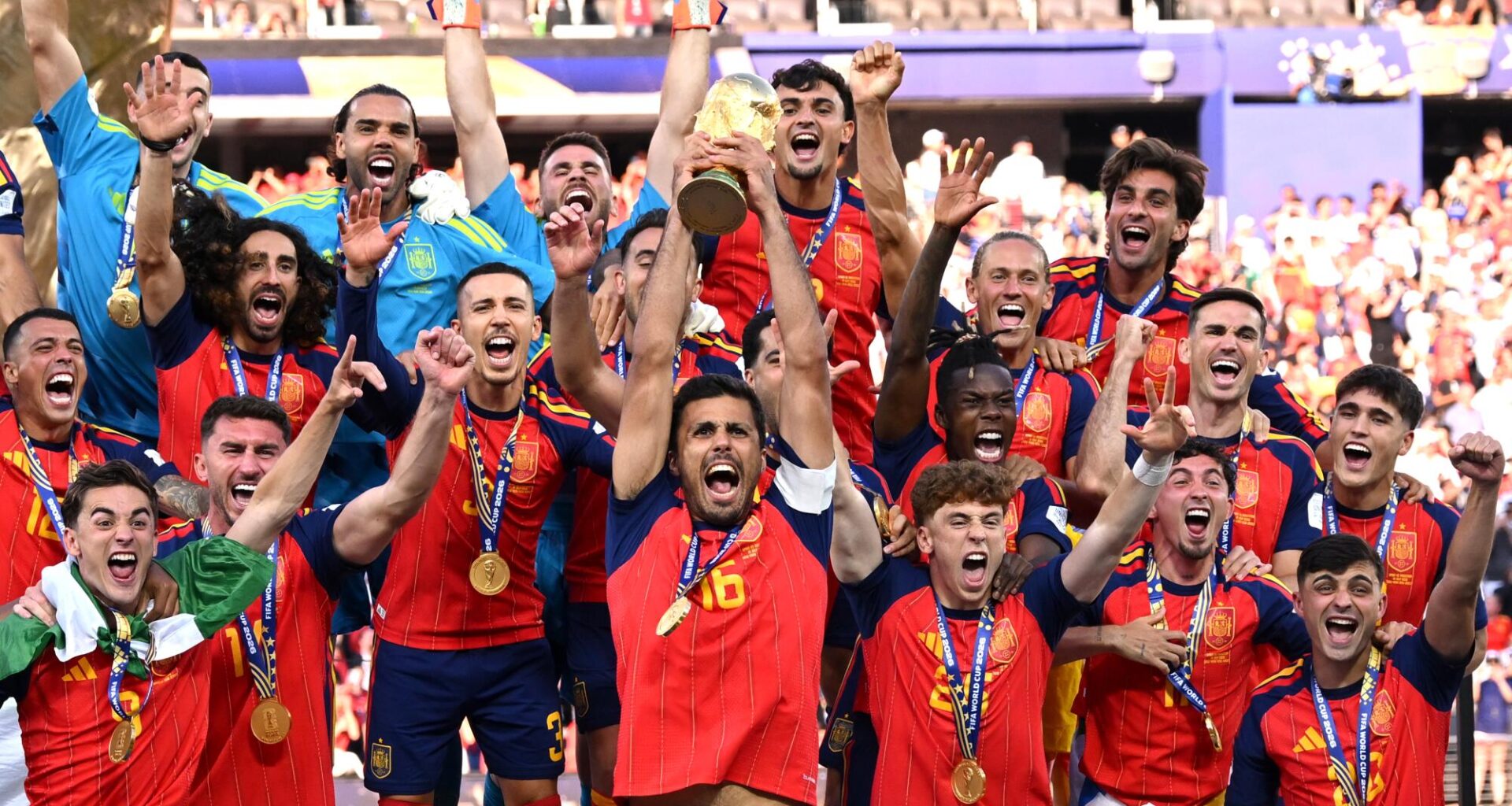
When the final whistle echoed through MetLife Stadium on July 19, 2026, a wave of red and gold swept across the field. Spanish players embraced one another, some collapsing to the turf in disbelief while others sprinted toward their supporters, who had traveled thousands of miles to witness history. Moments later, captain Álvaro Morata lifted the FIFA World Cup Trophy high above his head as fireworks illuminated the New Jersey sky. Spain had defeated Argentina 1-0 to become world champions for the second time in the nation’s history.
For Spain, it was more than simply winning another title. It marked the return of one of international soccer’s greatest powers after years of rebuilding and searching for a new identity. For Argentina, the defeat ended an inspiring tournament run that nearly resulted in back-to-back World Cup championships. Together, the two nations delivered a memorable final that perfectly capped the first-ever 48-team FIFA World Cup.
The championship match featured two of soccer’s most technically gifted nations. Spain entered the final having displayed disciplined defending, relentless possession, and clinical finishing throughout the tournament. Argentina, meanwhile, had captured the imagination of fans with its attacking creativity, resilience, and ability to thrive under pressure.
From the opening kickoff, the atmosphere inside MetLife Stadium was electric. More than 80,000 supporters packed the venue, creating one of the loudest environments ever experienced at a World Cup final. Every completed pass, every challenge, and every shot generated deafening reactions from fans representing countries from around the globe.
Spain controlled much of the early possession, patiently moving the ball across the midfield while looking for opportunities to exploit Argentina’s defensive shape. Argentina responded with dangerous counterattacks, using quick transitions and creative movement to threaten Spain’s back line.
The breakthrough finally came midway through the second half. After a sequence of crisp passing that reflected the style Spain has become famous for over the past two decades, Spain found the decisive goal that would ultimately separate the two teams. Although Argentina pressed relentlessly during the closing minutes, Spain’s defense held firm, preserving the narrow lead until the final whistle.
It wasn’t the highest-scoring World Cup final in history, but it was one of the most tactically fascinating. Every possession carried enormous significance, and both teams demonstrated why they had earned the opportunity to compete for soccer’s greatest prize.
Spain’s triumph did not happen overnight. Following its unforgettable 2010 World Cup victory in South Africa, the nation experienced years of disappointment in major international tournaments. Early exits and inconsistent performances led many observers to question whether Spain’s golden era had truly come to an end.
Instead of abandoning its philosophy, Spain chose evolution rather than revolution.
The country’s youth academies continued producing technically gifted players capable of thriving under pressure. Coaches emphasized possession, intelligent movement, and tactical discipline while incorporating greater athleticism and speed into the national team’s approach.
By the time the 2026 tournament arrived, Spain possessed one of the deepest squads in international soccer. Every position featured players capable of influencing matches, allowing the coaching staff to rotate throughout the tournament without sacrificing quality.
That depth proved invaluable during the demanding month-long competition. Spain consistently adapted its tactics depending on its opponent while remaining committed to its possession-oriented identity.
The result was one of the tournament’s most complete performances, culminating in lifting the World Cup trophy once again.
Although Argentina left New Jersey disappointed, its tournament deserves tremendous recognition.
As defending world champions, Argentina entered the competition carrying enormous expectations. Every opponent viewed defeating the reigning champions as a statement victory, placing additional pressure on every match.
Instead of shrinking from the spotlight, Argentina embraced it.
The team overcame difficult knockout-stage opponents while displaying remarkable resilience in close contests. Their semifinal victory over England demonstrated the character that has become synonymous with Argentine soccer.
Throughout the tournament, Argentina balanced experienced leadership with emerging young talent, showing that the country’s future remains exceptionally bright despite falling one victory short of consecutive World Cup titles.
Losing a final always hurts, but Argentina’s performance throughout the competition reinforced its status as one of international soccer’s elite programs.
The 2026 FIFA World Cup represented the beginning of a new era.
For the first time, 48 nations participated instead of the traditional 32, allowing more countries than ever before to experience the world’s biggest sporting event. The expanded format created additional opportunities for emerging soccer nations while increasing the tournament’s overall diversity.
The United States, Canada, and Mexico successfully co-hosted the competition, welcoming millions of fans across North America. Matches were played in modern stadiums stretching from Vancouver to Mexico City, showcasing soccer’s continued growth throughout the continent.
The tournament also produced numerous surprises.
Traditional powers faced greater competition from nations that previously struggled to qualify for the World Cup. Several underdogs delivered memorable performances that captivated neutral fans and demonstrated the rapidly improving quality of soccer around the globe.
By the time Spain lifted the trophy, the expanded tournament had proven that more teams could participate without sacrificing excitement or competitiveness.
Every World Cup creates new heroes, and the 2026 edition was no exception.
Spain’s success resulted from collective excellence rather than dependence on a single superstar. The midfield dictated the tempo of matches, the defense remained organized throughout the knockout rounds, and timely finishing provided the goals necessary to advance.
Goalkeeping also played a critical role. Throughout the tournament, Spain repeatedly relied on crucial saves during high-pressure moments, preventing opponents from gaining momentum when matches hung in the balance.
Argentina similarly showcased exceptional individual performances. Creative midfield play, aggressive attacking movement, and determined defending carried the defending champions through another remarkable tournament run.
Perhaps the greatest stars, however, were the young players making their first World Cup appearances. The tournament introduced millions of fans to soccer’s next generation, many of whom are expected to dominate international competition for years to come.
The World Cup has always represented something larger than soccer.
For one month, nations set aside differences to celebrate the universal language of sport. Families gathered around televisions. Schools adjusted schedules. Entire cities paused as millions watched unforgettable moments unfold.
The 2026 tournament amplified that spirit.
With matches hosted across three countries, fans experienced an unprecedented celebration of culture, diversity, and international cooperation. Travelers from every continent filled stadiums, restaurants, and public viewing areas, creating friendships that extended well beyond the final score.
The tournament also highlighted soccer’s remarkable growth in North America. Record attendance figures, passionate crowds, and widespread media coverage demonstrated how dramatically the sport has expanded across the United States and Canada over the past several decades.
For many young fans attending their first World Cup match, the memories created this summer will last a lifetime.
As Spain celebrated beneath a shower of confetti, another chapter in soccer history had been written.
Winning a World Cup requires more than talent. It demands consistency, adaptability, teamwork, and composure under extraordinary pressure. Spain embodied those qualities throughout the tournament, earning every victory on its journey back to the top of international soccer.
For Argentina, the defeat serves as motivation rather than failure. Reaching consecutive World Cup finals is an extraordinary accomplishment, and the foundation remains in place for future success.
The 2026 FIFA World Cup will ultimately be remembered not only for Spain’s championship but also for ushering in a new era of global soccer. The expanded format, successful tri-nation hosting, unforgettable upsets, and emergence of future stars ensured that this tournament will hold a special place in the sport’s history.
Years from now, fans will remember where they were when Spain reclaimed soccer’s greatest prize. They will remember the roar inside MetLife Stadium, the tension of a one-goal final, and the images of jubilant Spanish players celebrating with the famous golden trophy.
For Spain, the victory represented redemption, resilience, and the culmination of years of patient rebuilding. For the rest of the soccer world, it served as another reminder of why the FIFA World Cup remains the most captivating sporting event on Earth, a tournament where dreams are realized, legends are born, and history is written every four years.