
Long Beach leaders are seeking accountability for the fire runoff that got into the local waterways from the Lineage Warehouse fire in Boyle Heights last month, which may have impacted the city’s water quality.
The City Council recently requested city staff to return within 30 days with a draft of a letter supporting Los Angeles city’ request that the regional water quality control agency issue a cleanup and abatement order related to the firefighting runoff from the fire.
If the Los Angeles Regional Water Quality Control Board does issue that order, city officials said, they want that agency to include Long Beach in the abatement. Any remediation plan, environmental monitoring program or related regulatory action should evaluate the entire downstream system, including the Los Angeles River Estuary, the Dominguez Gap Wetlands and Long Beach’s coastal waters.
The request, according to the staff report, also asked city staff to send a letter to the appropriate agencies requesting improved and standardized notification and coordination protocols for fire runoff, industrial runoff, hazardous material releases, chemical spills, and any other incidents where pollutants or potentially hazardous materials enter storm drains, channels, rivers, wetlands, estuaries, bays or coastal waters. City staff will return to the council 90 days after the letter is sent with any responses and any available after-action reports.
“I want to start by recognizing the impacts that this Boyle Heights Lineage Warehouse fire has had on the Boyle Heights community,” Third District Councilmember Kristina Duggan said during the July 21 meeting. “We recognize the scale of the emergency and difficult work performed by firefighters, emergency responders and public agencies. At the same time, we need to recognize that the impacts of this fire do not stop at the Los Angeles City boundary.”
The fire at the large cold storage facility – which broke out on June 17 and burned for a week – produced substantial runoff and debris, including particles from solar panels, refrigeration insulation, and spoiled food, according to the city’s staff report.
While significant efforts were made to divert runoff and implement best management practices, Duggan said, millions of gallons of potentially contaminated water still flowed into storm drains, channels and the Los Angeles River system, which ultimately ends up in Long Beach.
While tests for total coliform, E. coli, and enterococcus near the site of the fire have been done, as of July 8, results from testing on other chemicals and toxins have not been provided to the city, officials said.
Reports of dead fish and wildlife in the Los Angeles River and Dominguez Gap Wetlands during the fire raised serious questions about what entered the waterway, how far it traveled, and the extent of its impact on habitat, aquatic life and public use, the staff report said.

Dead fish collect in toxic-filled water at the Dominguez Gap Wetlands on Tuesday, June 23, 2026, in Long Beach. (Photo by Howard Freshman, Contributing Photographer)

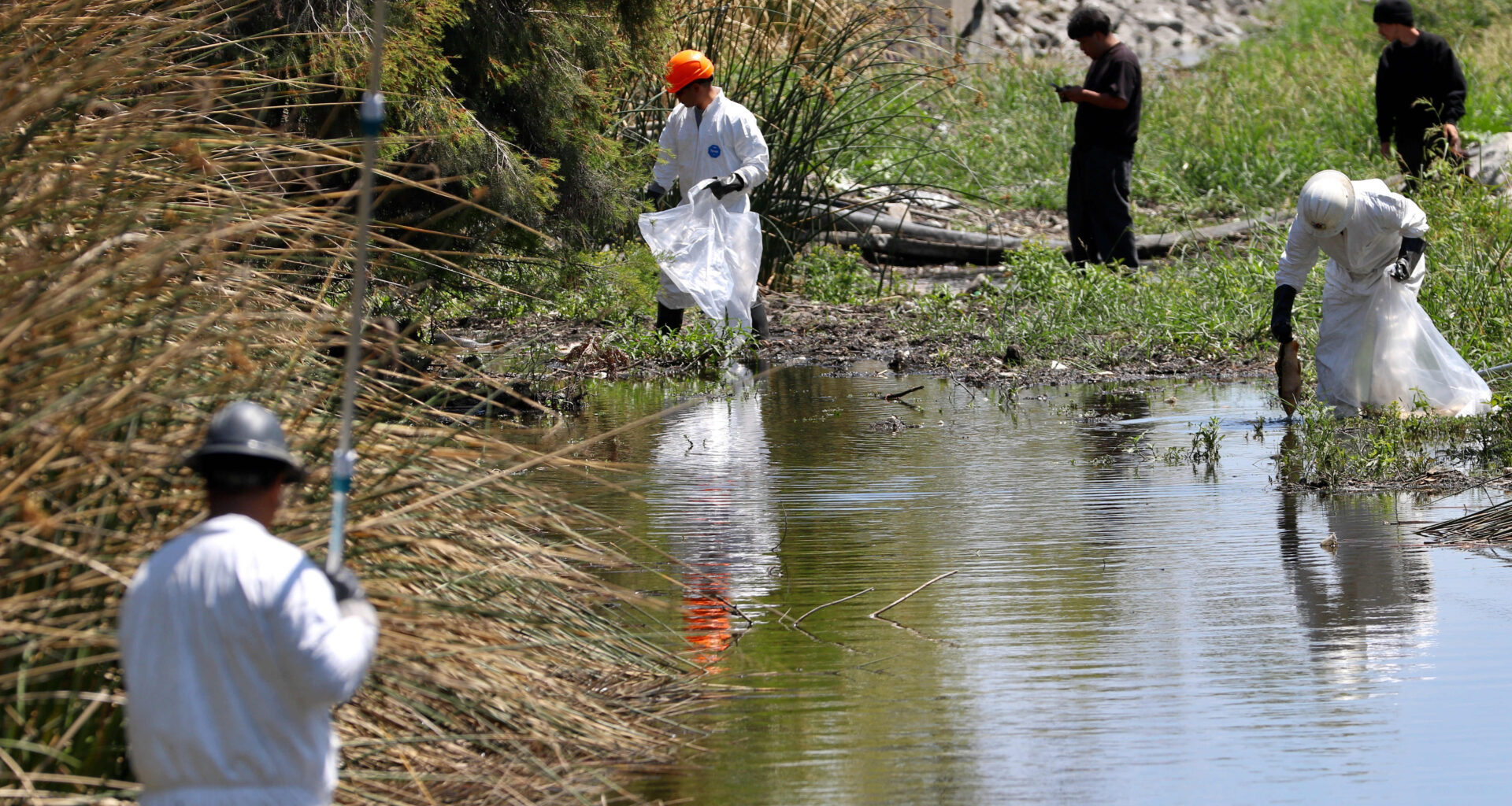
Workers from Ocean Blue Environmental Services collect trash and dead fish during an all-day cleanup at the Dominguez Gap Wetlands on Tuesday, June 23, 2026, in Long Beach. (Photo by Howard Freshman, Contributing Photographer)

Workers from Ocean Blue Environmental Services collect trash and dead fish in the Dominguez Gap Wetlands on Tuesday, June 23, 2026, in Long Beach. (Photo by Howard Freshman, Contributing Photographer)

Workers from Ocean Blue Environmental Services collect trash and dead fish in the Dominguez Gap Wetlands on Tuesday, June 23, 2026, in Long Beach. (Photo by Howard Freshman, Contributing Photographer)
Show Caption
1 of 4
Dead fish collect in toxic-filled water at the Dominguez Gap Wetlands on Tuesday, June 23, 2026, in Long Beach. (Photo by Howard Freshman, Contributing Photographer)
The timeline of the Lineage Warehouse fire and downstream water quality concerns, officials said, demonstrates why improved and standardized notification and coordination protocols are needed.
On June 25, eight days after the fire started, Long Beach received its first notification of potential water quality impacts related to the fire from Los Angeles County, including concerns that low pH levels had been detected, the staff report said. The concern is that from June 18 to 23, families were boating, jet skiing and fishing in the Los Angeles River Estuary, as well as swimming in the coastal waters near the river’s terminus, without any notice that water quality may have been impacted.
“That just isn’t acceptable,” Duggan said during the July 21 council meeting. “It’s now been more than a month since the fire started, and our health department, just today, received testing results back from the county.”
This request for accountability is not intended to blame or criticize any agency, Duggan added; rather, responding agencies actually followed the existing regulations. Firefighting runoff is generally exempt from municipal stormwater permit requirements, she said, as firefighters must be able to act quickly to protect lives and property, and emergency response can’t be delayed.
But the fire highlights an important gap, Duggan said, because there is no clear protocol requiring downstream communities to be notified when firefighting runoff from a major industrial incident may affect our public waterways.
Recent events across Southern California over the past year show that the impacts of major fires, hazardous materials emergencies and industrial incidents – such as the Palisades fire and the chemical emergency at GKN Aerospace in Garden Grove – are not limited to the sites where they occur, officials said. They have placed significant strain on fire departments and emergency responders, while also creating downstream water quality concerns when runoff or pollutants enter storm drains and waterways.
Current notification practices vary depending on the type of incident, the agency involved, the location and the pollutant. Regardless of these differences, however, Long Beach needs timely notification whenever pollutants or hazardous materials may enter waterways so that the city’s public health professionals can make informed decisions to best protect the community, officials said.
“We need our regional partners and neighboring agencies to provide timely notification,” Second District Councilmember Cindy Allen said, “and coordinate with us so that our residents are informed, and our public health teams can act quickly.
“It is also part of a larger conversation about regional responsibility and ensuring that Long Beach is not left to bear the environmental and financial impacts of pollution originating outside of our city, because protecting our coastline can not fall on Long Beach alone,” Allen added. “This is a shared regional responsibility from the source of the pollution all the way to ultimately where it ends up.”
Even when Long Beach’s beaches test well during dry weather, pollution events upstream can quickly change public confidence in whether beaches and bays are safe, the staff report said. Pollutants regularly move through the Los Angeles River watershed and end up in Long Beach.
From 2020 to 2024, for example, Long Beach collected more than 12,500 tons of trash at a reported cost of $12.3 million, the staff report said. Much of that pollution originated outside the city, but the cleanup, the majority of the cost, and the impacts to public confidence fell on Long Beach.
As the city continues phasing out its reliance on oil revenue, meanwhile, the city will have to absorb a “regional burden” with fewer resources, officials said.
“Pollution doesn’t stop at jurisdictional boundaries and neither should the regulatory response,” Duggan said. “Long Beach serves as southeast Los Angeles’ beachfront; families from throughout the region rely on our beaches, bays, wetlands and the estuary for recreation and access to the coast. We have a responsibility to protect that access and to make certain our public health professionals have the information they need to keep our community safe.”