
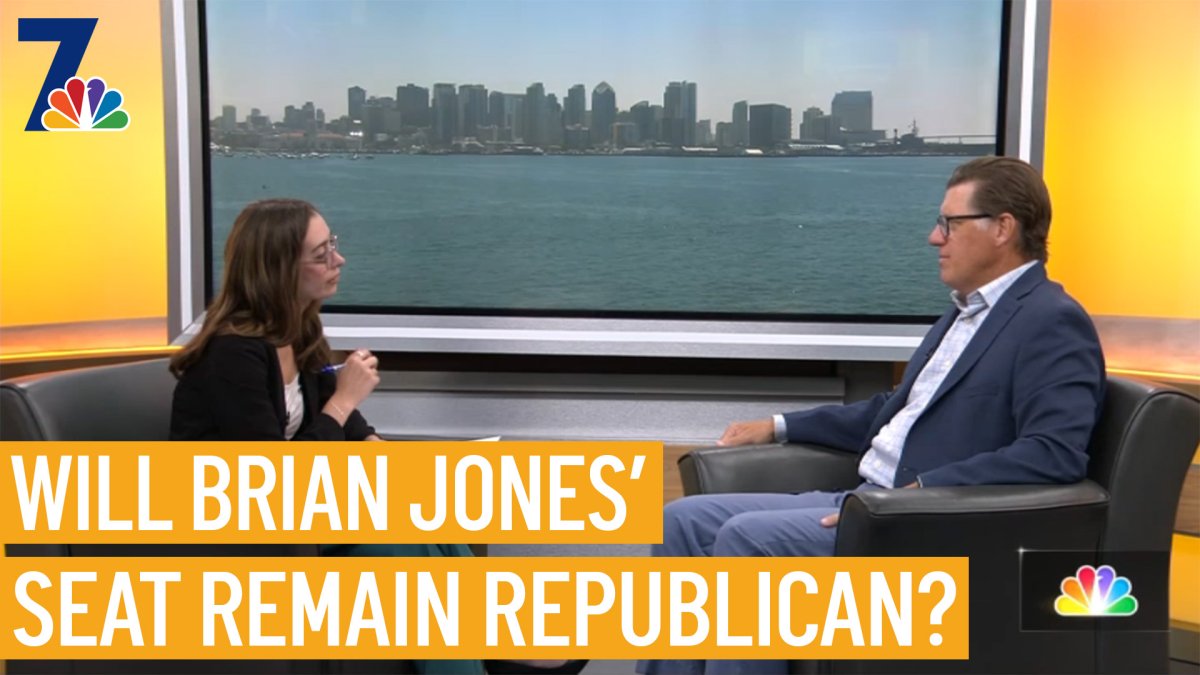
After 16 years in the legislature, Brian Jones is terming out of his state senate seat. He’s the highest-ranking Republican in Sacramento, but his seat is still highly competitive. He joined NBC 7’s Joey Safchik on Politically Speaking to discuss how he’s fighting for his fellow Republicans to bring more balance to California’s statehouse.
A transcript of that conversation is below.
Safchik: He is the highest ranking Republican in Sacramento, but his long tenure in the state House is coming to an end this year. Can Republicans hold onto his seat representing the state Senate’s 40th district? And what does Senate Minority Leader Brian Jones hope to accomplish during his last few months in office? Let’s ask him. Thanks for being here.
Jones: Good afternoon, Joey. Nice to be here. Thank you.
Safchik: What is your North Star these last couple of months?
Safchik: Well, I’m still Minority Leader, and I will be through election day. And so, really, the North Star from myself and my staff is, basically, running through the tape. You know, a lot of times, as a turned out legislator, you get some slack time at the end of your service. But as a minority leader, I have such responsibilities. And those responsibilities include fundraising for the caucus. As you mentioned in the intro, protecting my seat and making sure another Republican gets elected to my seat. And then we have other seats around the state that we’re protecting and hopefully, you know, trying to build the caucus, some more and pick up some more seats on the Republican side. So I have a lot to do, between now and November 30th.
Safchik: In this home stretch, if you can push one piece of legislation past the finish line, what would it be?
Jones: Well, there’s actually three.
Safchik: I’ll give you three.
Jones: So, probably, you know, the most important one right now is the elderly parole reform.
Safchik: You’ve been working on that for a while.
Jones: Yes, we have been. And, fortunately, it’s a bipartisan issue now. It didn’t start off that way. As you may remember, the governor and the Democrats in 2020, slipped in some language in a budget trailer bill at the end of session without much review, that lowered the elderly parole age to 50. Well, we want to restore that back, to 65 years old with 25 years served. So that’s one. I’m still working on the psychedelics, you know, for treatment for service members and first responders with PTSD as a result of their service. So there’s some new federal funds that have become available for that. I have a bill that passed out of committee right before break that would allow California to compete for those funds. A bill that did pass and has already done is the, Officer Kirkland Johnson Memorial Interchange between 805 and highway 52, a police officer that was murdered, over 40 years ago. And, we’re going to be able to name that interchange after him.
Safchik: What do you hope your legacy will be?
Jones: I think, you know, when I took over in 2022 as minority leader, Republicans were at their lowest point ever in the state of California. Now, fortunately, back in the 1930s, Democrats got all the way down to three seats. And I knew we weren’t going to do that. But we were at eight, which is the lowest that we’ve ever been. We were able to pick up two seats in 2024, one by a Democrat switching parties and becoming a Republican. And another, we beat a Democrat incumbent for the first time since 1980. And so I want to build on that this year. Hopefully pick up 1 or 2 more seats. And a stretch goal is to pick up three more just to build. And it’s not about Republicans taking over, or me taking over because I’m termed out. So I’m not even going to be there. It’s just creating balance in Sacramento. And I think if you ask most Democrat voters, you know, are they completely satisfied with Sacramento? I think most of them would say no. And the way we create balance in California, in Sacramento is to have more Republicans elected in the state legislature.
Safchik: Are you hoping that balance would force a little bit more moderation?
Jones: Correct. More moderation. More conversations across the aisle. Republican ideas being more taken more seriously. When it comes to the economy, when it comes to public safety, when it comes to keeping Californians safe, I believe Republicans have the best ideas on that. Right now, we’re somewhat shut out of that conversation, especially on the public safety committee, because it’s five Democrats and one Republican having those conversations. Well, if we can get to 4 to 2 or 4 to 3, then there’s a more robust conversation on public safety in California.
Safchik: What happens if your seat flips?
Jones: If my seat flips, you know, that won’t be good for San Diego County. I’m the only Republican in the Senate right now. Except for Seyarto. He has a small section of Borrego Springs and Julian. But that’ll create even more unbalance, especially here in San Diego right now, the San Diego delegation, made up of myself and my four other colleagues. We have a great working relationship, even in a bipartisan manner. And so we need to continue that. And to do that, we need to have some balance, which means a Republican winning my seat.
Safchik: Have you mastered the art of reaching across the aisle?
Jones: I don’t know if you could ever say mastered. I’d have to see how you quantify that word mastered. But I have been effective in working across the aisle, and have gained, a significant amount of favor with the Democratic leadership, to the point that I’m able to get bills passed and signed by the governor and help all of my colleagues, both in the Senate and Assembly, get bills passed and to the governor’s desk.
Safchik: How confident are you that your successor will be able to do that?
Jones: It takes some time. I mean, I’ve been there 16 years, so starting off the bat, nobody is going to be able to do that. But eventually you kind of learn the ropes there. And if you want to be effective, you have to learn how to do that. So, my successor, if it’s a Republican, she’ll figure it out.
Safchik: And the Republican running for your seat was not your preferred candidate in the primary. Are you throwing your weight behind her?
Jones: Oh, absolutely, 100%. Look, the primaries are for the the parties within themselves to battle out for the ideas and the and the leadership of the party in the primary. Christie won the primary. And so, she’s the Republican nominee for the seat. We’re fully behind her. And, we’re already doing things to help her.
Safchik: Is the Republican Party in California fractured right now?
Jones: I think that, you know, that’s another word you have to, you know, like, quantify for me and fractured because even within the Democrat Party, that’s the supermajority. There’s cracks and fissures and fractures even that.
Safchik: But they have a little bit more runway.
Jones: Oh absolutely. Yeah. So but you know, if you break it down, there’s 3 or 4 of, you know, primary groups within the Democratic Party in Sacramento and in and in California, in the Republican Party, there is as well, where we are now as a superminority. We are working better as a team, especially in the Senate, amongst the ten of us in the Senate, better than we ever have before, because we realize, you know, we’re in a foxhole by ourselves. And if we’re going to get out of this foxhole, we have to work together. So I think the desperation has created teamwork. And I’m very proud of my nine other senators that have decided, you know what? We’re going to work together to get out of this hole. Let’s get some more numbers and then start, you know, having those battles, those ideological battles within the caucus.
Safchik: We hear about this discord, whether it’s policy or more personality, it feels like the latter. But between you and Carl DeMaio, is that being overblown?
Jones: I don’t know, that’s not being driven by me. I have a job to do and that is to pick up seats in the Senate and period. That’s my bottom line.
Safchik: More so than pushing legislation through?
Jones: Well, both. But right now we’re coming into election season. So my focus is picking up seats. We have four more weeks of session. Yes. Passing legislation for the next four weeks is the priority. Once that’s done, then we switch into campaign mode. For the rest of the year, this division or this fracture. You know, unfortunately, he has said some things publicly, that I think were unnecessary and not accurate. And the media picked up on that, and I think the media has given it more play than it deserved. But I’m focused on my job. And what I’m doing, I’m not going to be distracted by that.
Safchik: Why should voters have faith in the party if they’re hearing about these schisms?
Jones: Because the schisms that I think you kind of mentioned, are personality wise, probably more than they are policy. You know, if you look at the voting records of, you know, the 20 Republicans in the Assembly and the ten Republicans in the Senate, voting records are I’m going to guess 98% aligned. So, like in any group in Kiwanis Club, youth football, Little League baseball, homeowners associations, when you have people on boards and, you know, like there’s always personality.
Safchik: The “politics.”
Jones: The personalities always come into play on those kinds of things.
Safchik: How do you convince voters to see past that, though?
Jones: I think most voters can see past that because they know it’s human nature. And I don’t think that the voters are necessarily distracted by that when they’re voting. They may be entertained by it or concerned about it while it’s in the media and social. Obviously, social media is not helping those kinds of things because now people can get on what I call keyboard warriors and type whatever they want to type into a social media platform and say whatever they want to say about another person without much repercussion of those words going out. I think some people type before they think, and because there’s with social media, there’s no repercussion. You’re not face to face with that person in the mean things that you’re saying. And so I think, I think voters are able to rise above that.
Safchik: Do you think there’s enough momentum at the top of the ticket, looking at Steve Hilton, to help you all flip seats?
Jones: Steve Hilton is a fantastic candidate for us. He’s one of the hardest working congressional or governor candidates we’ve had. I think he’s doing a great job. He’s building a lot of energy. One of the things I appreciate about him, he’s he’s not taking any single district for granted. He’s working in districts where for the Republican to win, it’s a long shot, but he knows for him to win, it’s a long shot. He needs to go into those long shot areas. So he’s being very helpful. And the entire ticket actually, Gloria Romero, Don Wagner, Herb Morgan here in San Diego that’s running for comptroller and all the others are doing a great job.
Safchik: Do you think it would behoove Republicans in California to focus more on everyday economic issues than something like voter ID as your signature issue this year?
Jones: No, that’s kind of a loaded question a little bit. Because that’s not a binary choice. I thought you were going to ask me rather than focus on national politics. My answer would be yes. Absolutely.
Safchik: I want to get into that.
Jones: Yeah. We need to focus on local stuff. But every day, economic issues, public safety, and education are the top priorities for Republicans in California. The voter ID issue, that’s a bipartisan, actually nonpartisan issue that has wide support across the aisle, both Republicans and Democrats.
Safchik: When I was the chair of the San Diego GOP on, she said that was her number one issue. Does that surprise you?
Jones: No, it doesn’t surprise me because, you know, we’re counting on that being a voter turnout issue.
Safchik: Getting people to the polls.
Jones: Yeah. And, you know, similar to prop 13 was in 1978. And so I think the Republicans have the right message on that. I think a lot of Democrat voters agree with us on that message. Now, will they come in, vote for that and vote for the Republican state Senate candidate? I hope so. But if we get voter ID passed long term, that’s a great move forward to building confidence in our election process here in California.
Safchik: But has there been enough emphasis on affordability from your party?
Jones: Well, it’s a continued emphasis from us. And when I say us, the Senate Republican Caucus. I know the Assembly, it’s a big driver for them as well in the areas. The fortunate thing for us this year in California electorally is that the competitive congressional seats, the competitive Senate seats in the competitive Assembly seats are all nested together, they overlap.
Safchik: Do you take pity on the voters in your district at all? Like they’re going to be inundated with mailers? That’s a heavy burden for them, right?
Jones: Yeah it is. But that’s the electoral process. And I have other opinions regarding all the mailers and the communications. You know, we’ve changed since I’ve become leader. We’ve changed a lot of the way that that’s done. And, you know, so voters are going to get less mailers and more direct, you know, social media contact and more, and more, interesting broadcast media communication.
Safchik: Interesting. Yeah. Are you worried about your seat at all?
Jones: Well, I’m always worried. I mean, it’s the most evenly split district in the state. A lot of people don’t, because I’m a Republican, because I’m the leader and because, you know, I won it by seven points in 2022.
Safchik: And you’ve held the seat for so long.
Jones: I’ve held the seat. You know, they think– it is a Republican seat in my opinion. And lots of people think that too.
Safchik: But that’s not a foregone conclusion.
Jones: I won it by seven points in 2022, but Kamala Harris in 2024 won it by four points. So it does flip back and forth. Now fortunately the flip to Republican happens in the governor’s race. So Brian Daley also won the seat in 2022. Lanhee Chen, who was running for controller, won it. I think every statewide seat won in ‘22. And then in ‘24, it’s the other way around. So in governor elections, gubernatorial elections with this is it has a stronger Republican leaning. In presidential elections, it has a stronger Democratic leaning.
Safchik: So are you worried about it?
Jones: I’m concerned.
Safchik: So what are you going to do about that?
Jones: Well, we’re all in it to make sure that the Republicans hold it.
Safchik: Let’s talk about this year’s budget–
Jones: And Kristi is working hard to keep the seat. And she understands the dynamic and how important it is to see this.
Safchik: Does she appeal enough to independents? Is she going to be able to win over independents, centrist Democrats?
Jones: Yeah, I think she’s going to do that. Yeah. She’s been elected before.
Safchik: So let’s talk about this year’s contentious budget process for a minute. How comfortable are you with how things played out? And are there any services that you think should have been cut?
Jones: The voters in California need to understand one thing about the budget in California. It’s a disaster. And the way that the budget is negotiated and, approved, eventually approved is one of the most disappointing aspects of the proposition in 2010 that lowered it from the two thirds majority to a simple majority. Because now what happens is, even in budget subcommittees, when the particular, individual issues are being debated and decided upon and Republicans could vote for something or vote against something in the subcommittee, the Democrats could be totally unanimous in supporting it. That final vote may or may not actually make it into the final budget. Now, if it did, then that process would be great. But because the budget is nowadays negotiated entirely by the governor, the pro tem Senate pro tem office and the Assembly speaker’s office, there’s basically three offices that control the entire budget. Now everybody has some say in it. It’s not. It’s not, you know, it’s just pushed down entirely. But there’s a lot of things to get put in the budget that even the Democrats don’t support as an individual issue. They get approved because it’s in the budget.
Safchik: I do want to ask you about what you brought up with national politics influencing this election. How do Republicans disassociate themselves from that? Right, and focus on the hyper- local?
Jones: Yeah, so we’ve been doing that for the last, you know, at least since 2022 when I took over. But even before that, we started to– California is different than the rest of the country. Bottom line. It doesn’t matter if you’re Republican or Democrat or you don’t vote, California is a different political animal than the rest of the country.
Safchik: Do Republicans here need to create daylight between them and the Trump administration?
Jones: We have. Yeah. And need is, you know, the issues that are important to Trump’s high impact areas, the red states, are not the same issues that we’re dealing with in California. So, you know, oil prices, obviously, that’s, you know, that’s across the board, but fortunately, Newsom and the Democrats have done a great job of differentiating California from the national politics just on the cost of living, the crime rate and education, being a disaster here in California, as Republicans were able to take advantage of that and differentiate ourselves from the national narrative as well.
Safchik: Before I let you go, even leading the super minority, why has this job been worthwhile?
Jones: Well, that’s a good question. Thank you. I don’t know that I’ve contemplated that question very much. It’s an honor to serve. I’ve always had, even from when I started out in the Santee City Council in 2002. My attitude has always been community service. Others before myself. And there’s a– I heard something a couple weeks ago that kind of resonated. There’s two types of politicians, those that want to be something and those that want to do something. And I’ve always tried to be the do something type of politician. And so, I’m very proud of my caucus over the last four years that we’ve been able to grow. Our fundraising this year is the best it’s ever been. There’s a lot of excitement, I think, amongst Californians about you know, maybe we should give some of these Republicans a chance and see. What have we got to lose? I mean, California’s so messed up now. You know, maybe some of their ideas will work. So, you know, based on picking up seats, based on our elections, our recruiting this year, we have the most diverse set of candidates running for office this year in the Senate than we’ve ever had. The highest quality group of candidates we’ve ever had. So I’m excited to be a part of all of that. And, that it happened under my watch with the team that we’ve put together is very encouraging and very exciting, as I am, being shown the door.
Safchik: Well, thank you for always answering the call. Thank you. When I call to say what’s going on in the caucus. Thank you, I appreciate it.
Jones: Yeah, well, and we’ll keep it up. We’ve got four more weeks to go. Right. Like I said before we came on, I encourage you to come up for the last week of session and, you know, set yourself up in the gallery and just watch the floor debate, for a week. And I think you’ll be somewhat entertained, a lot irritated. And you’ll have a lot to report back to San Diego and on what really happens in Sacramento.
Safchik: Well, you know, there’s nothing I’d love more.
Jones: All right. Great.
Safchik: Thank you. Thank you for being here.