
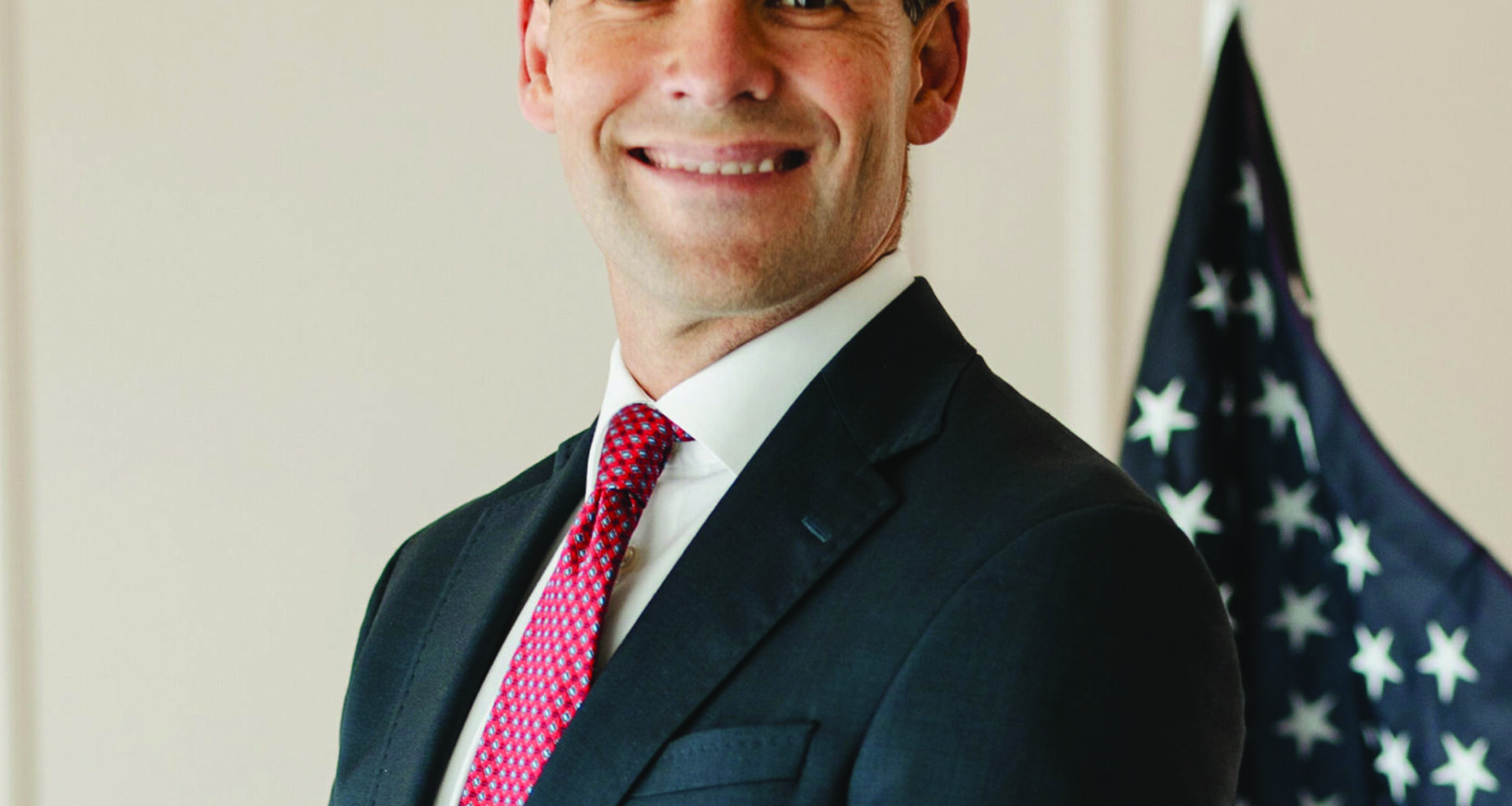
Editor’s Note: Jason Schmitt holds a Juris Doctor and Bachelor’s from Harvard and was unanimously appointed as treasurer by the Huntington Beach City Council a year ago.
Friends were surprised when I became the nonpartisan Huntington Beach treasurer last year. They struggled to understand why a successful CEO would voluntarily step into today’s polarized political climate. Many questioned whether public service was still worth the sacrifice. I understood their skepticism, but our country will fall short of its remarkable potential without a high-functioning government, and America deserves to dream big.
My husband Michael and I have lived the American Dream. My family went from hungry to Harvard in two generations, while Michael’s rose from canneries to college in one. My grandfather spent 30 years on an assembly line so that my disabled grandmother always had health care. My parents turned their $200 in life savings and two high school diplomas into a trucking company that stands 50 years later and made my Ivy League education possible.
When we moved back to California in 2024 to be near Michael’s parents, we committed to helping more Orange County families realize their American Dream.
‘Do Well by Doing Good’
Watching my grandparents struggle and my parents risk everything as entrepreneurs ignited a fire in me.
I spent the first five years of my career at McKinsey & Company, living on three continents while gaining firsthand appreciation for the complexities of global business. I sharpened that global perspective over the next 15 years as an executive at Fortune 500 retailers including Walmart and Amazon, companies that have helped millions of families save more to live better.
In 2019, I accepted the challenge of becoming CEO of Old Time Pottery, a $200 million regional budget retailer with 1,000 employees across 40 stores and 12 states. The decision to lead a cash-strapped retailer was risky, particularly as the pandemic threatened our survival six months later.
Over the next four years, I architected a business model transformation that stabilized operations, eliminated debt and delivered record performance. We saved hundreds of jobs, paid the first employee bonuses in a decade, and partnered with customers to donate millions to military families, seniors and domestic violence survivors. The successful turnaround culminated in our sale to a $1 billion retailer.
These experiences taught me that organizations succeed through their people. The best leaders earn trust through authenticity, humility and respect, treating employees as teammates not resources.
I brought that philosophy into the public sector when Tennessee Gov. Bill Lee appointed me to three statewide committees on workforce development, disability rights and small business.
Our results were tangible: 50,000 workers gained critical job skills, dozens of growing technology startups launched and free online financial literacy courses statewide. We successfully championed ethical artificial intelligence standards and a $400 million tax reduction benefitting 150,000 small businesses. Seeing others climb the ladder of economic opportunity inspired me to build a bigger ladder for more people.
‘Public Business Must Be Done by Somebody’
Local government rarely makes headlines, yet it shapes daily quality of life more than almost any institution.
In my new job, I never anticipated the number of diverse stakeholders with competing priorities that must be effectively addressed by local government.
Every repaired pothole, safe neighborhood and timely emergency response depends on public servants working together for all residents, not just the easiest ones to serve. Government cannot simply “run like a business” because businesses maximize shareholder value, while government safeguards opportunity for every citizen. That responsibility demands resources, but it should never be a blank check.
As treasurer, tax-collector and financial watchdog for 200,000 residents, my priorities are straightforward: maximize returns for our $500 million investment portfolio, expand audits to capture every tax dollar and leverage technology to drive efficiency.
My office generates nearly $20 million annually that supports essential services and helps keep our budget balanced.
Since I started, we have strengthened our investment strategy with greater broker competition and portfolio diversification, increasing yields by 10% while reducing risk and costs. We deployed artificial intelligence to identify anomalies, increased audits on hotels and utilities, eliminated manual processes and improved customer service—all while reducing staffing needs. Innovation should produce better government, not bigger government.
Financial stewardship is not enough—public trust matters. After taking office, I held community coffees and repeatedly heard that residents wanted straight talk and greater transparency. We responded by clarifying our investment policy, simplifying financial reports and publishing a guide to city taxes.
We partnered with neighboring cities, nonprofits, and local colleges to provide free financial literacy workshops, investment fraud awareness classes, tax preparation assistance and workforce development programs. Public service is about giving people tools to build their financial futures.
`The People Are the Government’
Ronald Reagan famously joked that the nine most terrifying words in the English language are: “I’m from the government, and I’m here to help.” The line endures because it reflects an unfortunate truth.
Business rewards bold innovators and calculated risk-takers while government resists change, fearing erosion of public trust and media amplifying missteps.
Across-the-board pay increases and limited negative repercussions for over-spending reinforce these incentives. California’s regulatory environment exacerbates these challenges by slowing projects, blurring accountability and financially burdening cities. Long-term planning is extremely difficult, as anyone whose home has required Coastal Commission approval can attest.
We need a smaller, more accountable government focused relentlessly on the responsibilities governments can uniquely fulfill. Government can learn from business and foster a performance-based culture. Profit and return on investment may not translate to City Hall, but customer service, fiscal discipline and measurable outcomes matter as much in the public sector as the boardroom.
My journey from private sector to public office has reinforced my conviction that strong businesses create prosperity, effective government creates conditions to widely share that prosperity, and neither succeeds without principled leadership.
My grandfather labored for three decades so his children could have brighter prospects. My parents proved that entrepreneurship can transform a family’s future.
I entered public service to keep that opportunity alive for the next generation, as the American Dream only endures if we sustain a government truly worthy of the public trust.