
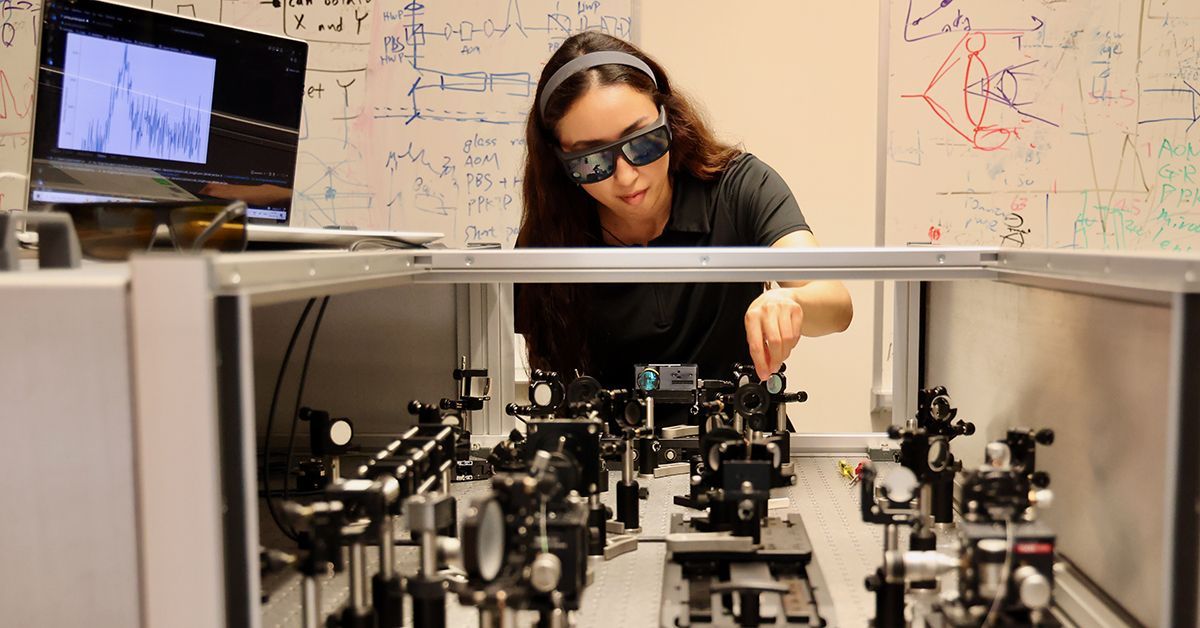
“Our RIMSE program follows the old adage that experience is the best teacher,” added Sailor.
The MRSEC has programming geared to UC San Diego transfer students.
“One of the major challenges for a transfer student is that they often enter UC San Diego with neither the time nor the training to participate in the research enterprise here,” said Sailor. “Our RIMSE schools have a specific focus on bringing transfer students into the materials science research community — the intensive workshops bring them up to speed so that they can seamlessly enter a research lab. Engagement of trainees in cutting-edge research is one of the most important activities of our MRSEC, because fluency in research concepts, tools and techniques is a key element of a well-trained STEM workforce.”
MRSEC Facilities
The UC San Diego MRSEC oversees a major group of facilities dedicated to materials characterization. Stood up six years ago as an element of the previous MRSEC grant, the center’s Materials Characterization Facility (MCF) has had a major impact on the research infrastructure locally and nationally. Since inception, it has engaged more than 100 companies and other external users.
“As it has grown, it has been really gratifying to see the facility nurture our local high-tech and biotech industries, especially the small start-ups,” said Ricardo De Luna, who serves as the manager for the MCF. “Many times we have provided measurements or expertise to help these small companies answer questions about their materials that they did not have the time or resources to answer themselves.”
One of the more impactful facilities developed by the center is the Mesomaterials Design Computational Facility, led by chemical and nano engineering professor Tod Pascal.
“Both of our integrated research groups face the same bottleneck: there are vastly more candidate structures than anyone can possibly synthesize,” said Pascal, who serves as the data director for the new UC San Diego MRSEC. “We’re developing machine-learning models trained on curated, purpose-built datasets drawn from first-principles quantum simulations. Those models predict which superlattice and metamaterial architectures are worth making, narrowing an impossibly large search space down to a set of targeted experiments. Our partnership with the NSF-supported San Diego Supercomputer Center lets us do that at a scale no single research group could.”
Public Outreach
In reaching out to the public, the UC San Diego MRSEC has benefited from a partnership with the Fleet Science Center, a world-renowned public science museum and planetarium located in San Diego’s historic Balboa Park.
“One of the great strengths of our MRSEC’s partnership with the Fleet is it has leveraged their broad reach into the community,” said Brydges. With their unique perspective on how to engage with and communicate science and technology concepts to the general public, the Fleet’s Science Communication Workshops train MRSEC students and faculty in the research-informed practice of public communication.
“The goals of many of the Fleet’s community programs and initiatives closely align with the education and outreach goals of the MRSEC,” said Dr. Mwenda KudumuBiggs, who serves as the vice president of community service and engagement at the Fleet Science Center. “We are thrilled to continue this partnership and to help connect the public with the exciting research happening right here in San Diego. Through programs like Sharp Minds and Suds & Science lecture series, people have the chance to meet researchers, ask questions and learn about quantum materials in a way that’s engaging, approachable and relevant to everyday life.”
Team UC San Diego
The MRSEC team’s success in winning this award benefitted from the support of many people and organizations throughout UC San Diego, most notably Albert P. Pisano, Dean of the Jacobs School of Engineering; Christine Hrycyna, Dean of the School of Physical Sciences; Corinne Peek-Asa, Vice Chancellor for Research and Innovation; Olivia Graeve, Director of the UC San Diego Program in Materials Science and Engineering and faculty in the Department of Mechanical and Aerospace Engineering; and the Office of the Executive Vice Chancellor.
Read more news about: Physical Sciences