
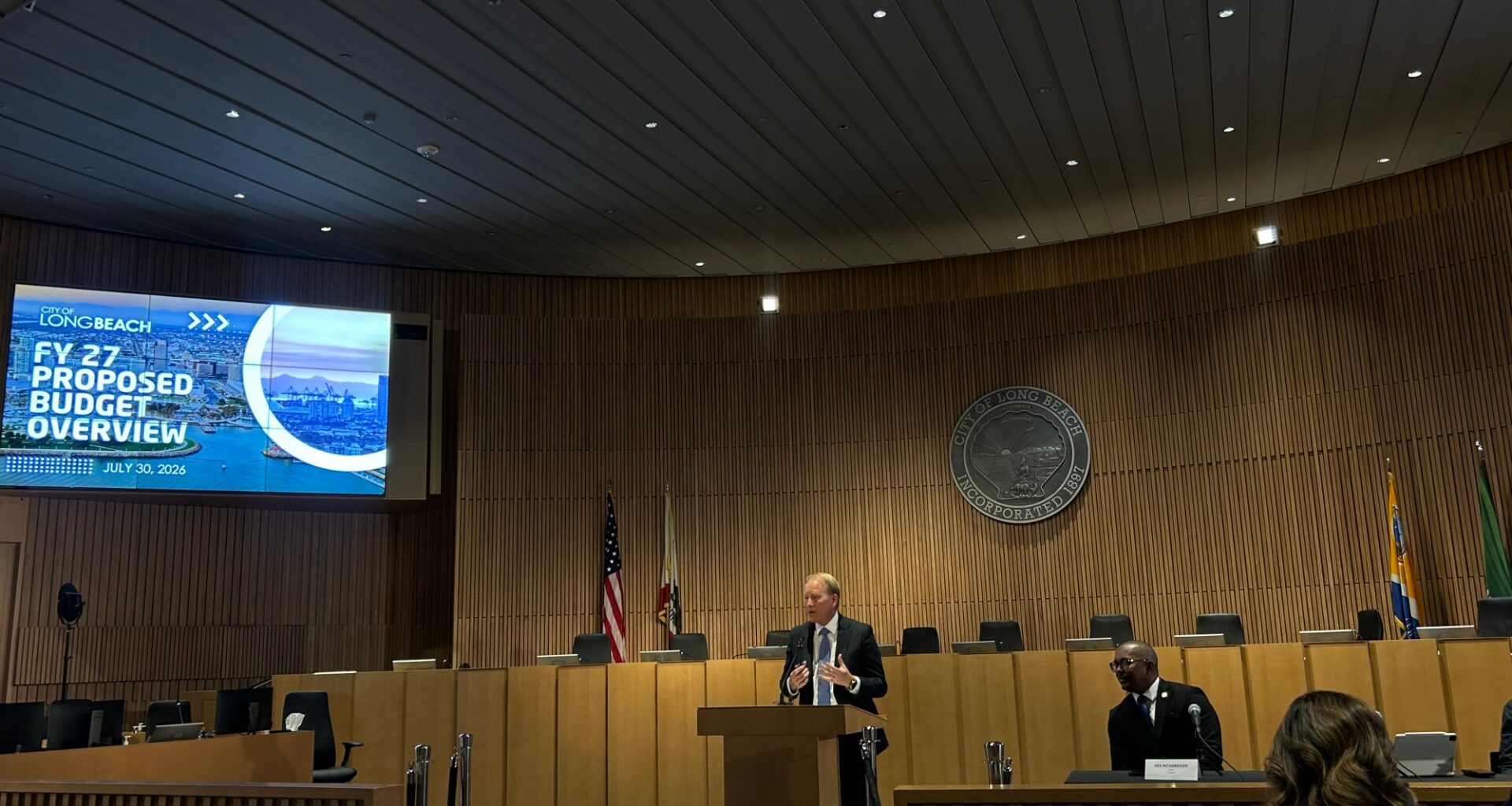
While Long Beach has balanced its proposed $4 billion budget for the 2026-27 fiscal year, there will also be cuts to programming and staffing to remain fiscally responsible, city officials said.
As the city continues facing fiscal challenges in the coming years, officials said, the proposed budget still reflects priorities from the City Council and community — and works to restore long-term fiscal stability.
Local leaders unveiled the proposed budget inside the Civic Chambers at City Hall on Thursday afternoon, July 30.
The 2026-27 fiscal year budget will undergo several rounds of review via Budget Oversight Committee meetings, community hearings and City Council presentations before its formal adoption by the council on Sept. 8, ahead of Long Beach’s new fiscal year, which begins Oct. 1.
Some priorities for the proposed budget include leveraging diverse funding sources to invest in infrastructure, economic vitality and future revenue-generating opportunities; navigating challenges while laying the foundation for a stronger and more sustainable future for the city; and having the budget reflect the values of the community.
“This budget is not simply about responding to today’s challenges,” Mayor Rex Richardson said during the presentation. “It’s about protecting the progress that we’ve made together, making responsible choices in the difficult moment, and positioning Long Beach to emerge stronger and more financially secure.”
The city had projected a $61.3 million deficit in the budget’s general fund. But because of critical needs set-asides having been removed and lower-than-anticipated allocations from Internal Services Funds, it has decreased. The shortfall is now $58.2 million in the 2027 fiscal year budget, City Manager Tom Modica said during the Thursday presentation.
That shortfall, city officials said, will be balanced with one-time funds and service reductions proposed in the FY27 budget. Every city department was asked to look for ways to lower costs, Modica said.
For the past couple of years, Long Beach has been anticipating a general fund deficit, as economic uncertainty across the country grows, federal funding cuts continue, the city’s oil revenue keeps decreasing, revenue growth has been slow, labor have risen, and the state faces its own budget challenges.
During this current fiscal year, the city was facing a $60.5 million general fund deficit through FY 2031. But the projection for the general fund, city officials said, has decreased, with a shortfall of $27.3 million for FY28, and a $2.4 million surplus by FY32.
The current deficit, city officials said, is not the worst that it has ever been. Rather, this is one-to-two years of projected deficits and does not require major year-after-year reductions. The city has also made efforts to grow revenue through programs and projects such as Space Beach, Grow Long Beach and the F&M Bank Amphitheater.
The main drivers of the deficit, Modica said, are increased costs of existing services, and police and fire hiring, revenue loss, and the health department. The deficit, however, is not caused by overspending, he added.
“We’ve been hiring police officers and firefighters, and we’ve been working to retain our city employees,” Modica said, “but that has a cost to it.”
Employee-related costs make up the majority of expenditures in the general fund, at about 79% and 66.2% is public safety, according to a recent budget presentation.
The Police Department moved from a 26% vacancy rate to 13%, while, the Fire Department’s sworn vacancy rate is 3.2%, according to the presentation. The bargaining agreements the city entered into with the police and fire associations earlier this year have come at a cost of $38.3 million over the next three years.
Shifts in fiscal policy at the federal level have resulted in loss, or potential loss, of federal funding for Long Beach of about $300.4 million. Several city departments have seen their funding impacted, or will potentially see it impacted, such as the Disaster Preparedness and Emergency Communications Department, with a decrease of $8.6 million; Health Human Services Department, with a decrease of $15.6 million; Long Beach Airport, with a decrease of $49.3 million; and Public Works, with a decrease of $220.7 million.
The FY27 budget decision-making approach, Modica said, included general fund service reductions, protecting core services for residents, identifying alternative service models, and evaluating subsidy models for city services while maintaining an equity lens and protecting city reserves.
This resulted in eight categories that worked to balance the proposed budget: reducing management and supervision; shifting costs to other funding sources; making internal reductions administrative capacity; enhancing core areas of community importance; investing in Police Department facilities, technology and the academy; contracting out services; reducing services; and replenishing reserves.
Reducing management and supervisory staff will save up to $7 million, though it would reduce staffing by 17 full-time equivalent employees, according to the budget presentation. The Parks, Recreation and Marin Department, for example, will eliminate a vacant recreation superintendent position, the health department will restructure two bureaus as part of a broader realignment of the Community Health Bureau; and the Fire and Police departments will eliminate captain, battalion, and chief lieutenant-level positions supporting recruitment, training and intelligence functions.
As part of shifting costs to other funding sources, positions and operations tied to infrastructure work (such as stormwater maintenance and pothole operations) are realigned to Capital Project and Infrastructure Funds. Other examples include Environmental Health fees being increased to reflect full cost recovery for permitting and inspection services; park maintenance costs tied to completed Measure A projects shifting to the Los Angeles County Regional Park and Open Space District program; and a new traffic sign replacement crew being funded through Caltrans Highway Safety Improvement Program grants.
Long Beach will also make internal reductions and is at a loss of administrative capacity; this will save up to $22 million, though staffing would be reduced by 73.08 FTEs. The Police Department, for example, will reduce non-contract overtime capacity used to backfill staffing gaps, while citywide savings were recognized from reducing fleet and technology internal service fund costs. The city will also discontinue the Cannabis Tax Credit Program due to limited participation and renegotiating a billing-services contract supporting the Utilities Department.
While cuts will be made, the proposed budget also makes investments to enhance core areas of community importance. The Median Program, for example, will get increased funding from parking meter revenues and Public Works administration reductions to address weed abatement, trash, irrigation and fencing needs. The Streetlight Program will expand to accelerate the conversion of streetlights from LED to solar, and focus existing crews on light repair.
Park Homeless Encampment Cleanup Services, city officials said, will move to structural funding for the first time after years of relying on one-time dollars. And a new Traffic Safety Division will consolidate the city’s approach to traffic calming and Automated Speed Enforcement.
Long Beach will also invest up to $14 million in Police Department facilities, technology and staffing capacity ahead of the 2028 Olympic and Paralympic Games. The next police recruit academy class will moving forward, and a new helicopter is on the way for the Air Support Unit – which will be funded through asset forfeiture funds. The Real Time Crime Center and the department’s digital forensics capabilities are both expanding.
“There’s always a lens of equity on what we do,” Richardson said. “I will tell you with my recommendations, when we discuss public safety, it’s always been the broader sense of public safety continuum. Sure it’s enforcement, it’s fire. But it’s also making sure kids have a place to go during the summer, making sure that programs are in our libraries, making sure we have teen programs. So we see that balance across the mayor’s recommendations and the city manager’s budget.”
A handful of functions will be shifting to contracted or MOU-based service models, such as parking services collections and billing, school guard services, and the city’s reprographics office, which will save up to $857,000; staffing would be reduced by 25.23 FTEs. Each is subject to a Proposition L analysis and the city’s meet-and-confer process with affected labor groups before it takes effect, Modica said.
The majority of reductions will be in services, with about $33 million saved and a reduction of 197.79 FTEs. In public safety, for example, Fire Engine 14 will be eliminated with support from surrounding fire engines to respond; one engine will be converted from permanent staffing to overtime; vacant patrol officer positions will be eliminated across all four patrol divisions; quality of life and motor detail officers will be scaled back; and there will be a reduction in structural police overtime funding.
Long Beach’s public libraries, meanwhile, would all return to five-day services. Bay Shore, Burnett, El Dorado, Harte, Michelle Obama and Dana branch libraries are currently open six days — but would now be closed on Mondays. Parks and Recreation programming would be scaled back at multiple sites, including program hours at all BeSAFE sites; teen programming at Chavez Park; the frequency of classes at the Homeland Cultural Center; maintenance at Rancho Los Alamitos and Rancho Los Cerritos; and the WRAP program at seven LBUSD campuses.
For the health department, the health fund would eliminate long-vacant positions tied to grant programs that have wound down, such as reducing capacity for the Office of Veteran Affairs; the REACH homeless outreach team; the Maternal, Child and Adolescent Health Program; and Childhood Lead Poisoning Prevention Program.
“These are people,” Modica said. “These are real people with real jobs and real lives. That you know, this is their employment to support their families and support support their kids, and we take that very very seriously. While this is the right thing to do, and we need to do it from a from a fiscal perspective, I’d like us all to remember just the human impact of what is happening today.”
Earlier this month, the city released the results of its 2026 homeless count, and also discussed the loss of funding for addressing the homelessness crisis in the city. Los Angeles County Measure A funding to the city will drop from $13.08 million to $8.92 million in FY27 – a 32% decrease – with another 43% cut forecast for FY28, city officials said.
Federal uncertainty at the U.S. Department of Housing and Urban Development has also caused concerns. The city anticipates losing $4.8 million in HUD Continuum of Care funding starting in July 2027 (enough to no longer subsidize about 148 households). The Emergency Housing Voucher reimbursements will also be terminated nationwide, affecting up to 480 Long Beach households.
The combined county and HUD Continuum of Care loss totals roughly $11 million in annual funding, according to the presentation. This will cause reductions in outreach, prevention and support services for the city’s programs addressing homelessness.
Mayor’s recommendations
As part of the proposed budget, the mayor also presented his recommendations to be considered. His priorities include protecting jobs and essential public safety services, preserving public health in the face of federal cuts, advancing mobility and traffic safety, investing in neighborhoods, and enhancing quality of life citywide.
The mayor’s recommendations also include $308,910 in combined structural and one-time general fund spending, plus the current budget allocation, for a total of $1 million for the Long Beach Justice Fund. They also include restoring several Park and Recreation programs, such as BeSAFE and classes at the Homeland Cultural Center, as well as restoring funds in the Health and Human Services Department to sustain support for the Office of Veteran Affairs.
Restoring those programs and services will be funded by one-time savings freed up by the uncontested June municipal election, a Port of Long Beach cost-recovery adjustment for Fire Department services, voter-approved Measure ER dollars for public health up to $7-8 million, and the restoration of the state’s Homeless Housing Assistance and Prevention program.
Richardson has also taken up a new role as an L.A. Metro Board member, representing the Southeast region, which also comes with support to advance mobility and traffic safety in the city, he said.
As Long Beach continues growing and preparing to welcome the world for the 2028 Olympic and Paralympic Games, Richardson said, ensuring safe, efficient and well-coordinated transportation and traffic infrastructure has never been more important.
Overall, the mayor’s recommendations help restore or enhance recreation, library and cultural programming reduced in the city manager’s proposed budget, and make targeted investments to keep public spaces safe, clean and welcoming for residents and visitors alike.
The recommendations also chart a longer-term path toward fiscal stability, Richardson said.
Building on the city manager’s proposed $9.8 million operating reserve allocation, for example, the recommendations add $200,000 one-time funds, bringing total reserve replenishment to $10 million. About $303,000 one-time dollars from the general fund group will be utilized by the Budget Oversight Committee and City Council to further community priorities and budget restorations on a one-time basis.
Long Beach will also continue completing its Elevate ‘28 Infrastructure Investment Plan, which increased to $1.24 billion for more than 180 projects across several categories, such as community and cultural investments, mobility and safety improvements, park improvements, public facilities, and specific 2028 Olympic preparations. The city will also draft its pavement management plan, city officials said.
While some restorations and investments will be possible in the upcoming fiscal year, many city employees will still lose their jobs. The proposed budget estimated a reduction of 227.08 FTEs, with the mayor’s recommendation restoring 39.56 FTEs; that still leaves a reduction of 187.52 FTEs.
“The city will follow all applicable Civic Service Rules, labor agreements, and personnel policies throughout the implementation process,” according to the budget presentation, “and will provide affected employees with timely communication regarding available placement opportunities, key milestones, and next steps as workforce changes are implemented, with the anticipated process completion to be the start of the fiscal year, Oct. 1.”