
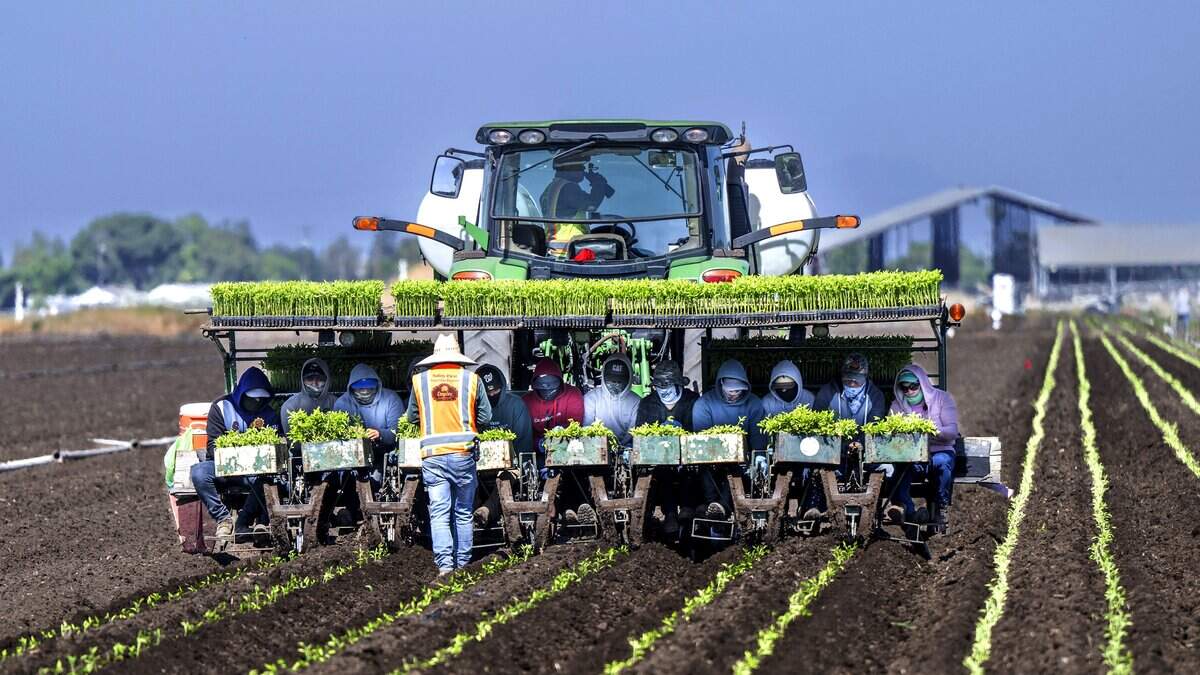
Farmworkers sit on the back of a tractor as they plant tomato plants in Stockton on June 3, 2025.
HECTOR AMEZCUA
hamezcua@sacbee.com
More than 90% of California farmworkers say immigration enforcement operations and deportations have affected their employment under President Donald Trump’s second term.
That’s according to a new survey released Thursday morning by the UFW Foundation, which is a farmworker advocacy organization separate from the historic labor union. The survey, which consisted of 2,250 farmworkers, is a window into how the nationwide surge in immigration enforcement has affected a heavily undocumented workforce in California. Respondents were from across the country but mostly lived in the state and had no legal status.
Among the most striking findings were that 90% of farmworkers feared family separation, about two-thirds had shopped less and roughly one-third had not sought medical attention. About 85% of all respondents had lived in the country for more than 10 years.
“Those in power often talk about and act towards undocumented farmworkers as if they are not important. They are,” said UFW Foundation’s CEO Erica Lomeli Corcoran at news conference Thursday morning. “They talk about undocumented farmworkers as if they don’t sacrifice their lives to bring a great wealth of food to all America and much of the world. They do. Finally, those in power so often talk about and act towards undocumented farmworkers as their voices don’t matter. They do.”
Estimates on the number of noncitizen farmworkers in the state vary widely though most experts believe roughly half of the workforce is undocumented.
Last year, The Sacramento Bee reported that the federal administration had mostly avoided high-profile immigration enforcement at farms and agriculture businesses in California’s Central Valley during the first six months of Trump’s second administration. Experts attributed the restricted enforcement to the influence of powerful agriculture businesses.
That has largely remained true one year later, though fear remains high among immigrants amid an escalation of arrests, deportations and crackdown on the legal immigration system. Nearly 90% of the farmworkers surveyed feared detention and deportation.
There have been some cases of large enforcement at agricultural workplaces, including immigration sweeps in July 2025 at two Southern California cannabis farms that led to the arrests of more than 300 people. One man, a 56-year-old husband and father, died after he fell from a greenhouse roof while trying to hide.
The survey also focused on what lead author and San Diego State University Imperial Valley lecturer Jonathan Angulo called “hopes and aspirations for the future.” The federal government has failed to pass any major immigration reform in the last 40 years. Bipartisan legislation has been introduced in Congress, and even passed the House, but repeatedly stalled.
Of those surveyed, 87% said they would visit a family member if such federal reform was enacted. Another 34% said they would attend and organize the school activities of their child.
“Despite the many fears and concerns farmworkers have, they remain hopeful for a better future in the United States, including a better life for their family and generations to come,” said Angulo, who is also UFW Foundation’s research and policy analyst fellow.
At Thursday’s news conference, Angulo called the survey a first of its kind and noted the challenges in polling a largely undocumented workforce. Farmworkers feared retaliation, often labor in seasonal work and speak many languages, he said.
“The data is clear,” Angulo said. “From the many years working in agriculture, they have become experts and highly skilled workers. They have also become long-term residents with deep growth in their communities.”
This story was originally published July 30, 2026 at 11:09 AM.
Related Stories from Sacramento Bee
The Sacramento Bee
Mathew Miranda is a political reporter for The Sacramento Bee’s Capitol Bureau, covering how decisions in Washington, D.C., affect the lives of Californians. He is a proud son of Salvadoran immigrants and earned degrees from Chico State and UC Berkeley.