
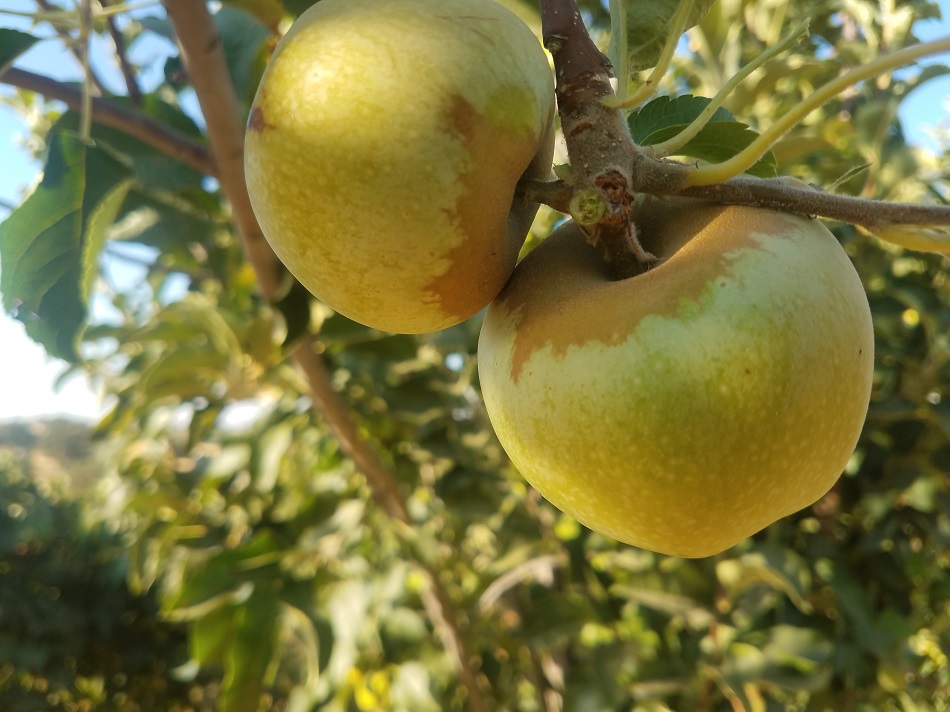
Even 250 years after the American colonists founded our United States, today’s generations can still enjoy the fruit of trees our forefathers once enjoyed thanks to nurseries like Trees of Antiquity, a specialty nursery in San Luis Obispo County, with roots in Sonoma County.
The nursery is currently taking reservations for its antique fruits now for shipping in winter and early spring 2027 at treesofantiquity.com.
Long before apples became polished and perfected for the produce section of grocery stores, they thrived in American backyards and family homesteads.
They were passed from generation to generation, spread along the frontier by the beloved Johnny Appleseed, and satisfied humans and wildlife alike with their appealing varieties, shapes, sizes, textures and taste. The apples often arrived with their own backstories and rich personal provenance.
Some ripened in late summer; others kept families fed through winter. Some were tart enough for cider; others perfumed an entire kitchen from the pantry shelf.
Thanks to Trees of Antiquity, though, heirloom trees — ones that owner Neil B. Collins considers to have been grown before World War II, industrial agricultural and patented commercial cultivars — are still being cultivated and spread across America to gardeners who value biodiversity, heritage and want authentic and genuinely tasty fruit.
“The common supermarket varieties appeal to commercial growers because they need fruit that ripens all at once, doesn’t bruise easily, grows high yields, ships and stores for extended lengths of time and sits on the shelf without a blemish,” Collins said. “Flavor is often a secondary consideration.”
That trade-off has left countless remarkable varieties behind.
For more than four decades, Trees of Antiquity has become one of the country’s leading sources for heirloom fruit trees, shipping more than 400 varieties of bare-root fruit trees to backyard growers and orchards across the United States. At the heart of the nursery are more than 250 antique apple varieties.
Collins had been the farm manager of Sonoma Antique Apple Nursery, founded by Carolyn and Terry Harrison in the 1970s, when he took it over in the 1990s, renamed it Trees of Antiquity and relocated the operation, first to Healdsburg where scions, or cuttings of the mother trees, were grafted, before migrating down to Paso Robles.
By then, the nursery had long established itself as a pioneering organic grower of grapes, fruits and vegetables and cultivator of unusual apple and pear varieties.
The stock includes apple trees, which our forefathers might have planted or enjoyed the fruit they produced. According to Collins, among the most notable in his Trees of Antiquity catalog are the following:
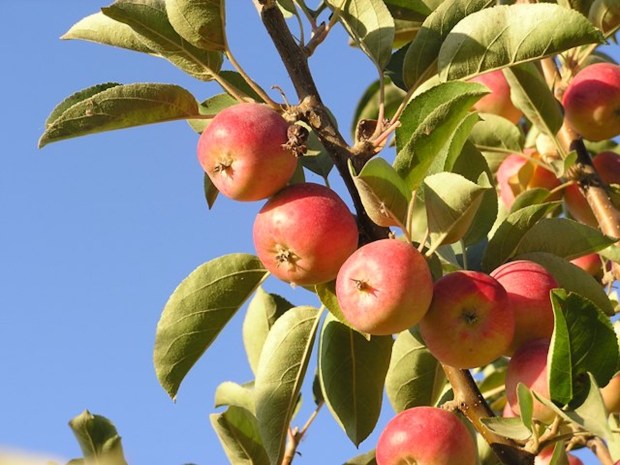 The antique Hewes Virginia Crab was the most important cider apple in the 18th century. It was used by George Washington and Thomas Jefferson for the estate ciders. (Courtesy of Trees of Antiquity)
Roxbury Russet
“Considered America’s oldest named homegrown apple variety, it originated in Roxbury, Massachusetts, in the early 1600s,” Collins said. “Possessing a dense, rough greenish-bronze skin, this heavily yielding winter keeper was widely used for cider production and was known to be a favorite of George Washington.”
Esopus Spitzenburg
“Originating in Esopus, New York, in the late 1700s, this crisp, spicy, highly aromatic red apple was Thomas Jefferson’s absolute favorite dessert fruit,” Collins said. “He planted dozens of them in the South Orchard at Monticello.”
Newtown Pippin
“First discovered as a chance seedling in Queens, New York, in the early 1800s, this yellow-green apple holds a legendary spot as America’s first major fruit export,” Collins said. “It was deeply admired by both Jefferson and Washington, who planted them extensively on their respective estates. Jefferson famously wrote from Paris that Europeans considered it the finest apple in the world.”
Hewes Virginia Crab
“A small, intensely tart apple that likely crossed a European variety with a native American crabapple,” Collins says, “it became the most important cider apple in 18th-century Virginia. Both Washington and Jefferson used it exclusively to brew their highest-quality estate ciders.”
Beyond the prominent estates, Collins says, several other legendary heirloom apples sustained early colonial life and those in the American Revolutionary War era.
Rhode Island Greening
“Dating all the way back to the late 1600s near Newport, Rhode Island, this is one of the very first named American apples,” Collins said. “Large, grass-green and aggressively tart, it was the definitive culinary apple of the Revolutionary War era, cherished for its ability to hold its shape perfectly in pies and baked dishes.”
Original Winesap
“Originating in New Jersey before 1800, this dark red heirloom became a staple of colonial orchards,” Collins said. “Its deep, wine-like, savory flavor made it an exceptional dual-purpose fruit that was highly prized for pressing into complex hard ciders and durable enough to remain crisp in root cellars all winter long.”
Baldwin
“Discovered as a chance seedling in Wilmington, Massachusetts, around 1740, the Baldwin was originally known as the ‘Woodpecker’ apple,” Collins said. “It became the defining commercial apple of New England, prized by Revolutionary-era families for fresh eating, cider and making winter preserves.”
These are just a few of the thousands of flavors waiting to be rediscovered by apple enthusiasts and home gardeners.
“Our heirloom and traditional fruit trees exist thanks in great part to the home gardeners who continue to explore beyond the store shelves,” Collins said. “We encourage everyone to maintain this search and share in the revival of these relics from the past.”
Most of the nursery’s stock is USDA certified organic, supported by five-year crop rotations, compost, native hedgerows and habitat that welcomes beneficial insects, birds and other wildlife rather than relying on synthetic chemicals.
And while apple trees are the center of the nursery, Trees of Antiquity also offers pear, peach, plum, nectarine, persimmon, quince, medlar, almond and hazelnut trees, as well as grapevines, berry bushes and others. Most trees are available on semi-dwarf rootstock suitable for modern home landscapes but can also be espaliered for space and easy picking.
“Our trees come from all over,” Collins said, “but primarily from folks who lived their lives with the trees and planted them with an eye to the future.”
That’s what Collins hopes Marin gardeners will do, too. He wants them to think beyond the next season and toward the next generation and to enjoy the flavors and varieties rooted in American history.
Show off
If you have a beautiful or interesting Marin garden or a newly designed Marin home, I’d love to know about it.
Please send an email describing either one (or both), what you love most about it and a photograph or two. I will post the best ones in upcoming columns. Your name will be published, and you must be over 18 years old and a Marin resident.
Not to miss events
• Eugene Rougeau of Petaluma’s ED Wilson Roses will discuss his rose selection process and how to best care for David Austin roses at the Marin Rose Society’s monthly meeting at 6:30 p.m. Aug. 11 at the Marin Art and Garden Center at 30 Sir Francis Drake Blvd. in Ross. The event will also feature a rose show and raffle. Admission is free. Go to marinrose.org.
PJ Bremier writes on home, garden, design and entertaining topics every Saturday. She may be contacted at P.O. Box 412, Kentfield 94914, or at pj@pjbremier.com.