
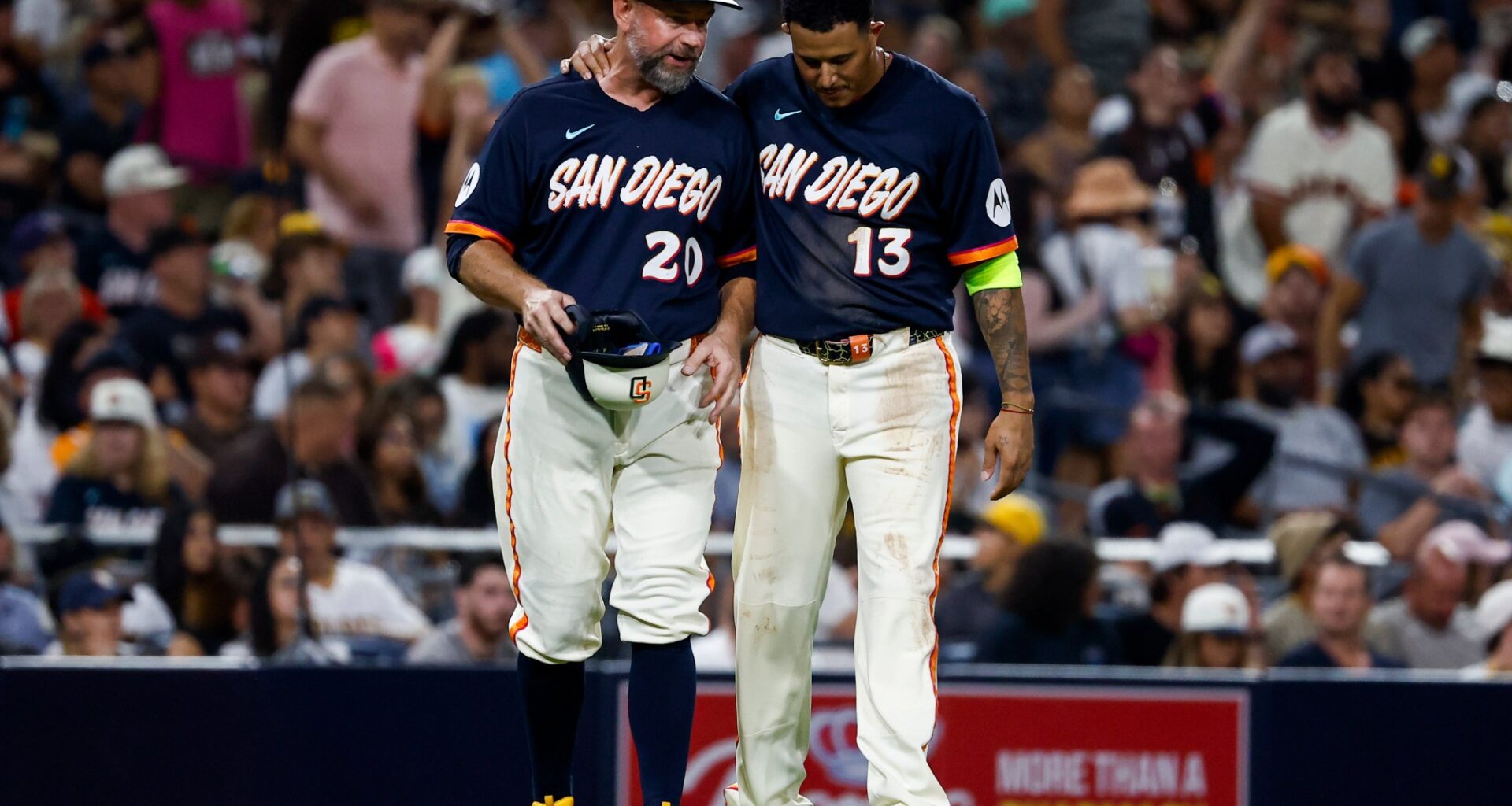
In December, the Padres added Bob Henley to their coaching staff as third-base coach. Henley, 53, spent his entire professional career with the Expos/Nationals organization, first as a player and later as a coach.
Drafted by Montreal in 1991, Henley spent six seasons in the minor leagues before making his major league debut on July 19, 1998. A catcher, he appeared in 41 games with the Expos before his career was derailed by an injury.
Henley transitioned immediately into coaching after retiring as a player. He served as a minor-league manager, field coordinator, infield coach and player development instructor before joining the Nationals’ big-league staff in 2014.
During his time in Washington, Henley crossed paths with pitcher Craig Stammen, who was with the organization from 2009-15.
This interview has been lightly edited for length and clarity.
You worked so hard to get to the major leagues. How difficult was it to see your career end after only 41 games?
A: I’m a small-town boy from Grand Bay, Ala. Going to the major leagues, when you come from a small town like that, it’s like going to the moon. It’s just far-fetched. You watch guys on television playing and you always think about how great they are, and then to work so hard and have an opportunity and to play well, and then to have injuries … Injuries are a part of it. It’s difficult. You have a surgery, then you have another surgery, then you have another surgery and realize that you can’t throw a ball anymore. That part was difficult. But I think through adversity, you learn a lot about yourself. It was evident that having a long career or an opportunity for a long career wasn’t in the cards for me. And that in taking some of the lessons that I’ve learned over the years and being able to talk to players and tell them to continue to fight for their work and fight together as a group, and come together as a group and do something special, I’ve had a chance over the years to kind of live through them in their careers, and I’ve embraced that.
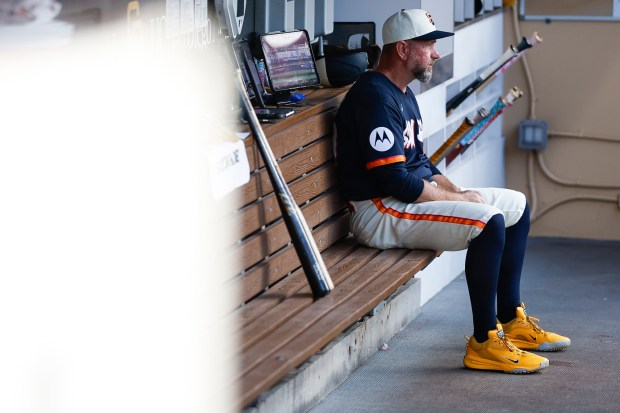 Bob Henley of the San Diego Padres looks on in the dugout before the game against the San Francisco Giants at Petco Park on Friday, July 31, 2026 in San Diego, California. (Meg McLaughlin / The San Diego Union-Tribune)
You’ve been a coach since 2003. Why is coaching a good fit for you?
A: The people. I love the game, but for me, it’s all about the people, the relationships, the work. You’re surrounded by people that are all like-minded. They’re trying to all be the best at what they do and trying to do something special individually with their career, but also as a group trying to do something — to win a championship. So, any small part I can do to help that process. It’s not about me. I understand that this whole thing has nothing to do with me. It’s ‘What do I need to do to help others be the best they can possibly be?’ And sometimes it might be saying something. Sometimes it might be putting an arm around somebody. Sometimes it could be a little kick in the pants.
You remained with the Expos when they became the Nationals. You were brought back through managerial hirings, firings and organizational restructuring. They kept you in the organization for 34 years …
A: That means I’m old. That’s what that means.
Was it difficult to leave or strange to put on a new uniform at first?
A: Yeah, it’s all I had ever known. It is (strange). I love every minute of putting on the brown, though. I love every ounce of it. I’m just soaking it up. That decision, there was a lot of thought put into it. Once that decision was made, I have not looked back at all. My family’s excited about it. I’m embracing every single thing about what it is to be a Padre. I had a chance to meet Trevor Hoffman (in spring training). He got me donuts. We got into some conversations about Krispy Kreme donuts, and he got me my own dozen. And getting a chance to meet Jake Peavy for the first time. I’ve been on the working end on the other side of that, when he beat us in the playoffs when he was pitching. He’s from Mobile, Ala., the same town I’m from, but I’ve never had a chance to truly meet him. We had a chance to spend four or five days together, and it was wonderful to get to know him and learn more about him. … One thing I can say about the fans is they’re passionate about their Padres. I’m fired up as well. I’m excited about being a Padre, and every day I wake up excited to come to the field.
It sounds like a fresh start was just what you needed.
A: Yeah, I think so. When I got a phone call (in the offseason) and started talking ball and then hearing Craig’s voice — you know, he was a player in our system when I was a coach. He’s a very unique, uncommon man, and I just draw to that. And then just the organization … I’m excited to be on the home side of Petco with our fans, wearing the brown, going after a championship, taking it one step at a time. Craig had talked about laying bricks early in spring. One brick at a time. I think it’s just the daily work, the daily game, preparing for that, competing on a daily basis, our group coming together as a family. A lot of people use that term loosely: family. There’s nothing I wouldn’t do for my family. And Padres and wearing this brown, that’s my family. The fans are my family now. I take that very serious. I want to try to do the best job I can for my family.
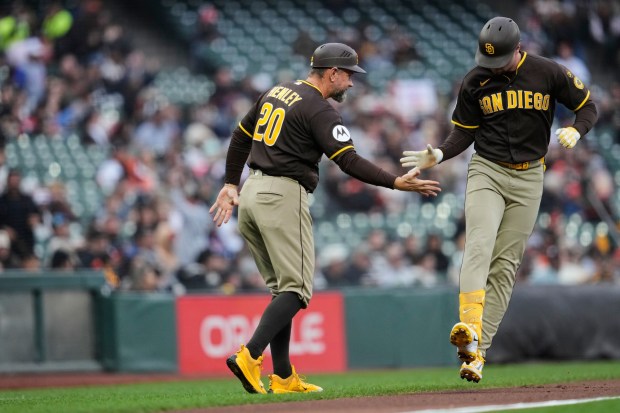 San Diego Padres’ Jackson Merrill, right, celebrates with third base coach Bob Henley (20) after hitting a solo home run during the first inning of a baseball game against the San Francisco Giants, Monday, May 4, 2026, in San Francisco. (AP Photo/Godofredo A. Vásquez)
At third base, you’re the closest that anyone can get to game action. You’re kind of in the game. You affect the game at times. What is that like?
A: I’ve done it for years. Sometimes you affect the game. When you’re not noticed, that’s usually a great thing. Anytime something happens and somebody gets thrown out by 30 feet, nobody hates it more than you do. And I understand all of that. I do enjoy being out there. I used to be a little more athletic. I’ve never been accused of being an athlete, because I was a catcher. I used to be a little more athletic and a little more agile, and now I don’t move as well. But the great thing is, we have an amazing lineup. Guys that can really run fast and really have a lot of instincts to play the game. A lot of the decisions that are made out there, they make on their own. You know, I’m kind of in charge of left turns after they get to third. If we got a shot at scoring, we’re going to go after it. And there’s a lot that goes into that. Scoreboard, what the score is and how guys’ bodies are feeling, and trying to take a chance when you need to take a chance. Sometimes it’s just time to stack them up and let them hit. So I think just balancing that and learning each guy and also what they’re capable of doing and trying to navigate that (is key). Always learning every day. I care immensely. And the whole goal is to win a World Series.
Major League Baseball enforced a rule this year requiring the third-base coach (and first-base coach) to remain inside their designated coach’s box until the pitcher releases the ball. How different has that been for you?
A: That’s something that, you know, is interesting. (When the new rule was implemented) there was a photo used of coaches being out of the box, and they used my picture on the photo. And I’m like, of all things, they used me (as an example). They dug up something from years ago of me standing out of the box. And where I was in relationship to the box was probably the closest I’ve ever been to the box (laughs). I didn’t realize there was a box over there until this spring. They said, ‘Hey, you’ve got to stay in the box.’ I’m like, ‘What box?’ And they said, ‘The coaching box.’ It’s definitely different angles that you are looking from (when you’re) in the box. But all the coaches have the same issue, so it’s not like I’m the only one.
Let’s talk about the stop versus the send. How do you balance aggressiveness with caution and needing to make that decision in milliseconds?
A: Of course, you would love to have every person you send make it safely. That is not the case. It’s an aggressive game. We have aggressive players and they’re wanting to score, and I’m wanting them to score. I think the scoreboard dictates a lot. Our lineup construction dictates a lot. Who we’re facing that night. The pitcher. Some of the guys that you’re going to be facing, they don’t give up many runs. Some of these starting pitchers, some of these guys that come out of their bullpen, don’t give up many runs. And so there might be moments that you take chances at runs because the guy on the mound can go through the next three hitters and you don’t get that shot again. There are some calculated risks that you definitely take. There’s nothing that’s going to be done on a whim. You know, you think about the cut of the grass when you go into (a ballpark), and if the ball is hugging the ground versus a bounding ball that goes to the outfield. Outfield arms, how accurate are their arms? How do they get to the ball? How much time is it between glove to release when they do get to the ball? Are they throwing accurately to the relay man, because each second can be 25 feet, depending on who’s running. And sometimes big leaguers make big league plays. There’s times where you do all the homework … and then he makes a great throw. There’s a lot of prep work involved in it. After you do it for a while, it, it’s kind of just like breathing air. You factor all those things in and at the end of the day, you try to make the best decision possible. I think as time goes, as you learn the players and the league, that you have a better opportunity to do that. The situation is always changing. That’s the fun part of it.
You don’t strike me as someone who’s on social media, but you probably wouldn’t be shocked to hear that there’s a lot of Monday-morning quarterbacking when it comes to what you do.
A: Oh, yeah. “You’re an idiot.” I’m probably tougher on myself than anybody can be tough on me. Again, you go out there with a full understanding of how this game can develop and as it develops, you’re basing that (with) the personnel and what play is happening. There’s not a play that would happen that would just catch you off guard. So it’s being aware of what’s going on and then in those moments, trying to make a decision based on that.
You have to have a quick ability to flush plays. You learn from things, but you have to have the ability to move on to the next pitch. So yeah, I’ve had many of those moments. I’ve had playoff moments where there’s been long offseasons. I’ve had moments where you would make a decision that didn’t work out and you think about it all night long, and you think about what you need to learn from that instance. It’s one thing to beat yourself up, but tomorrow’s coming, the next inning is coming, the next pitch is coming. You need to be ready for that because the team deserves that.
What goes into scouting the opponent and preparing for new teams?
A: I watch hours of video. I try to learn their outfielders and how they move and how athletic (they are) and how they get to the baseball, how accurate they are. Try to find where we can expose things. Maybe tendencies that they might have, that you might give a player that has nothing to do with you making a decision; it’s for them to make a decision and look for. And if the timing isn’t there to slide in safely, it’s trying to find ways to get timing in situations where we’re wanting to be aggressive. You got to dig deep for that. But you know, everybody’s digging deep. You got folks going to work, coming to the ballgame. They’re grinding it out, bringing their families and whatnot, and they’re committed to the Padres. I’m committed to our players. The players are committed to each other and committed to the fans. So it’s just one big family that has the same common goal, and that’s to win. That’s what it’s all about. And when those moments come, you want to be prepared and you want to be ready and you don’t fear those things. You embrace those things. That’s what this is. That’s the part of this journey that’s great, is that it’s not easy. It’s hard. That’s what you love about it, right? I’m passionate about every single aspect of what it takes to win.
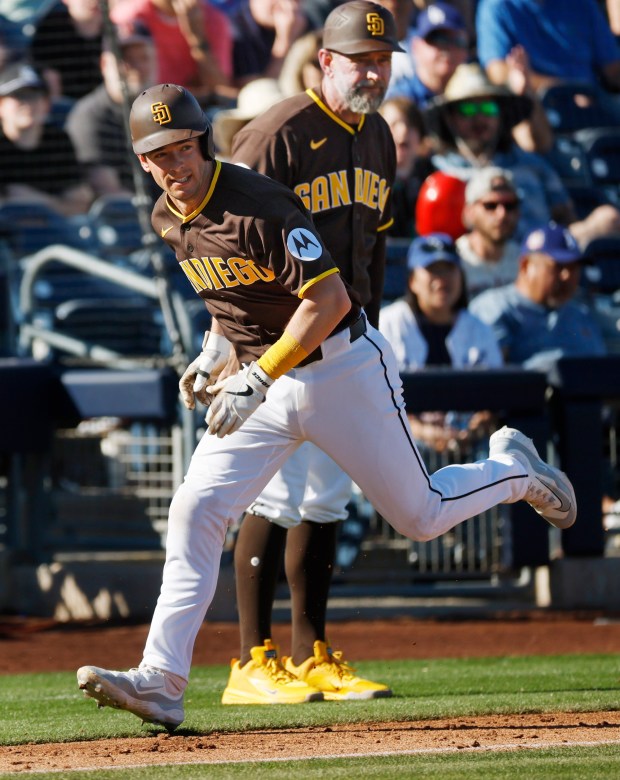 Nick Solak of the San Diego Padres runs by third-base coach Bob Henley to score against the Los Angeles Dodgers during a spring training game on February 22, 2026 in Peoria, AZ. (K.C. Alfred / The San Diego Union-Tribune)
What’s life like for you back home in Alabama?
A: Slow living. We live out in the woods. My wife, we’ve been married for 27 years, and my daughter’s 25 and my boy just turned 19. We have some land out there in the outskirts of Mobile, so there’s a lot of deer, turkey and rabbits and squirrels and a pond. You don’t have to be a great fisherman when you have a pond out there. You throw some bait out there and they take it, and you show somebody a fish you caught. But it’s kind of a rigged deal, you know? You don’t have to have much talent to catch fish in our pond. But it’s just slow living. You come to a four-way stop and everybody’s waving to everybody to go next. And if you don’t wave to somebody, they’ll say, “Bobby Henley didn’t wave at me today.” Well, you just didn’t see them. They’ll talk bad about you in church. But it’s where I was raised … I love it though. That’s home.
Can you leave us with something you’ve learned about baseball and life over a long career?
A: I’d say that it’s hard. I grew up in a farmer’s town and you kind of reap what you sow. What you put into something, you can expect to get out of it. There’s no substitute for hard work. You always hear the term: “Give it 110%, 120%.” Well, 100% is all you got, you know. And so giving 100%. Sometimes when players are out there playing and they’re banged and bruised up and got a little hammy or a little calf (injury) or something going on out there, they’re giving 100% of what they got that day because that’s all they can give. I think even coaching third base, it’s understanding that (a guy is) playing busted up. Sometimes it might seem on TV like, “Well, why didn’t he send him right there?” Because he is hurting and he’s wanting to be in the lineup tomorrow and second gear is his fifth gear today. So it’s respecting that and understanding where they’re at and that they’re giving all they got to that process, and me trying to make sure that I take care of that player in those moments too.
Life can be hard, and the game is extremely hard, but what you put into something, you can expect to get out of it. And always learning from mistakes. Lord knows I have. You learn from mistakes you make and when things happen that are successful, you learn from those too. It just seems like those mistakes, you learn bigger lessons from those over the years. They stay with you.