
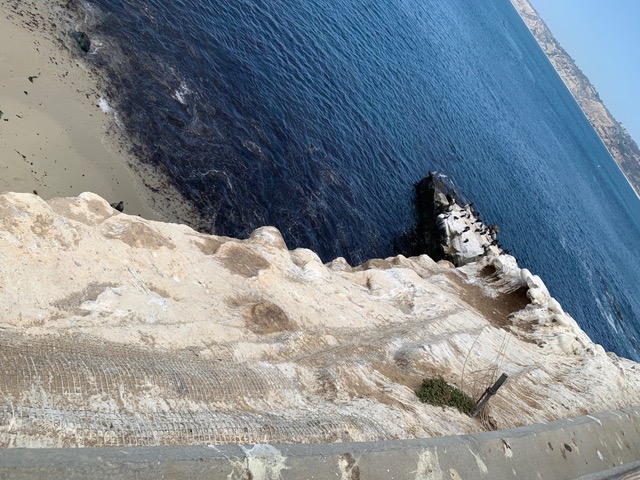
Visitors to La Jolla Cove may notice fewer Brandt’s cormorants’ nests on the surrounding bluffs in the coming weeks, whereas they numbered much higher mere months ago.
However, researchers say that is due to normal ebbs and flows in the nesting season, which is especially early in Southern California as compared to northern areas (where nesting extends into late spring and summer) and is not likely due to human intervention.
Brandt’s cormorants, part of the Phalacrocoracidae family, are the largest cormorant on the Pacific Coast. The black-feathered expert divers can swim deeper than 200 feet and are well known for demonstrating their bright blue throats during breeding season.
Beginning in October last year, students at UC San Diego’s Scripps Institution of Oceanography captured baseline data on Brandt’s cormorants and other seabirds around La Jolla Cove across two surveys to gauge their reproductive success. The team behind these surveys included Scripps graduate Alex Rubenstein, along with current Scripps students, researchers and members of UCSD’s Bird Club.
The first survey was conducted every two weeks from Children’s Pool to Goldfish Point to count the species of birds, their nests and eggs, how many in the species there are and how those numbers change throughout the year. The second survey focused solely on Brandt’s cormorants, and was conducted every week.
For the cormorants in particular, Rubenstein and fellow surveyors first saw nest building and birds mating in December. By mid-January, the first set of eggs were hatched, and by May, the numbers began to taper off.
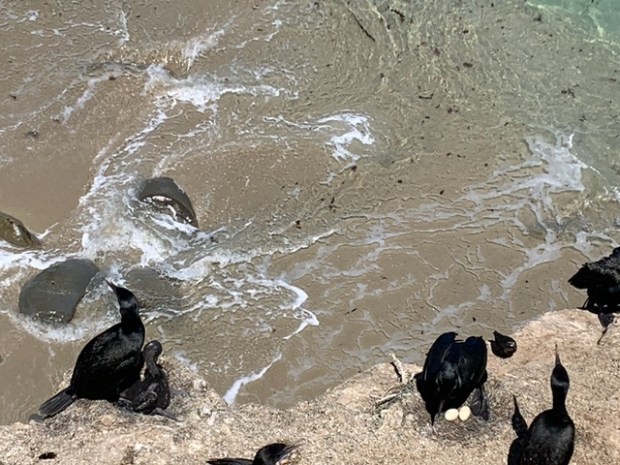 Brandt’s cormorants reside on cliffs in La Jolla Cove during nesting season. (Kaia Gantzel)
With nesting season winding down, Rubenstein said the cormorants’ nests are made up of organic material, making it likely that the materials naturally decomposed and degraded due to weather and usage of the area from other species between the spring and summer rather than it being attributable to human intervention. Power washing, scrubbing or spraying on The Cove bluffs to remove nests would likely be accompanied with other signs of disturbances like erosion, he added.
Looking to conduct future studies, Tammy Russell, a marine seabird expert at Scripps, is also monitoring the bird population surrounding La Jolla Cove to better understand how seabirds use the area, and said the work will continue into future breeding seasons. Two students will lead the study.
“I’ve been wanting to survey The Cove for a long time now, so it’s great to have students that are interested in doing this,” Russell said. “Our lab will now be monitoring this area during each breeding season and I’m looking forward to understanding how seabirds are using this valuable breeding and roosting habitat and how that changes with different environmental conditions … and human impacts over time.”
— La Jolla Light editor Ashley Mackin-Solomon contributed to this report.