
KeysQuestions4Explore4
Redesigning hydropower turbine blades — not adding screens or bypasses — just changed the blade shape, and sturgeon survival jumped from as low as 42% to nearly 100% at the same speeds.
A third of every fish that went through the conventional runner was simply severed in half, and that number effectively dropped to zero with nothing but a geometry change.
The Department of Energy just greenlit a real-river test with live eels at an operating power plant, which means this could rewrite how every existing dam in America handles its fish passage problem.
Ask The Box →
Ask The Box:
SummarizeContextWhat does it mean?Related
Energy
A hundred bulldozers worked 22 hours a day to pile 8.7 miles of dirt ramps up to 82 feet tall around an Icelandic town, and they sit parked there now because the lava gives 20 minutes of warning before it comes up
2 hours
Energy
Frankfurt Airport stood 37,000 solar panels dead upright along 2,800 meters of a runway, edge-on to the sun, so the array gives up the middle of the day on purpose and comes out as a camel with two humps instead of one
3 hours
Energy
A Chinese-built railcar climbs 26 miles up an Andean gorge on 352 kilowatt-hours of battery bolted to its roof, pulls into a mountain village, plugs in for 25 minutes and goes back down, and there is not one solar panel on it
17 hours
Energy
A 190-foot free-fall tower drops riders inside the cooling tower of a 327-megawatt German reactor that was finished, filled with liquid sodium and never handed a single fuel rod, and a Dutch scrap dealer bought the site for about $3 million
20 hours
AI-generated summary from reviews, comparisons and articles by AutoNotion
Drive past a hydroelectric dam that has a fish problem and you can usually spot the fix from the road. Screens bolted across the intake, a bypass channel running around the side, sometimes a concrete ladder stepping up the bank. The logic has barely moved in a century. The turbine is the dangerous part, so keep the fish away from it.
A study published in March went at it from the opposite end. Researchers took juvenile white sturgeon and sent them straight through a spinning runner on purpose, 112 of them, then ran 115 more through a conventional runner turning at the same speed under the same head of water. It was the same turbine both times. The only thing that changed between the two sets of trials was the shape of the blades.
The conventional runner killed between 22 and 58 percent of the fish that went through it across the five speeds tested. About a third of all the fish it passed were severed. The reshaped runner returned every sturgeon alive at four of the five speeds tested and 95.6 percent at the fastest, which the company says came down to a single delayed death.
Four months later the Department of Energy cleared the next step, which is doing this in an actual river, with live eels, at a plant that is currently selling power.
Two runners, one variable
The paper is titled “Comparison of juvenile white sturgeon blade strike survival through a conventional and a novel hydropower turbine,” which does not leave much to the imagination. It ran in the Journal of Ecohydraulics, written by a team from the Fangue Fish Conservation Physiology Lab at the University of California, Davis and turbine maker Natel Energy. The money came from a competitively awarded Department of Energy grant, and the trials ran under the oversight of the UC Davis animal care committee.
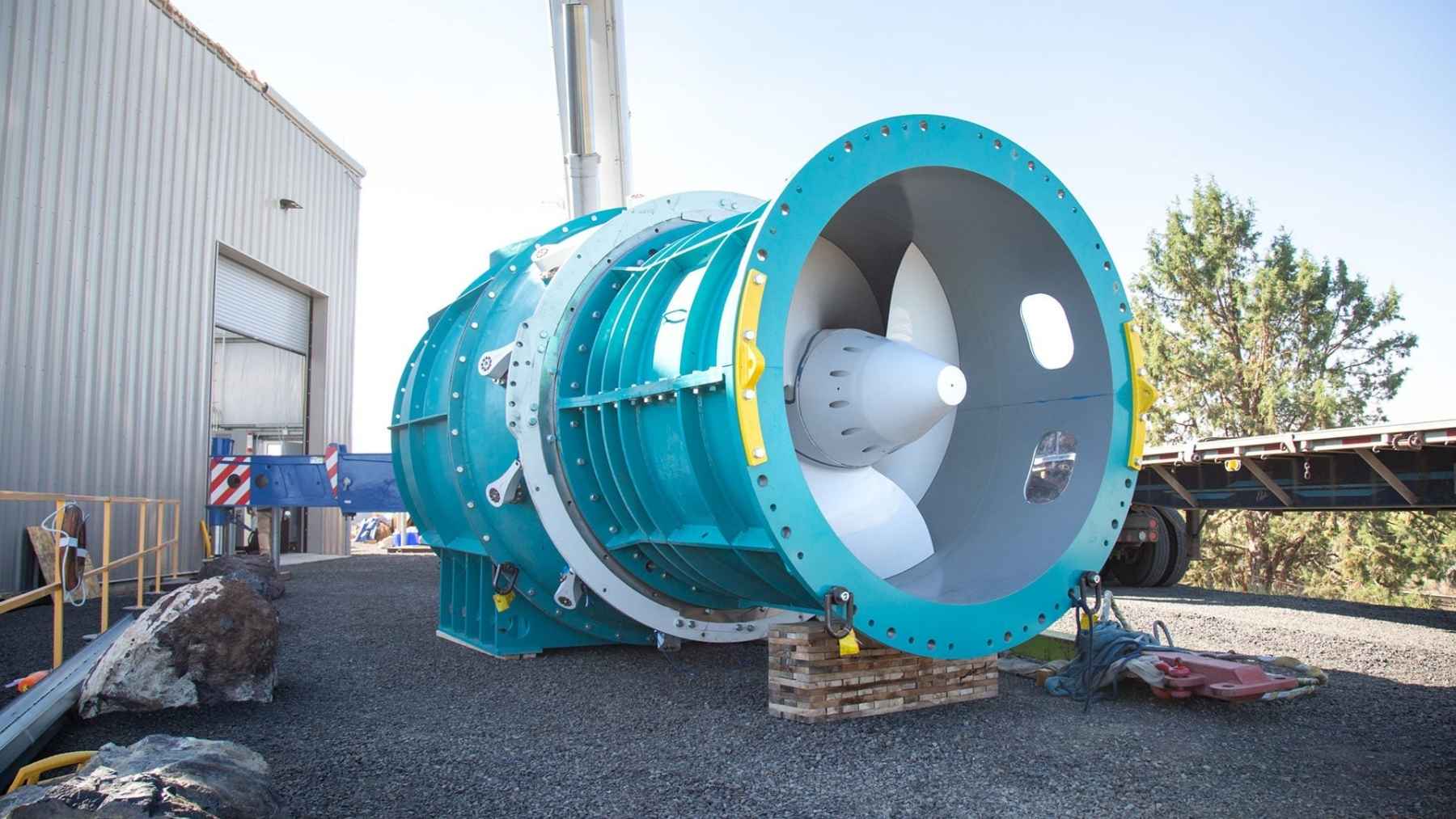
The design is about as clean as fish biology gets. One model-scale turbine. Two interchangeable runners, one with the thin, straight leading edges you would find in any textbook, the other with thick leading edges slanted back from the hub. Matched head, matched shaft speed, five blade tip speeds between 15.0 and 27.6 meters per second, which Natel puts at 33.6 to 61.7 mph.
A third group of 125 fish went through the rig with the turbine bypassed, to establish how many die from the handling alone. Every passage was filmed on high-speed video. The fish were anesthetized going in, then checked for injuries immediately after and again 48 hours later.
Natel’s own announcement of the results puts the practical claim in one line from Sterling Watson, the company’s principal engineer, who says changes to blade shape alone can cut passage risk while matching a conventional turbine’s speed, size and power.
Autonoción Newsletter
No spam. Unsubscribe anytime. Privacy policy (opens in new window)
Conventional runner
42–78%
48-hour survival across five speeds. Roughly a third of all fish tested were severed.
RESHAPED
FishSafe runner
100%
At four of five speeds. 95.6% at the fastest setting tested.
Blade tip speed
33.6–61.7 mph
15.0 to 27.6 m/s, matched across both runners. Blade shape was the only variable.
Sturgeon in the trial
352
112 through the reshaped runner, 115 through the conventional one, 125 controls past the turbine.
The blade shoves instead of slicing
A conventional turbine blade has a thin leading edge that comes off the hub more or less straight out. Hit a fish with that at highway speed and you get what the paper describes, without much euphemism, as severing.
The alternative is to make that edge thick and blunt and rake it backward. A blunt edge pushes a slug of water in front of itself, so the fish gets shoved aside a moment before the metal reaches it. The backward slant handles the rest, turning a square-on hit into a glancing one.
That idea has a paper trail. In 2020, a group including Natel engineers ran rainbow trout through a rig that struck them with 100-millimeter blade analogues. At 10 meters per second, a strike at a 30-degree slant left 98 percent of the fish alive. The same speed at 90 degrees, straight on, left 26.8 percent.
Where the blade lands turns out to matter almost as much as how fast it is going. A 200-millimeter fish struck near the tail survived 68 percent of the time. Struck near the head, 7.9 percent.
The eels go in a real river next
On March 19 a Department of Energy compliance officer signed a categorical exclusion covering the field half of a separate DOE-funded project, this one on American eel. The laboratory half was cleared back in January 2024. What just got approved is the outdoor part.
The site is Garvins Falls in Bow, New Hampshire, an operating hydro plant on the Merrimack River owned by Patriot Hydro, which runs 39 plants across 11 states. Natel has been studying a runner swap there since June 2024.
The temporary hardware listed in the paperwork is unglamorous and very specific. An eel induction system measuring 70 by 29 by 42 inches. An x-ray station needing at least six feet, with fifteen feet of clearance for safety. A swim chamber 164 inches long. All of it goes on a paved parking area beside the plant.
Each eel gets a PIT tag or a balloon tag, drops into the dam intake through the induction system and travels down the old intake into the turbine. The balloon tag floats the animal to the surface downstream so the crew can collect it. Every fish comes out of the water at the end of the run.
Test plan support comes from Pacific Northwest National Laboratory in Richland, Washington, the USGS Silvio O. Conte Anadromous Fish Research Laboratory in Turners Falls, Massachusetts, and Harvard’s Museum of Comparative Zoology. The eels are farmed rather than wild, which is why the project needed no federal permit. It did need one from California, to import American eel into the state.
Utilities are buying this for the screens, not the sturgeon
Nobody replaces a runner because they feel bad about eels. They do it because fine screens and bypass channels cost money twice, once to build and then again in the generation they quietly eat for the rest of the plant’s life.
Natel’s public reference portfolio puts one hard number on that. A 9 MW vertical Kaplan runner replacement somewhere in the northeastern United States lists fish passage savings of $63,290,000. Every other project on the page has that field marked not public.
The sales argument is that a runner swap touches neither the civil works nor the generator, so a plant staring down a relicensing condition can satisfy it by changing the part that spins rather than building something new around the outside. Natel claims 94 to 95 percent peak hydraulic efficiency for its runners, tested to the ASME PTC-18 standard at its own California facility, plus up to 10 percent more output from not bleeding flow into a bypass. Those are company numbers.
So is the wear claim, which is arguably the more interesting one for an operator. In testing to IEC 62364, Natel says the thick leading edges took 78.5 percent less abrasion in sediment-heavy water than conventional blades, and translates that into roughly five times the service life. That comes from a company white paper, not a journal.
Some of the authors work for the company that makes the blade
The declaration of interest in the sturgeon paper is a single sentence, and it says the authors’ declared interest is employment at Natel Energy, a private hydropower turbine company. Watson and Natel co-founder Abe Schneider are on the author list. Ken Zillig and Nann Fangue are UC Davis, which is where the outside eyes come from, and the manuscript went past two anonymous reviewers before it ran.
A few more things belong in the same paragraph as the 100 percent. The turbine was model-scale, not a nine-megawatt machine in a powerhouse. The conventional runner it was measured against was a textbook profile built for the comparison, not a competitor’s product pulled off a shelf. The sturgeon were farmed juveniles, anesthetized, so nothing in the test involved a wild fish trying to swim out of the way.
Blade strike is also not the only way a dam kills fish. At tall dams the pressure change through the machine does plenty of damage on its own, and no amount of blade reshaping touches that.
The operating record is smaller than the reference list makes it look, too. Natel has three FishSafe installations actually generating: 35 kW at a restored mill in Freedom, Maine, 300 kW on an irrigation canal in Culver, Oregon, and 15 kW on a tributary of the River Mur in Austria. The megawatt-scale entries, up to a 27 MW unit in the mid-Atlantic, are design studies. Nothing that big is turning yet.
The finding underneath is about geometry, not about a vendor
Strip the branding off and what is left is a geometry result rather than a product result. Thick and slanted beat thin and radial at the same rpm by a margin that would be embarrassing if anyone had bothered to run the comparison sooner.
The wildlife question follows the hardware wherever it goes, too. It shows up around the 35-kilowatt cross-flow machine sitting on an Alaskan riverbed, around the wave energy sites racking up operating hours in Europe, and offshore, where biologists tracking seals hunting along North Sea wind farms keep finding that animals react to the steel, not to the claims made about it.
The number regulators should be looking at is not the 100 percent. It is the 42. That is the floor a textbook runner produced under controlled conditions, with someone counting. Almost none of the textbook runners still turning in American rivers have ever been measured this way at all.
The Merrimack work will be messier than the lab was, because a river refuses to hold head and rotational speed still while you tally fish. It will also be the first time this blade shape gets graded on an eel that either reaches the ocean or does not, rather than on a survival curve.