
“This is a world in which each of us is essential.”
—Elizabeth Lambert Wood
I think it’s important to recognize our local heroes, to remember their contributions and honor them as our forebears. This should be especially true in our neck of the woods where so many layers of history are piled on top of one another — Native peoples and their cultures, the ambitions and accomplishments of early pioneer families, Lewis and Clark’s endeavors, the stories of fishermen and women, loggers, politicians, writers, and our artists and musicians — they and their stories have accreted over time like the layers of an oyster shell.
Today I want to pull one name out of that mix: Elizabeth Lambert Wood, because she has not been recognized sufficiently as one of our local heroes. Is it because she’s “only a woman?” I don’t know. But I feel as if I’m pulling on a string that was braided decades ago. I’m plucking it out from the weave of time and attempting to put her into a new weave, bringing her closer to our current era in order to seal her memory into those of the next generations of visitors, tourists and locals.
If we agree that our history and the people who made it are important, then how do we honor them and their stories? How do we bring them along with us as we race into the future? Here’s just a little about one remarkable woman who deserves our attention.
Candy’s story
Elizabeth Augusta “Bessie” Lambert Wood was born into a prominent Portland family in 1874 (some records say 1871). She was the last of nine children born in Milwaukie, Oregon, to Joseph and Clementine Lambert. Her father was a notable Oregon civic figure — county commissioner, bank president, and a founder of the Oregon Horticultural Society who developed the Lambert cherry. She married Dr. William L. Wood, a Portland physician, and, though she had all the makings of a wonderful life — a sound mind, a good marriage, wealth and position — it was shaped by tragedy, tragedy that she overcame with grace and charity.
But why should we remember her? Why is she important to us in Pacific County?…because her story is part of our history.
Last week I sat with Candy and Erin Glenn, who welcomed me into their home; it was once the cherished home of Elizabeth Lambert Wood. It was a house that Candy used to walk by on her way to the beach, wondering about the woman who lived there. “I came every summer to Long Beach and I used to walk this white picket fence, but I never saw Mrs. Wood — I never saw anyone here. When I was 14, I met my future husband, Frank, on this same street, on 13th street. He stopped me to talk, and he’d had a history of coming to Mrs. Wood’s house for her ice cream parties. So this whole area is close to my heart.”
“I loved that house,” said Candy. “And when the house came up for sale in 1972 — there was an ad in the Observer — we bought it, and I’ve felt a calling to Elizabeth ever since. You can feel the embrace of her spirit here, her sadness and her love.”
A writer’s life
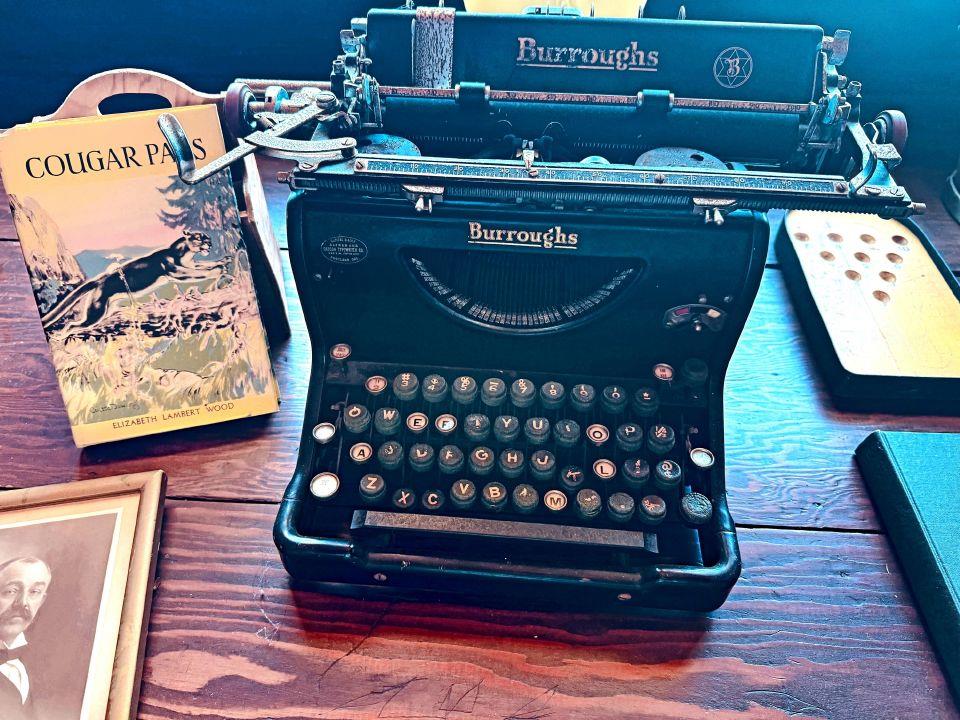
When the Glenns purchased the house, they found it still full of Elizabeth’s things: her furniture, photographs, and many of the books she had written. In fact, her writing room at the tippy top of the three-story house was pretty much as she left it.
Erin, who now owns the home, started our conversation by taking me up to visit Elizabeth’s writing room and library. I was transfixed. Her Burroughs typewriter is still on the desk along with a couple of her books and a marble game.
Elizabeth’s books fill shelf after shelf. They clearly show the eclectic range of her interests and the expanse of her hungry intellect: there was everything from home fix-it books, to health, to a row of international dictionaries. A few examples; A Wanderer in Paris (Lucas); Justice (Galsworthy); Libro Primario (Weiss y Ugarte); two volumes of Mental Efficiency: Common Sense and Perseverance; Course in Foreign Trade, Direct Exporting; Vouza and the Solomon Islands (MacQuarrie and Hector); and an early edition of Fowler’s Modern English Usage (a book still on writers’ book shelves today, mine included).
Tragedy shaped her
Bessie’s husband contracted tuberculosis while studying in Europe so they traveled to the southwest for drier weather and purchased a home in Oracle, 36 miles to the west of Tucson. They would regularly commute between their two homes. (Even after Dr. Wood died, Bessie and her long-time companion, Hulda Foresman, drove south to winter in Oracle, and then would return to spend the summer months in Long Beach.)
Her husband’s death was only the beginning of her troubles. She had two children: Lambert and Helen. Lambert became a Lieutenant in WWI and was killed in Germany on July 18, 1918. (He was awarded the Distinguished Service Cross — second only to the Medal of Honor — and the French Croix de Guerre.) When the marriage of her daughter Helen failed, Bessie took her on a voyage to cheer her up, only to have her commit suicide by jumping overboard. Bessie then adopted Helen’s young son, also named Lambert, who died in WWI in an airplane accident.
Out of this adversity, she developed a special love for young people and was known for her philanthropy. She donated property both in Arizona and in Long Beach. Elizabeth gifted a parcel of property adjacent to the Lone Fir Cemetery that she had hoped would become a park of forest and streams. She donated property for the Presbyterian church and commissioned stained glass windows in honor of her son that are now installed in the church center in Long Beach.
On holidays she had special parties of food and presents for the children in Oracle and was known for her summer ice cream parties for children in Long Beach. She was a prolific author of both short stories, children’s books, essays, and poetry, and contributed to the Ilwaco school library by donating many of her own children’s adventure novels.
Legacy
I cannot give you the full details of her stellar life in these few words. I must bow to historian Sydney Stevens, who knew her and has written about her life and her Long Beach home in much more detail in the pages of the Chinook Observer: “A House Fit for a Bride,” published November 10, 2008; and “A good life overly seasons with tragedy.” And I wrote an earlier column about her in 2017 when I discovered we were making the same winter commute to Oracle (tinyurl.com/3pb9j7nz).
Elizabeth earned well-deserved notoriety in Arizona as well. She often appeared in the pages of the Arizona Daily Star for her history of philanthropy there — particularly her donation of land in Peppersauce Canyon for a boy’s club, just one instance of many gifts to that community. A long entry about her is captured online in a “Garden Home” history site, the neighborhood of her family’s home in Portland (tinyurl.com/sw6u2azz). Many of her books, now collectable, and her biography can be found at Abe Books (tinyurl.com/22yhr645).
So here’s my plea: that we remember — and we could take even take partial credit for — this amazing community booster, mother, author, poet, philanthropist, traveler, horsewoman, intellect, pioneer and lover of youth. She was tempered in the cauldron of the Northwest and emerged as a shining example of caring citizenship.
We should not lose her history, we should spotlight it. She gave so much to us — we should give as little back to her. We need to honor her with a tribute worthy of her remarkable life. She deserves a plaque, a sign, a photo somewhere on our Peninsula. Something people can read and marvel over about a pioneer woman ahead of her time. How ‘bout it, Mayor Sue and commissioners?