
It feels like a mistake, something to trip you up and impede your progress. A glitch is typically understood as something to overcome, but the artists in the Feminist Image Group found a different perspective.
In “Master Glitch,” 29 of the collective’s members have submitted pieces where “glitches are not mere accidents, they represent a resolute commitment to truth,” according to a statement from the organizers. The exhibition, which opens Aug. 7 at the Techne Art Center in Oceanside, with an opening reception from 5 to 8 p.m. Aug. 15, focuses on the cracks in dominant social narratives, and how formerly oppressed and silenced voices can emerge from those fissures to tell another, more honest, story.
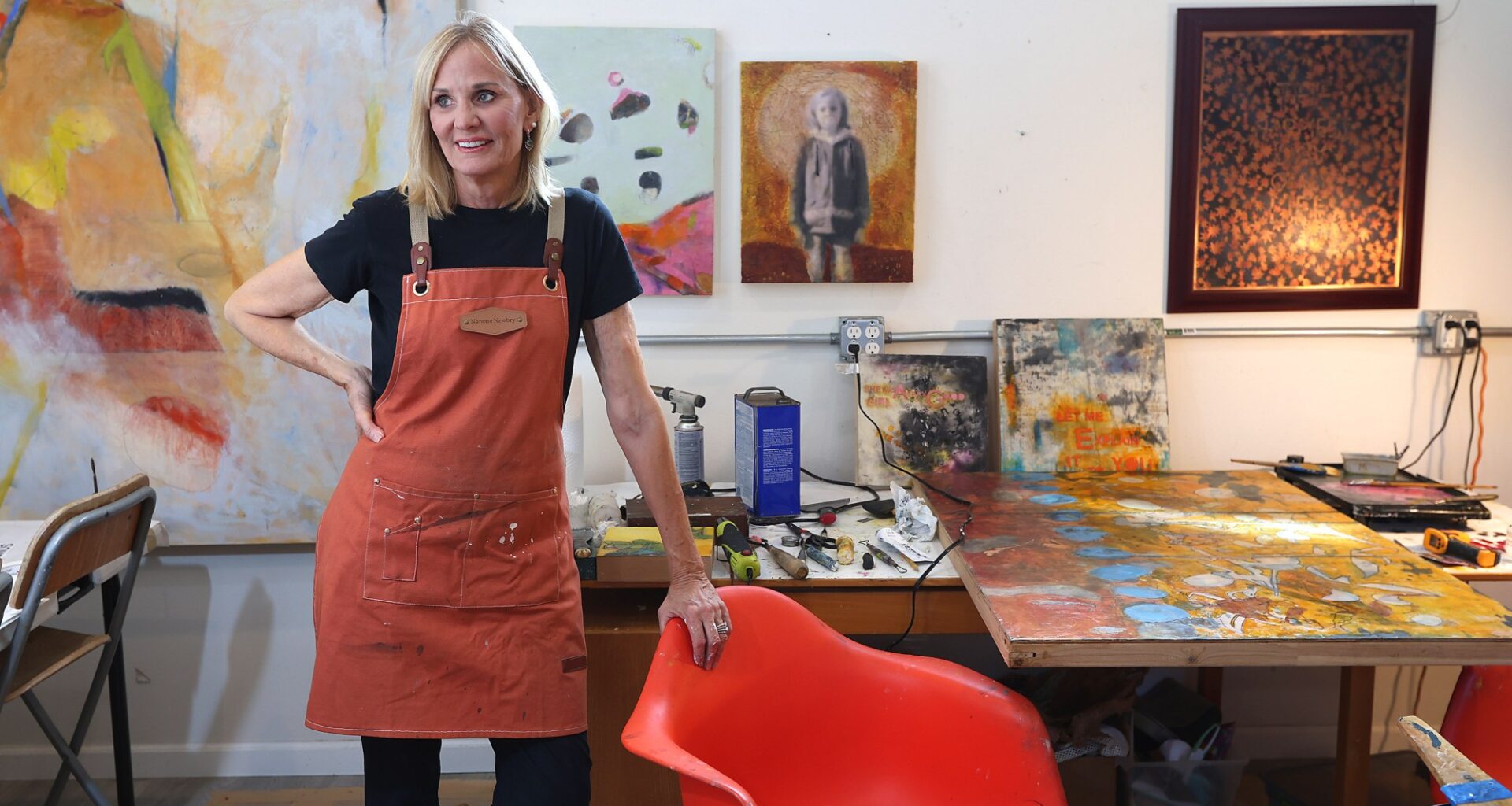
One of the featured artists is Nanette Newbry, co-curator of this exhibition. An encaustic artist who joined FIG about four years ago, she previously ran her own graphic design business for 30 years before becoming a full-time artist, teaching and painting from her studio in Carlsbad for the past 18 years. She took some time to talk about her work, and how “the members of the Feminist Image Group view the glitch as a site of resistance, using art to disrupt the status quo.” (This interview has been edited for length and clarity.)
Q: What is encaustic art?
A: It was formulated by the Greeks in 400 BC, or something like that. It’s beeswax melted with pigment/color and then fused with heat. They were mostly funerial masks that were on mummies, so they would create the person’s likeness. They would wrap the body in linen and then they would paint the likeness of that person on the linen with the beeswax, and then fuse it with heat. That really hasn’t changed over these thousands of years. What has changed is our accessibility to torches that you can plug in; we don’t have to build a fire in our backyard. Most encaustic artists use pre-made pigments, so they have pigment with dammar, which is a binder, and then beeswax.
Q: What is it that appeals to you about this artform?
A: Gosh, a lot of things. I love the smell. A lot of artists that use oil paint say, “I just love the smell of paint,” so I really like the smell of the beeswax. That is a physicality that’s interesting to me. I like the translucency. Most of my works have 10, 15 layers of encaustic and other medium on them, so I like being able to build up texture. It’s kind of my thing. If you think of walking down an old road in Italy or something, you see a wall that has this great patina on it; I’m really drawn to those kinds of textures and the visualization of time passing over a long time.
I just love the texture and how you can simply mold and move the wax around. There are a lot of, not mistakes, but things that happen that really excite me, that I wouldn’t have been able to do without encaustic.
Q: Tell us about what inspired the idea for “Master Glitch.”
A: I had exhibited eight pieces at the Techne Arts Center for a show last year, and one of our main missions is to show our work as a group. I just called them up and said we’d like to put a proposal in for a show. They had this slot in August and September. At first, we wanted to do something on the environment. We were told, “Nobody cares about the environment anymore.” I tend to disagree; we had a group show at Mesa College called “Climate Reckoning” and that was very successful. Anyway, I did some research and came up with “Master Glitch.” We have 150 pieces.
I wanted to get a contemporary theme, something that was current, that touches every one of us. I felt like there’s so much media, and so many silos and echo chambers, that I felt like there’s something there for us to look at. Because we are a coalition of women who look at human rights, who look at society as a whole, at women’s rights, I thought that “Master Glitch” has a lot to do with truth telling. I’m up to my ears with untruth, and it was broad enough for each artist to come to their own interpretation of what that means to them.
Q: As you and your co-curator have been working on this show, what were you looking for in the art you wanted to include? What were you thinking about in terms of the kinds of artists who would be the right fit? The kinds of artwork that would align with the premise of the show?
A: I think that we looked at it differently because we did not want to “curate” what they were going to submit to us. We just asked for 10 pieces that fit the theme. Once we got the work, we went through it and said what works and what doesn’t really work. We had their artist statements, so we read those. Then, if you looked at the work, sometimes we would look at all 10 pieces, and maybe three of those just didn’t seem to fit, so those we excluded.
Lisa Hutton’s work, who deal a lot with the environment. You just look at it and you know what she’s trying to say, but you don’t have to monkey around and try to figure it out. It’s very immediate, plus it’s kind of an Art Nouveau style, so it’s very elegant. The color is great; I’m a big colorist, so I’m really drawn to things that have color. Then there’s Kathy Nida, who does these amazing quilts. They’re large, and we’re going to have about four or five of those in the show. Hers are about feminism and reproductive rights and war, and they’re just stunning. She’s an international award-winning artist, and they’re meticulously created. The craftsmanship is just exquisite. I’m very drawn to craft, to things that are just really, really well executed.
Q: When you say that, “In our culture, master systems have long held sway, promising stability while perpetuating oppression,” can you share a couple of examples of what you mean?
A: I think this system of funding for campaigns, when the Supreme Court basically said that corporations are people, seems totally insane to me. To me, that just really made the playing field so uneven. You could even say something about education. They say, “We’ve got this great public education,” and then they pull all the money out for these private schools and things like that. That, “Oh, it’s going to be great. People are going to have a choice,” and I have a grandson who went through a charter school, and it was just—I probably shouldn’t say it—terrible for him. I guess you can call those master systems of how things get swayed, and promises are made for some sort of improvement and advantage for all, when it does not do that.