
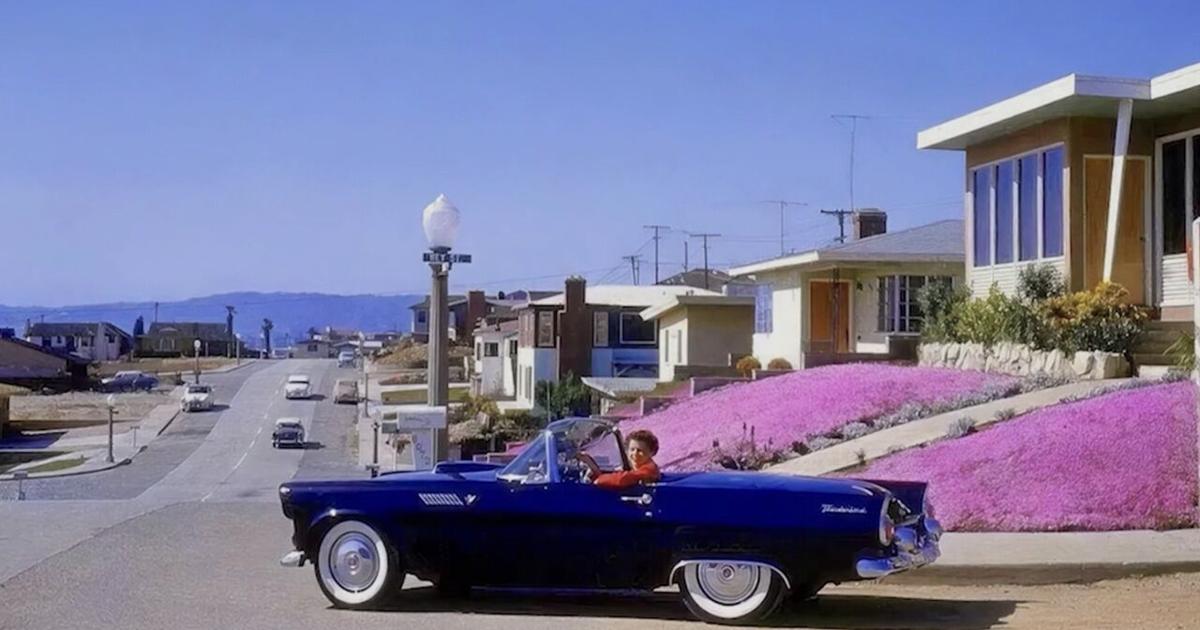
For many travelers who are flying in or out of Los Angeles International Airport, the land surrounding the runways is little more than a blur from an airplane window. A forgotten history of vibrant neighborhoods lies hidden beneath those empty fields and barricaded roads. A place where families once built homes, children played outside until dawn and surfers walked down to the coast.
Filmmaker Kevin K. Williamson’s documentary, “The Price of Progress, LAX and Its Neighbors,” centers on this history. Hosted by the Westchester/Playa Historical Society, the film will be screened on Aug. 15 at Cinemark Playa Vista.
Decades before Williamson ever decided to pick up a camera, the groundwork for this project was already beginning to take shape.
“When I first moved to Los Angeles, I used to ride my bike through Playa del Rey every morning,” Williamson said. “I’d see the Surfridge neighborhood stretched out along Vista Del Mar, and it always fascinated me.”
Williamson’s curiosity only deepened after moving to Westchester in 1999, where he ended up discovering abandoned streets, sidewalks and the remains of residential communities that used to exist right outside the airport’s boundaries.
“I started finding these little ghost towns all over the place,” Williamson said.
The suspension of his television series during the COVID-19 pandemic provided Williamson with the unexpected opportunity to explore the mystery that had long captivated his attention. What started as informal research gradually transformed into a three year documentary project.
By gathering archival photos, aerial views, television broadcasts, and interviews with former residents, Williamson reconstructed the history of communities like Surfridge and East Westchester neighborhoods that vanished as LAX grew into one of the country’s busiest airports.
One discovery that surprised Williamson more than any other.
“The scale of time,” Williamson said. “Some of these people built their dream homes overlooking the ocean and lived in them for only about 10 years before they were told they had to leave.”
Having grown up in a South Hadley, Massachusetts home that is now more than 280 years old, Williamson found it difficult to grasp how an entire community in Southern California could be established and demolished within the span of a single generation.
“I can’t imagine building your dream house and then, 10 years later, being told you have to get out,” Williamson said.
This film also highlights the memories of the residents whose childhoods unfolded beneath the flight paths of an evolving airport.
Many families still recall a time when children would surf after school, hunt for rabbits in neighboring fields and roam the streets until the streetlights came on. They would even race down the massive local sand dunes known as “Thrill Hill” on makeshift cardboard sleds.
These individual narratives, according to Williamson, formed the emotional core of the documentary.
“They described what sounded like paradise,” he said. “Five minutes in one direction and they were surfing. Five minutes the other direction and they were hunting rabbits.”
Although some viewers might expect the documentary to cast LAX as the villain, Williamson explained that the situation is actually far more complex.
“The title is ‘The Price of Progress,’” Williamson said. “It really wasn’t anybody’s fault.”
Instead, Williamson sees the story as a consequence of Los Angeles’ rapid growth, advances in aviation and the difficult choices cities face as they evolve.
“It comes back to people’s need to assign a villain,” Williamson said. “Sometimes something’s just got to give.”
In addition to recording what was lost, Williamson hopes his documentary will inspire viewers to value the frequently ignored history of Southern California.
“Los Angeles has always shocked me in how things just get wiped out and you have no idea they were ever there,” Williamson said.
Williamson points to examples like Pacific Ocean Park, formerly one of the most renowned amusement parks in Southern California, which vanished leaving virtually no physical trace behind.
“If I could do one thing,” he said, “I’d go around town putting up plaques that say, ‘On this spot it is meaningful…’ because there are so many incredible stories people don’t know.”
In the end, Williamson’s hope is that the audience takes away something far deeper than just a respect for local history.
“I say at the end of the movie, ‘This could happen to you,’” Williamson said. “The city will continue to grow and evolve. At some point, you may be asked to get up and get out because that space is needed for something else.”
A screening of “The Price of Progress, LAX and Its Neighbors” followed by a Q&A session with Williamson will take place at Cinemark Playa Vista (12746 W. Jefferson Boulevard, Suite 3190) on Saturday, Aug. 15 from 6 to 8 p.m.
Although tickets for this event are currently sold out, plans for a second screening date are actively underway.