
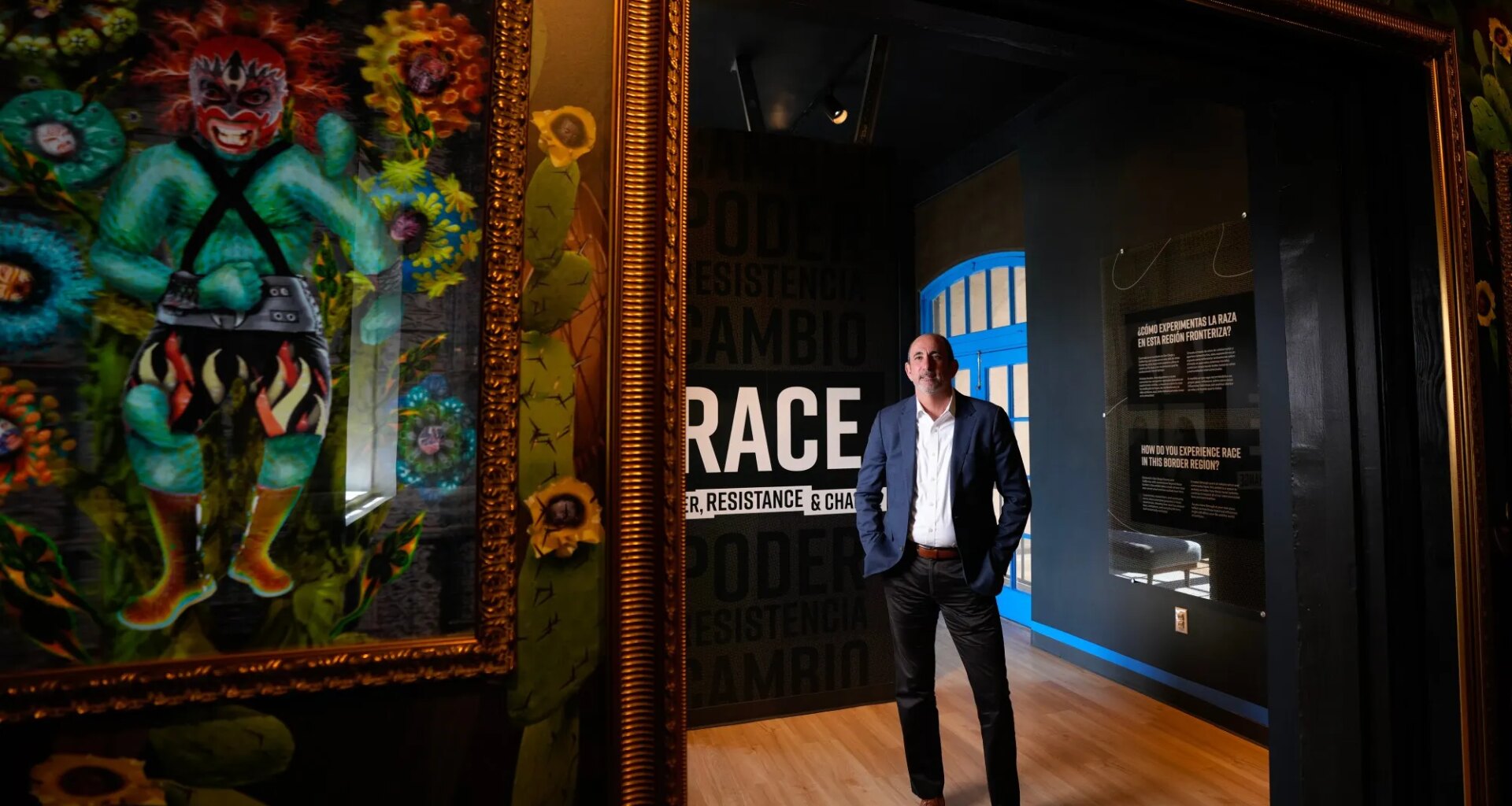
Whenever Micah Parzen is having a bad day, he walks over to the west wing of the Museum of Us and slips into the “Race: Power, Resistance & Change” exhibit. In a quiet corner, he stands still, allowing the museum’s hallowed walls and the weight of history beneath his feet to center and ground him.
In Parzen’s world as CEO of the 111-year-old museum, bad days are allowed, and he often encourages staff members to acknowledge and experience them in their totality.
“First and foremost, we support each other,” Parzen said Thursday during an interview in the mezzanine overlooking the museum’s grand lobby. “We show up for each other. We create conditions where people feel comfortable bringing their whole selves to work — that it’s OK to have a bad day. We all do. We’re all human, right?”
In the years he’s been at the helm of the Museum of Us, good days have outnumbered the bad. Not because Parzen chose to ignore the bad but because he chose to turn the bad into good.
As a leader, “I’m not coming from a fear-based perspective but instead from a loving place. You know, trying to show up for people and support them in ways that are not about you but about them, and really bringing that sort of energy to the work,” Parzen said.
Since 2010, that ethos — grounded in transparency, vulnerability and, well, love — has been the hallmark of his leadership. Today, Parzen’s 16-year run as chief executive officer of the Museum of Us ends. It’s his last day at the Balboa Park cultural institution, whose storied history dates back to 1915, when it was established as the San Diego Museum of Man as part of the Panama-California Exposition.
“Sixteen years is a long time,” Parzen said, “and I’ve always been a believer that organizations need new and fresh leadership that can bring new ideas to the table and take an organization to the next level. I firmly believe that the museum is in such a good place right now that it’s time for somebody with a very different lived experience to help take the leadership helm and take the museum to a place where I would never be able to take it.”
On Sept. 1, he will become executive director of the Phoebe A. Hearst Museum of Anthropology at UC Berkeley, where, he said, “I have an extraordinary opportunity to continue the work of relational repair that we’ve been doing here at the Museum of Us for many years now.”
It’s a bittersweet moment for him and the museum’s staff. But it’s a triumphant exit, too, for the 56-year-old Parzen, who took an institution in distress — financially and operationally — and turned it into a museum now considered to be at the forefront of a decolonization movement that’s transforming cultural institutions across the country — some willingly, others unwillingly.
The Museum of Us falls squarely in the former. For more than a decade now, it has been working diligently to right the wrongs of its past.
Earlier this year, an executive summary outlined everything the museum has done in the last few years. The three-page treatise began: “The Museum of Us (formerly the San Diego Museum of Man) inspires human connections by exploring the human experience — in all of its beauty and its messiness.”
“With our community’s guidance,” it continued, “we’ve transformed an old-school anthropology museum with a legacy of colonial and racist harm into a human-centered museum that builds empathy and healing. We’re a place for everybody now, and especially for those who haven’t been able to tell their own stories from their perspective in museums such as ours.”
 Micah Parzen is leaving the Museum of Us after 16 years to join the Phoebe A. Hearst Museum of Anthropology at UC Berkeley. (Nelvin C. Cepeda / The San Diego Union-Tribune)
‘Failure was not an option’
How the Museum of Us became “a place for everybody” can be traced to the moment Parzen crossed the threshold on Aug. 9, 2010. He was a 40-year-old attorney in downtown San Diego, a partner in the labor and employment division of Luce, Forward, Hamilton & Scripps. Besides a law degree, he had a doctorate in anthropology from Ohio’s Case Western Reserve University, where, for his dissertation, he wrote about therapy programs for Navajo teens. That combination caught the eye of the museum’s board, whose members were looking for someone to reinvent the museum.
From a field of 90 applicants, the board chose Parzen. It was a bold choice: picking someone who’s never worked in a museum before — a move that, Parzen admitted, raised the eyebrows of many in the museum community.
“In many ways, I flipped the script on that,” he said. “Instead of that being a weakness, I turned it into a strength, and the way I did that is I realized that I just didn’t have the baggage that so many others had around me in the field about what a museum should be, who it should be for, how it should be run.”
“And it allowed me to ask sort of the dumb questions about why are we doing things this way, and why are we focusing on this, and why are we prioritizing these things and not these other things, and not be OK with the answer that ‘Well, that’s just how we’ve always done it.’ It allowed me to kind of bring my own sense of creativity and partner with others to do really innovative things.”
“For me failure was not an option,” he said. “I left a lucrative law practice. I was a partner at one of the largest firms in San Diego, and I sacrificed a lot to transition to work that was really aligned with my values and that I thought would feed my soul instead of eat away at my soul.”
When Parzen became CEO, he joined a museum deep in crisis, its finances in tatters and morale at an all-time low. In 2007, missed financial projections forced it to dip deeply into its reserves to the tune of $1 million. Two years later, the executive director was dismissed, a move that shook the board and enraged longtime donors. The firing jeopardized its accreditation with the American Association of Museums.
Those, however, were hardly the only bumps on the road for the museum. For decades, it had been grappling with an elephant in the room: How could it continue being San Diego’s anthropology museum of record knowing that since its inception, it has promulgated what the museum itself called “a legacy of colonial and racist harm”?
Shortly after his arrival, Parzen would take the museum in a direction that would shake the institution even more. And it all started with an exhibit about race.
‘Real turning point’
Six months into his tenure, a canceled exhibit forced the staff to look for a replacement. Parzen had already been “looking desperately for something to begin a process of transformation, not knowing where that would lead, and I saw that there had been a cancellation in the schedule, so we immediately jumped on it.”
“It” was the exhibit “Race: Are We So Different?” The museum’s description called it “an award-winning traveling exhibit about the science of race, how it functions as a cultural construct, and the experience of race and racism in everyday life.” It had previously been at the Abbe Museum in Bar Harbor, Maine, widely recognized for its decolonization efforts.
That exhibition, Parzen said, was “the real turning point.”
“I was walking through the gallery one day, and I saw an older woman sitting on a bench, and I asked her, ‘Did you like the exhibit?’ She said, ‘I love it! My family and I are visiting from Wisconsin. We’ve always been prejudiced against people of color. That’s just how we were raised.’ And then she said, ‘I’m 86 years old now, and I finally get it. Race just doesn’t matter that much. God put people on this earth for the same opportunity, and they should have that opportunity.’”
For Parzen, what came next was an epiphany that would change the trajectory of the museum’s journey.
“It was in that moment that we thought, ‘Wow, we can have this kind of impact by expanding people’s hearts and minds …,” he said. “We thought this is the direction we want to go and even more so.”
To do so, Parzen and the museum’s board and staff would have to do a lot of soul-searching.
“You can’t bring an exhibit about race to the museum … without looking under the hood of your own privilege and how you as an institution have wielded that privilege to harm others and may be continuing to do that unintentionally or unknowingly. And so it really led us to do a deep excavation of really reflecting on who we had harmed as an institution over many years and what that harm had looked like and what might it look like to begin to partner with them in a way that we could start to build up trust anew and engage in that process of relational repair.”
In the aforementioned summary, the museum said that for “more than 90 years, it ‘collected’ tens of thousands of ‘artifacts’ in violent ways, at worst, and through inequitable means, at best.”
To address that, Parzen approached the board and suggested a stunning idea. The museum, in its approach, hurt and damaged many communities, especially those in the Kumeyaay and Luiseño tribes. To repair the harm, Parzen would like to return the “artifacts” back to where they rightfully belonged. That would call for an assessment and possible repatriation of what the museum has identified as more than 75,000 “cultural resources from 185 Indigenous communities throughout the world.”
“The relationships that we had with Indigenous communities were riddled with distrust and anger and frustration,” Parzen said. “They had been coming to this institution and many others like ours and trying to be heard and express what was important to them and asked to be listened to. But it always fell on deaf ears.”
 Micah Parzens is leaving the Museum of Us in Balboa Park after 16 years at the helm. Under his watch, the museum has become one of the leaders in the decolonization movement in American museums. (Nelvin C. Cepeda / The San Diego Union-Tribune)
‘Bless and release’
For Parzen, the time to begin listening had finally arrived. The board had hired him to reinvent the museum, and Parzen proposed steps that he thought would jumpstart that reinvention. His recommendation shook the museum to its core. But, he thought, it was an approach that, if done properly, could have implications beyond Balboa Park.
And indeed it has. The Museum of Us, under Parzen’s leadership, has been hailed as one of the leading institutions on the front lines of decolonization efforts, undoing more than a century of policies and programs that not only promoted but often celebrated the consequences of colonization.
His proposal came at a cost — one that Parzen was more than willing to pay.
“At that time, there was a process we called ‘bless and release’ that, once we had enough critical mass that this was the direction we were going,” he said, “if that’s not something that feels comfortable to you or that you believe in or that aligned with your values, that’s OK. While we will try to share with you why we think this is the right direction, if you need to peel off … we support that and we thank you for your service, we bless and release you.”
“That happened, both on the staff and on the board,” Parzen said. “The work we were doing from a decolonial perspective, particularly back then, conflicted with how many of our team had been trained as museum professionals — you know it’s about the quote unquote artifact at all costs. We don’t call them artifacts anymore, we call them belongings. It was not about honoring the wishes of Indigenous communities. It was about what’s best for, you know, what’s in the museum’s holdings and what’s best for the museum.”
Since that fateful interaction with an 86-year-old woman from Wisconsin, Parzen has led the museum through a remarkable transformation, both inside and outside its walls.
“Over time … we began reflecting on how it must feel to have your sacred family belongings — stolen from or otherwise given up by you under duress — locked in a glass case for others to gawk at, accompanied by ill-informed stories that you had no part in telling,” the museum declared in its treatise. “We knew we had to do better.”
Under his watch, in 2020, the museum rolled out a rebranding campaign that went well beyond changing its name from San Diego Museum of Man to the Museum of Us, a move that it says was a way to reflect “both the museum’s anti-racist and decolonial journey as well as its aspiration to become a museum that is truly for all of us.”
The renaming wasn’t just a cosmetic change, though. It was part of a larger strategic plan to truly reimagine what it means to be an anthropological institution in modern America.
Over the years, the museum outlined a litany of policy and philosophical changes, all laid out under the “Decolonizing Initiatives” section of its website. In it, the museum said it recognizes “that our mission can only authentically be fulfilled through a decolonial process that centers around truthfulness, accountability and reconciliation. … The heart of our decolonizing initiatives work is to acknowledge and redress the ways that our museum participated in the colonial enterprise, both intentionally and unintentionally.”
In 2018, it launched its Colonial Pathways Policy, in large part “a commitment to return any cultural resource acquired from an Indigenous community by way of a colonial pathway back to its rightful home.”
Internally, it revisited its staff pay structure, making it more equitable. It rebuilt its board of trustees “to better reflect our community and vision,” with 52% of the board composed of people of color. And last year, it launched The Homeward Project, described as an “enhanced commitment to audit all cultural materials in our care and support community-led decisions about their future return, stewardship or display.”
Taken piecemeal, a policy change here and there may seem inconsequential. Viewed in its totality, the changes are radical — a museum more than a century old basically flipping everything on its head and making a very public pivot, for the better, all in real time.
No one’s been more impressed with how it all unfolded than Ileana Ovalle, the outgoing chair of the museum’s board of trustees.
“Micah led us through a transformation that has positioned the museum remarkably for the future,” said Ovalle, chief strategy and governance officer at the Qualcomm Institute at UC San Diego and also the first woman of color to chair the museum’s board in its 111-year history. “Under Micah, the museum shifted away from collecting and exhibiting objects from around the world. Today, we engage local and global communities so they can tell their own stories, in their own voice.”
“Our board, staff and donors are aligned to carry our mission forward: to inspire human connections by exploring the human experience. This is the heart and legacy Micah leaves behind and one we will carry forward. Needed now more than ever.”
That legacy is the result of much self-reflection on Parzen’s part.
“It took a lot of work, personal work, particularly in terms of me being a very privileged White male and having walked through the world and in the world in a certain way in my whole life to understand my own privilege and how I’ve wielded that privilege in ways that at times has been harmful to others,” he said.
Part of the work is “cultivating a garden of sorts where the alchemy is just right and others can really come together and thrive both individually and collectively in service of really meaningful work.”
For Parzen, the journey may be ending at the Museum of Us today, but the decolonization work will continue 510 miles north of San Diego at UC Berkeley, where more than 3.5 million items are waiting to be analyzed and, if necessary, repatriated.
But before that work, he has a couple of things in his office left to pack up: the framed David Bowie print he bought from the San Diego Art Institute next door after the singer died in 2016 and a big metal arrow emblazoned with the words “All You Need Is Love.” It was a gift from a trustee many years ago, but today, of all days, it holds deeper meaning.
In Parzen’s world, empathy and understanding go a long way, but in the end, “people who know me would probably anticipate what I would say … that all you really need is love. I get teary-eyed just saying that.”
“I know that you can’t just talk about the lovely, wonderful daisy-making, Pollyanna aspects of love, you have to also delve into the darker side, the shadow side, both as an individual and as an organization, and you have to hold a space for all of that to exist simultaneously because two things and more can be true. When you do all that in a sort of container of love, all things are possible.”