
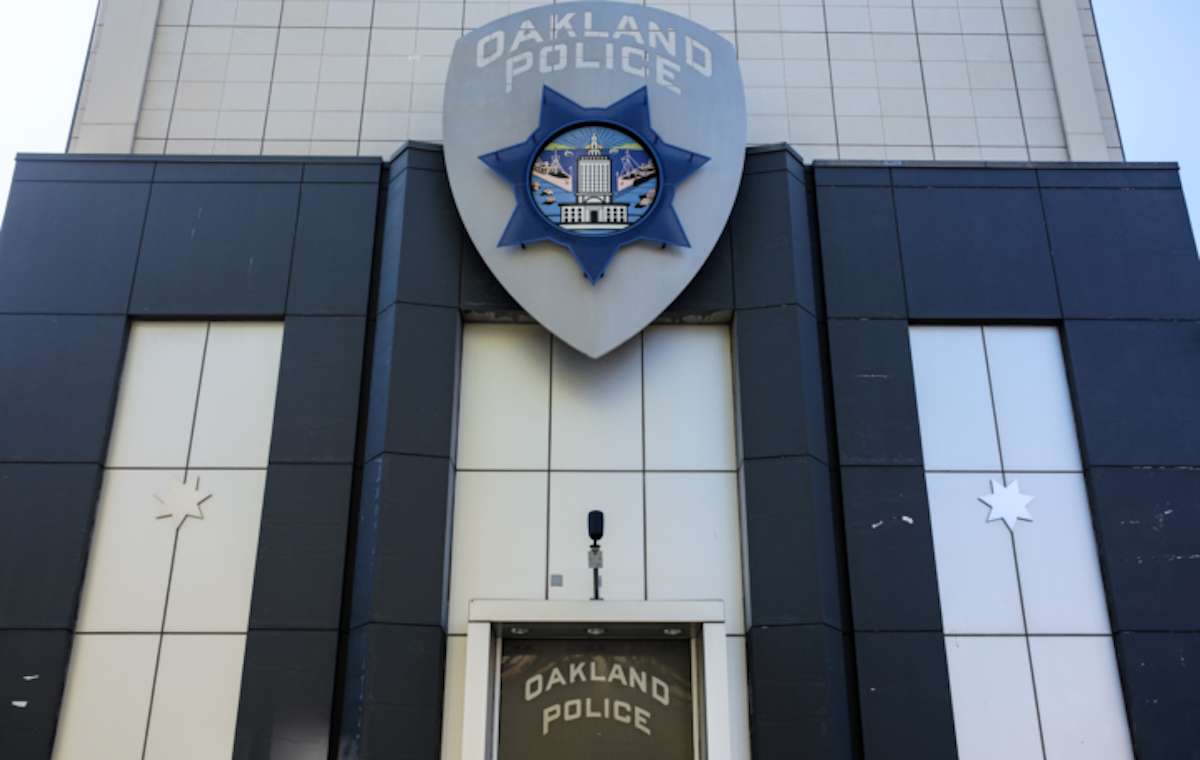
The Oakland police are facing a new public records lawsuit.
On Monday, Robbie Powelson, a homeless advocate, filed a lawsuit in state court alleging OPD violated the Public Records Act by refusing to disclose information about a recent fatal police shooting.
Two OPD officers shot and killed a man on July 13 near 40th Avenue and International Boulevard. The police department has kept a tight lid on the case since then, releasing few details.
Powelson accused OPD of “showing contempt for the rule of law by withholding records without justification.”
The department did not respond to questions from The Oaklandside about Powelson’s lawsuit or the shooting. The city attorney also did not immediately respond to a request for more information.
Six days after the shooting, Powelson filed a public records request with OPD asking for a wide range of records, including incident reports, photos, videos, and witness statements. Powelson also asked for policies, general orders, and training materials that generally govern how OPD officers are supposed to use deadly force.
The Public Records Act, a decades-old state law that provides the public with access to government information, gives cities 10 days to respond to a request.
OPD responded in nine days to Powelson, on July 28, with a blanket denial, telling him that all of the records he is seeking are “currently part of an active investigation” and therefore don’t have to be made public.
Powelson said he believes the department’s response falls short of the law in several respects. The justification of not handing over records because there’s an “active investigation” contradicts the law’s requirements, he said.
“If there’s an investigation, the department has to set forth records and facts about why there’s a public interest in withholding records,” he said. “Their response doesn’t do that.”
The department’s response, visible to everyone on the city’s public records portal, is a terse three sentences, stating the internal affairs case number for the shooting investigation and explaining, in the department’s view, that “At this time, there are no responsive, disclosable records.”
One key piece of information the department has repeatedly refused to make public is the name of the man who was killed.
When The Oaklandside asked OPD to identify the deceased man, the department responded on July 28, “We are not releasing the individual’s information until we notify next of kin.”
The county coroner’s office, which helps investigate police shootings and is under the authority of the sheriff, has also refused to identify the man. A technician with the coroner’s office told The Oaklandside last week that there is a “press hold” on the case and declined to provide further information.
Powelson said part of the reason he’s suing OPD for records in this case is that the person who was shot appears to have been homeless.
“When you’re dealing with people who are unhoused, by the police withholding that information, it’s almost menacing,” said Powelson. “So many people unhoused have been ostracized and alienated, and it’s hard to find their loved ones and next of kin.”
What’s known about the shooting
According to the police, CHP officers attempted to stop a man near a homeless camp in Fruitvale on July 13 around 2 p.m. The man fled, and CHP called OPD to help find him. According to OPD, when they located the man near 40th and International, he was holding “dangerous weapons.” Some media outlets, citing OPD, described the weapon as a knife or “bladed weapons.” In a statement after the shooting, OPD Chief James Beere said officers attempted to de-escalate the situation, but the man “attacked” them. The officers responded with less-lethal and lethal force.
When interviewed the day of the shooting, Beere declined to provide details about the incident, saying he didn’t want to prejudice the statements the police officers would give about the shooting when they’re interviewed by homicide investigators and internal affairs.
Some community members and advocates, including the Anti Police-Terror Project, have protested outside OPD headquarters, saying the police haven’t provided enough information to the public about the shooting. A vigil was also held on July 18 where activists criticized OPD for withholding records.
OPD said in a statement on social media last week that they plan to allow the public to see a “contextual critical incident video and supporting audio and video” related to the shooting before the end of August.
Under the state law known as AB 748, police are required to allow the public to obtain copies of and view videos of “critical incidents,” which include police shootings, no later than 45 days after the incident took place.
Oakland police initially refused to hand over video of former NFL player Doug Martin’s death during an October incident in which he was detained by several officers. But OPD changed its mind in March, releasing portions of body camera video. Martin’s family filed a wrongful death lawsuit against the city in June.
Oakland has faced several lawsuits over its violations of the Public Records Act in recent years. Six years ago, a group of investigative journalists sued the Oakland police for failing to hand over public records. To settle the case, Oakland agreed to a list of reforms and paid $127,000 in attorneys’ fees, but the attorney for the journalists has recently said OPD is violating this agreement.
Last year, the city settled a lawsuit by the Alameda County Taxpayers Association and attorney Marleen Sacks that included allegations Oakland violated the Public Records Act. And earlier in 2025, Oakland settled a separate lawsuit by Sacks, also over alleged violations of state transparency laws. (Oaklandside News Editor Darwin BondGraham also was a party to a lawsuit against Oakland and won a court ruling in 2021, forcing the city to disclose decades of police misconduct records.)
Roselyn Romero contributed reporting to this story.
“*” indicates required fields