
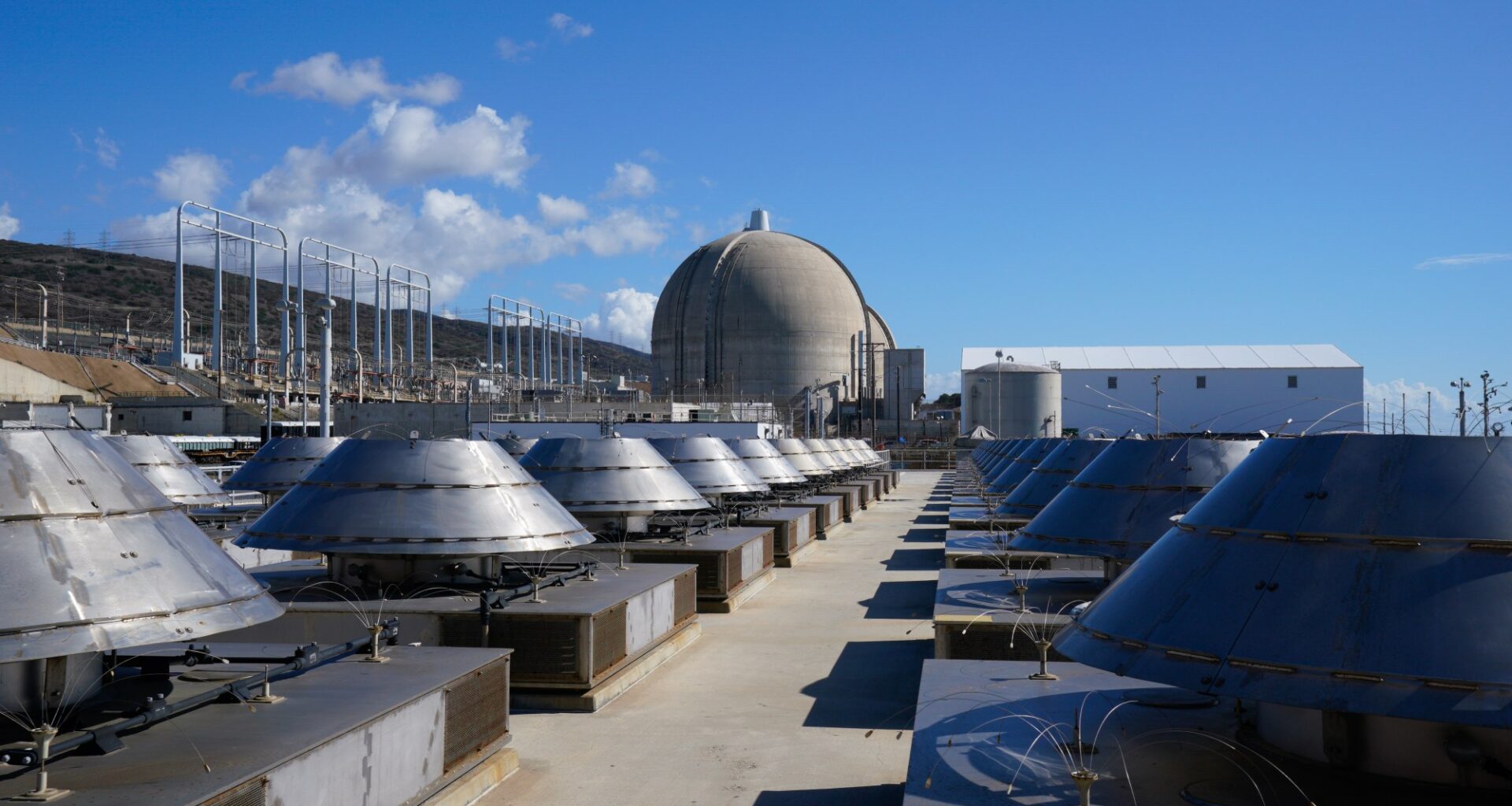
Leadership at Southern California Edison’s Community Engagement Panel is hopeful that last week’s announcement that five states will consider hosting “nuclear campuses” may eventually lead to the removal of the 3.55 million pounds of nuclear waste at the San Onofre Nuclear Generating Station.
“We’re cautiously optimistic that there’s a potential light on the horizon,” panel chairman Dan Stetson said.
Utah, Tennessee, Oklahoma, Louisiana and Idaho have signed memorandums of understanding with the U.S. Department of Energy to strengthen and modernize what’s called the nation’s “full nuclear fuel lifecycle” — which includes a disposal site for the spent nuclear fuel rods and other debris.
The radioactive waste at San Onofre is stored in more than 120 stainless steel canisters at the now-shuttered generation station, known as SONGS, because the federal government has yet to find a permanent repository to send it.
It’s the same case for the more than 95,000 metric tons of spent nuclear fuel that has piled up at nuclear power plants across the country.
Originally, Yucca Mountain in Nevada had been slated as a permanent site to take the waste. But in 2010 the Obama administration cut off funding for Yucca, following years of protests from lawmakers in the Silver State who had long opposed it.
The Department of Energy said it received 28 applications from 26 states that expressed interest in hosting Nuclear Lifecycle Innovation Campuses before DOE winnowed the field to five states last week.
“These campuses will be massive generators of economic growth, create thousands of high-paying jobs, and be crucial to unleashing America’s nuclear renaissance, Energy Secretary Chris Wright said.
DOE touts the proposed innovation campuses as having the potential to attract up to $50 billion in capital investment, generate as much as $10 billion in state and local tax revenue, and create nearly 25,000 jobs.
The campuses look to host advanced reactor deployment, power generation and co-located data centers — topics that have gained attention due to anticipated growth in electricity demand to meet the needs of artificial intelligence.
The potential sites would also explore reprocessing and/or recycling spent fuel so that it could be used again in reactors.
While it remains unclear what will come from the agreements with the five states, the announcement may indicate that progress — however tentative and glacial — is being made toward ending the nuclear storage stalemate that has persisted for decades in the U.S.
“I think overall, the message is that it’s great that the administration is taking a look at the problem of spent nuclear fuel,” Stetson said.
Rep. Mike Levin, D-San Juan Capistrano, applauded the selection of potential nuclear innovation campuses, saying the news “is a monumental step in the right direction … for the first time, states are raising their hands.”
At the same time, Levin said there’s plenty of work to do.
“The hard part is still ahead of us,” he said last week. “The federal government has a bad track record on nuclear waste and has not kept its promises to communities for many decades.”
Levin has been a leading voice on Capitol Hill on nuclear disposal issues and pushed for legislation that would give priority to move spent fuel from reactors that are no longer active and located in areas that could pose risks to public safety.
Since SONGS is located just yards from the Pacific Ocean and in a region with a history of earthquakes, the waste at San Onofre would meet the criteria.
“Any development of new nuclear energy hinges on our country having a workable answer to the spent nuclear fuel challenge,” Levin said.
But while the five states may express interest in developing nuclear in general, it appears to be an open question about their respective appetites for storing the legacy stockpile of waste and for how long — and whether the states receive financial compensation from the federal government for doing so.
Cally Younger, administrator of the Idaho Office of Species, Mineral and Energy Coordination, told the Idaho Statesman the Gem State is unlikely to accept a deal that only brought jobs and tax revenue if it meant storing spent fuel in perpetuity.
“That’s great, and that’s what got us to apply,” Younger said of the potential economic boost, “but if we’re really talking about permanent storage, they’re going to have to pay.”
Stetson said a representative from the Department of Energy will discuss projects dealing with nuclear waste at the next meeting of the SONGS Community Engagement Panel.
The discussion is open to the public and will be held via Microsoft Teams on Aug. 27 from 2 p.m. until 4:30 p.m. The link can be found at songscommunity.com/community-engagement/meetings/cep-regular-meeting-department-of-energy-used-nuclear-fuel-project-updates.
Southern California Edison operates SONGS, which stopped producing electricity after a leak in a steam generator in 2012 led to the plant’s closure. The facility is in the midst of an eight-year dismantlement project.
But until the federal government finds a place to take the 3.55 million pounds of spent fuel, the waste sits at a pair of dry storage facilities on the north end of SONGS.
One storage facility contains 73 stainless steel canisters containing spent fuel that have been lowered into vertical cavities. The other holds 50 canisters that are stacked horizontally.
Another 13 canisters of material from the dismantlement that are classified as greater than Class C waste sit in the horizontal storage site.
The canisters rest a little more than 100 feet from the Pacific, protected by a seawall.