
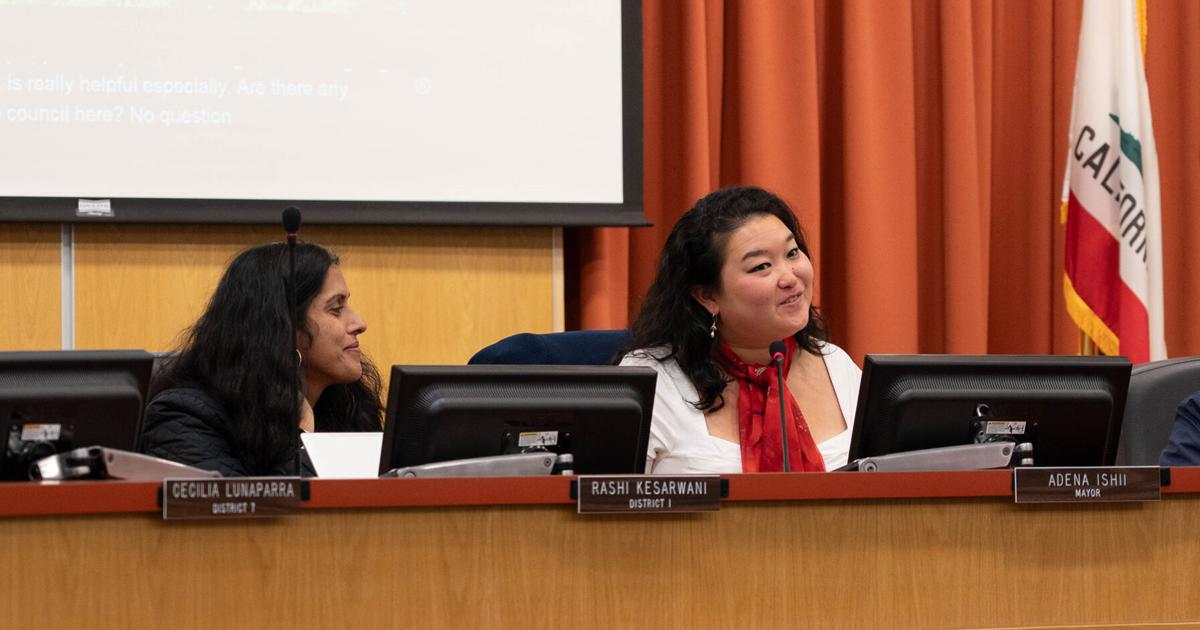
Berkeley City Council entered its regular summer recess following last week’s meeting, capping off a legislative season marked by budget cuts and deregulation of the Berkeley Police Department which may leave city residents — especially its most vulnerable ones — more dependent on BPD.
“There’s also a lot that I’m worried about and that I’m hopeful for in the future,” said District 7 Councilmember Cecilia Lunaparra. “There’s a lot of uncertainty in the future.”
In May, Lunaparra was among a group of council members pushing back against a planned expansion of the city’s contract with controversial surveillance company Flock Safety.
A leaked memo from the city attorney’s office — first reported by The Daily Californian — revealed severe legal risks for the city in contracting with Flock, whose automated license plate reader systems could violate city, state and federal data sharing restrictions according to the memo.
The Flock vote was one of a number of recent moves by council apparently aimed at empowering the city’s police this summer.
The city is now seeking bids from other vendors for a host of new police technologies estimated to cost $2.4 million, according to a June 30 City Council report.
“I trust our police to follow their own rules,” said District 5 Councilmember Shoshana O’Keefe before council June 30. “I have to because we let them have guns. If our police didn’t follow their own rules we’d have a much bigger problem but they do.”
During its budgetary cycle, which saw the city contend with a crippling $30 million deficit, council however approved cuts to police staffing, just as they did for a number of other city departments.
As part of its staffing reductions, the city reduced its communications staff to just one person responsible for answering to the media, which city staff say will weaken communication in times of crisis.
Council members presented these cuts as an unfortunate necessity, a reckoning with decades of over-reliance on one-time funding sources and self-described poor budgeting practices.
“We all remember a time when the city could do all kinds of amazing things,” said District 2 Councilmember Terry Taplin in council’s May 19 meeting. “I think we did that as long as we could in a way that we are now being confronted with needing to figure out a way not just to keep what we have but to return to doing more.”
Council members have banked their hopes to address the current deficit on the passage of a 0.5% sales tax increase referendum during the November election. If that measure fails, more positions could face cuts, according to a city budget document.
Council also slashed the city manager’s DEI office, proposed shuttering Fire Station 4 if the sales and use tax measure fails and eliminated the Mobile Crisis Team, which handled mental health emergencies. In addition, council closed the winter shelter program and cut funding for the STAIR Center, a navigation center and shelter in West Berkeley.
“As it pertains to our work addressing homelessness, when you look at the totality of work that we do, we’re proposing very limited reductions here,” Deputy City Manager David White said in April. “So really, the effort was to try to preserve as much as we can.”
The cuts leave services for some of the city’s most vulnerable residents reduced and shift the burden of psychiatric emergencies and wellness checks to the police in what Director of Health, Housing, and Community Services Scott Gilman described in June as an “unintended consequence.”
Council hopes that the county will step in to alleviate those lost services. In an email, District 4 Councilmember Igor Tregub said the city is in continuous conversation with regional partners and Alameda County supervisors about opportunities to restore local or regional funding for crisis response services.
Asked whether that shift would strain BPD or increase its costs of operating, BPD Public Information Officer Byron White said in an email, “It is difficult to know what the true long-term effects will be from the loss of the Mobile Crisis Team.”
Council has signaled support for the police in other ways, voting in recent months to loosen restrictions on K-9 and helicopter deployments and peel back pepper spray reporting requirements. It was scheduled to vote on possible reintroduction of tear gas use, which was banned after the 2020 Black Lives Matter protests, but the vote was pushed to a later date due to public outrage.
“I have become concerned about items that collectively may contribute to the militarization of law enforcement,” Tregub said, who voted against the K-9 and helicopter items, in his email.
At the same time, the city has filled all positions on its beleaguered Police Accountability Board following three recent appointments.
In its most recent annual report, the board found that BPD disagreed with all findings of “sustained” misconduct over the past year. The former director of the PAB, Hansel Aguilar, is suing the city for allegedly retaliating against him and dismissing him for his investigations into misconduct.
“This is a little cliche but we had a big moment of reckoning with how we deal with law enforcement and social justice half a decade ago and it is really disheartening to see the political winds having shifted,” Lunaparra said in her interview. “I think it is insane for this to be our local response.”
Lunaparra added that she sees affordability as the largest issue still facing the city.
All other council members and the mayor did not provide comment.