
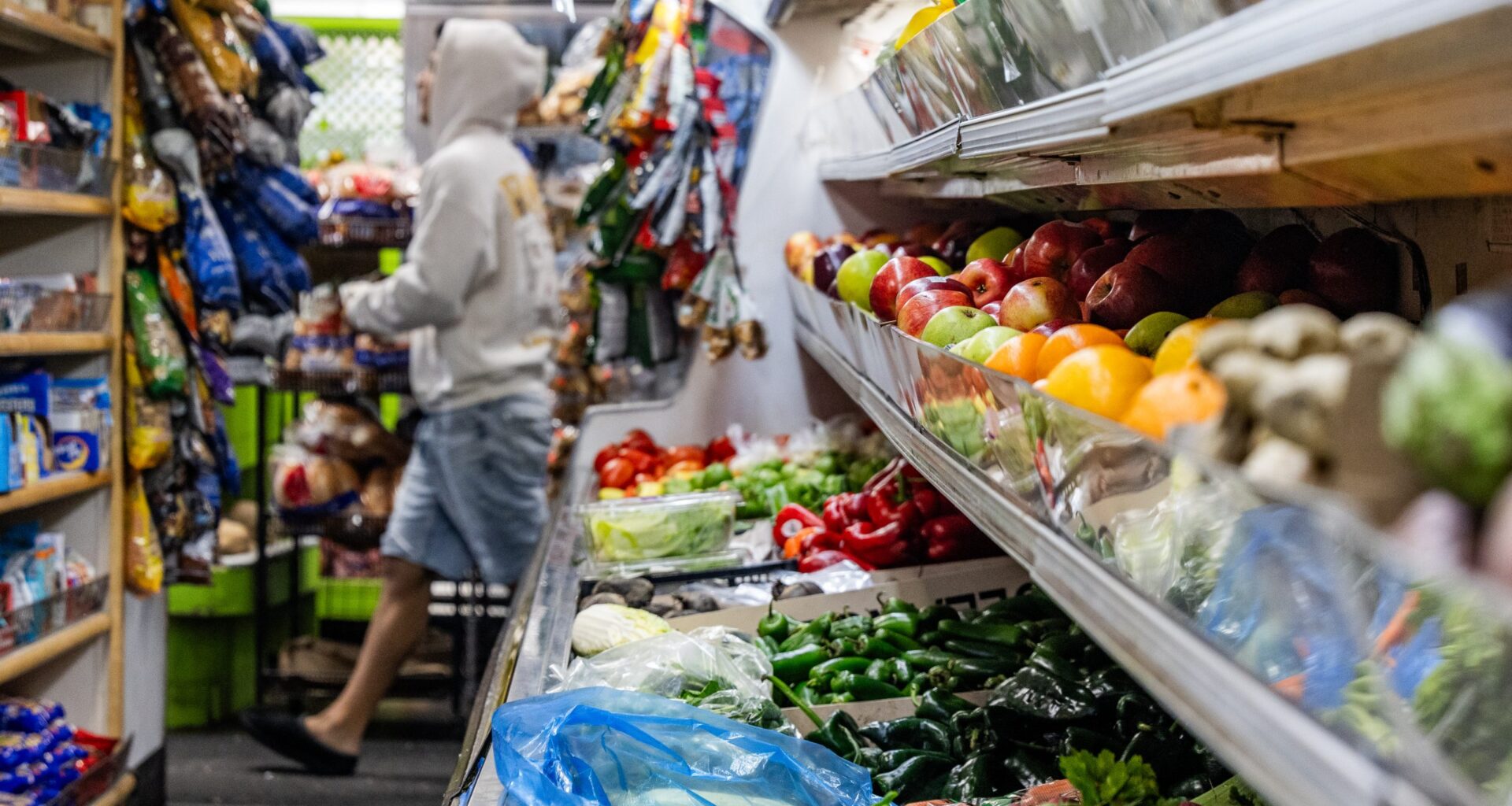
Supervisor Bilal Mahmood has a plan to use the Tenderloin’s 70 corner stores to start selling healthy food, but it’s unclear if the storekeepers are on board.
Few would dispute Mahmood’s description of the Tenderloin – home to some 3,500 children – as a place where its ubiquitous corner stores mostly sell “junk food, liquor and processed food.” But as Kris Lynn, owner of Noors Snacks on the corner of Hyde and Ellis Street, said, “you need to sell tobacco and alcohol to survive here.”
Even if merchants wanted to improve their offerings, they note, the Tenderloin’s low-income customer base already has other options, including a network of food banks where residents can pick up free produce and other staples and a twice-a-week farmer’s market at Civic Center with competitive prices.
Mahmood’s plan for participating stores – introduced at the Board of Supervisors in late July – would revive a short-lived corner store conversion program in 2016 known as Healthy Retail SF, which aimed to reduce alcohol and tobacco to 20 percent of merchants’ sales and increase the space for fresh produce to 35 percent.
The pilot program converted 10 stores citywide, including five in the Tenderloin. The city paid roughly $25,000 to cover part of each store’s physical upgrades and design services; Mahmood said he plans to increase that sum to adjust for inflation.
“Food prices have obviously gone up. Infrastructure costs have gone up. So we’ll be making assessments as we move forward,” Mahmood said last week about his draft request to resurrect the program.
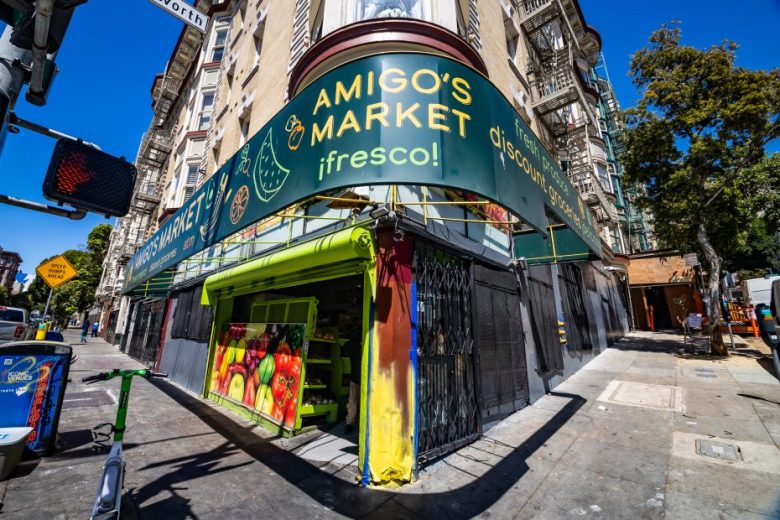 The exterior of Amigo’s Market, one of the corner stores partnered with Healthy Retail SF, on July 28, 2026. Photo by Zoe Malen.
But even with that help, some owners said adding produce doesn’t pencil out or fails to make sense for other reasons.
Lynn, for example, said she already stocks basics like lemons, limes, and bananas so that the store can qualify to accept EBT customers. But the produce often goes bad before anybody buys it.
Rafeek Algahim who runs El Dorado Market at 124 Jones St, said his customer base is largely unhoused residents. And, like many corner stores, space is limited.
“I’m not saying it wouldn’t work… But the store is small, so it’s hard to imagine where I would fit fruits and vegetables in,” said Algahim. Moreover, he added, buying produce in small quantities makes it hard to price competitively.
Other storekeepers agree. A 2018 UC Berkeley study of Tenderloin merchants who declined to join the city’s first effort in 2016 found, while most weren’t opposed to its goals, they doubted it would work for them.
Of 17 non-participating merchants interviewed for the study, 11 said they weren’t interested, citing failed past attempts to sell healthier products, doubts about customer demand, and fear that meeting the program’s requirements would hurt their bottom line. Cigarettes and liquor make money; vegetables often don’t.
Several owners described losing money on produce that went bad for lack of demand. “I buy $15 bags of [produce] and sell maybe 2-3 pieces and put the rest in the garbage,” one owner said.
Another owner pointed to price as a major issue for customers. “Tenderloin residents barely have money to pay for rent, let alone healthy food,” one said, noting that a Little Debbie snack cake costs under a dollar.
Lynn agreed: Little Debbie snacks, she said, are by far her most popular item.
Whole Foods, the last full-service grocery store near the Tenderloin, closed in 2023 after little more than a year. Another, Cala Foods, closed in 2011. Other full-service grocery stores that survive – Trader Joe’s and Safeway – are on the periphery of the Tenderloin.
Still, for the four stores that did opt into the program in 2016, the program has worked well. Dalda’s Community Market on 18 Eddy St., for example, has fresh fruit like apples, melons, and oranges, and holds shelf staples like brown rice, low-sodium canned soup, and fat-free salad dressings– Tenderloin shelf rarities.
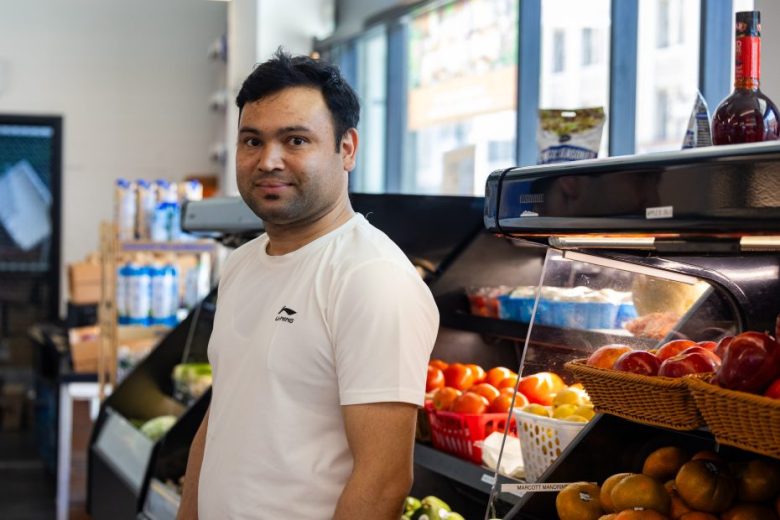 Gopal, employee at Dalda’s Community Market on July 28, 2026. Photo by Zoe Malen.
Stores that completed the program, according to the 2018 study, saw produce climb from 6% to 12% of total sales, and sold an average of 21,000 additional units of produce over three years.
Fadhl Radman’s Radman’s Market, on Turk Street, is one of the program’s early success stories, opening with vegetables for sale in August 2017. On a recent weekday, shelves that once mostly held packaged snacks and candy, now carry parsley, carrots, and peppers. It wasn’t as extensive as a grocery store, but also offered some protein like bacon and sausage, and dairy products like cheese and milk.
He said the store had a healthier atmosphere, too. “When families walk in here, they feel like they can let their children roam freely. And they can mind their own business, pick their fresh vegetables and stuff,” Radman said. He had never sold tobacco and alcohol, so his store’s income and customer make-up were unaffected.
Satwinder Multani, owner of Dalda’s Community Market, said partnering with the Healthy Retail Program forced him to modify his sales of alcohol; shot-sized and pint bottles are out. Multani said he made up the loss through the increase in fresh produce sales. “You also need to make sacrifices like this for the sake of the community, not just legislation,” he said.
“The data shows that with investment, these companies and storefronts have been profitable since… It’s a very high return on investment for both the store and the community,” Mahmood said.
Even so, merchants in the study expressed a deep skepticism that no amount of shelving or refrigeration can fix a customer base that can’t reliably afford or want the product.
“Every store has a niche. There’s a store down the street that has the cheapest beer in the neighborhood, and if you want produce, you go to Amigo’s,” Lynn said, referring to one of the stores already signed up with the Healthy Retail Program. “Why would I want to compete with someone who already has a customer base for what they sell?”
There’s also Start & Save Market on 4015 Eddy St. that sells mostly meat products.
For now, families and others in search of fresh fruit and vegetables outside the Healthy Retail Program also use the farmer’s market at Civic Center on Wednesdays and Saturdays. Those facing food insecurity can visit one of the free daily food giveaways at GLIDE memorial church, or one of the nearby neighborhood food pantries in partnership with the SF Marin Foodbank.
The latter was a feature that several merchants pointed to in the 2018 study. “Why would people buy produce from us if they can get it for free?” asked one store owner. Another agreed: “not enough people buy [fresh produce] here because they get them at [a local church].”
San Francisco isn’t alone in trying this approach. As of 2016, 11 states and Washington, D.C. had enacted healthy food retail legislation, with California, Oklahoma, and D.C. specifically including provisions for convenience stores.
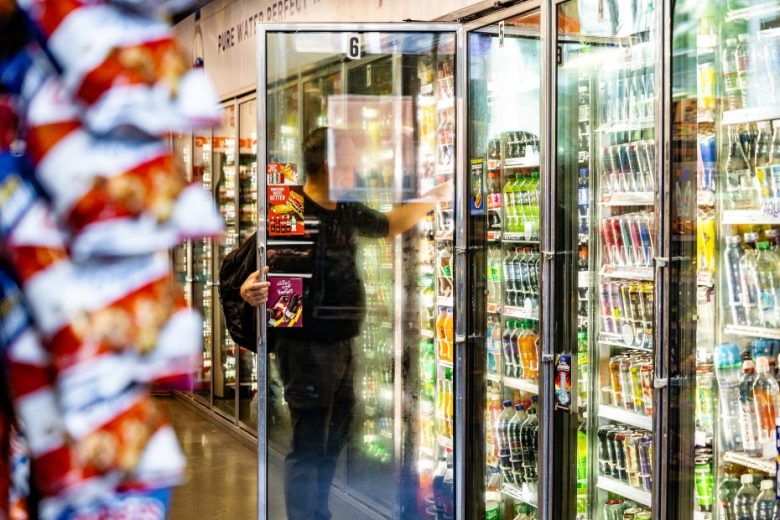 A customer shops in Dalda’s Community Market on July 28, 2026. Photo by Zoe Malen.
The most established model is in Philadelphia, where the nonprofit Food Trust launched its Healthy Corner Store Initiative as a pilot in 2004 and folded it into the city’s Department of Public Health a few years later, expanding it rapidly citywide.
A study of Philadelphia’s program found it significantly boosted access to fruits and vegetables in participating stores, with the largest gains coming at stores that received new refrigeration and shelving, the same physical redesign approach at the center of Mahmood’s plan.