
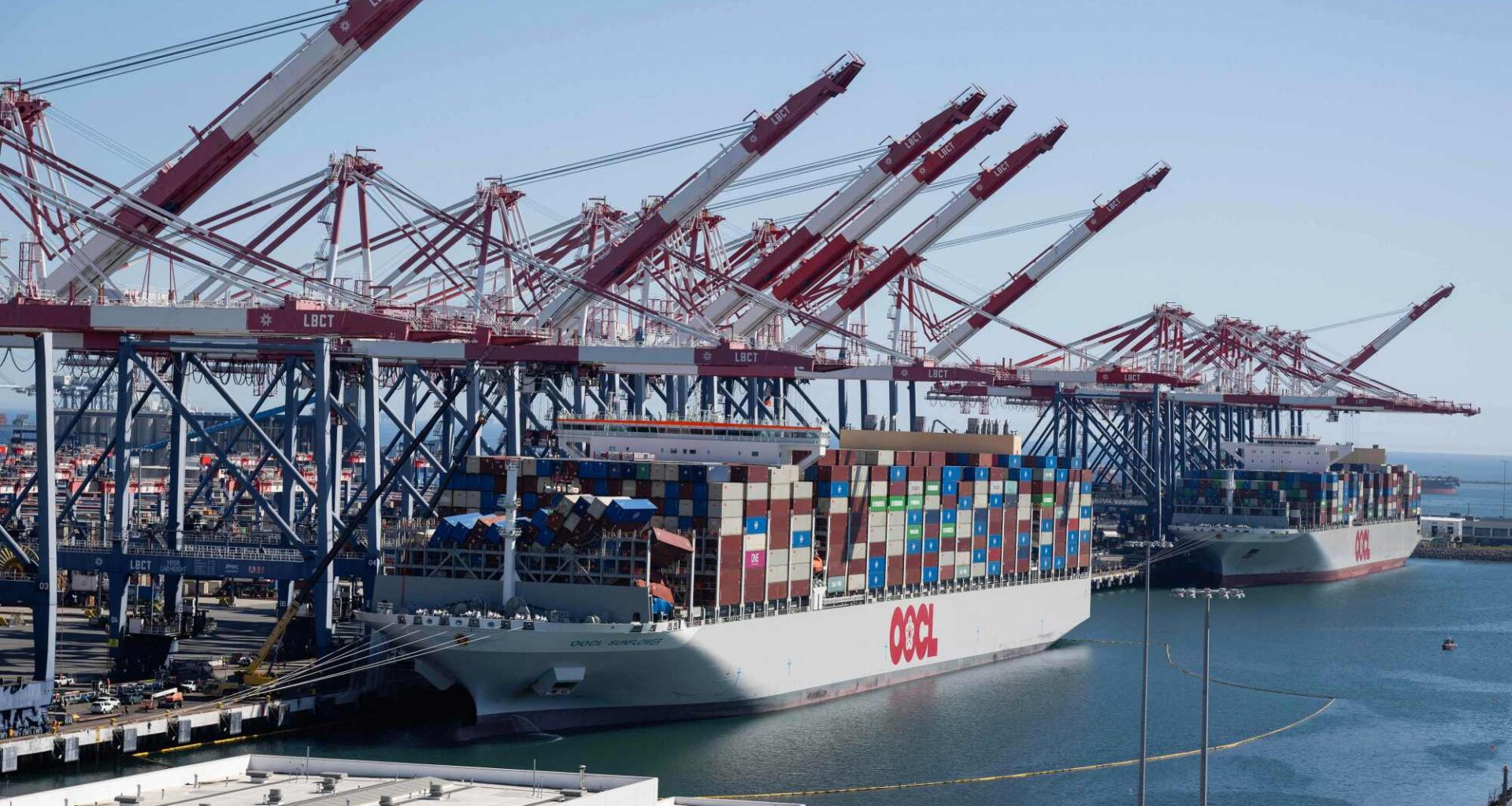
Re “California’s Invisible ‘Port Tax’ is Costing Every American,” July 28:
Tradeoffs matter
Lora Karch’s “California’s Invisible Port Tax Is Costing Every American” asks readers to focus on the cost of reducing pollution while ignoring the far greater cost of allowing it.
For decades, communities surrounding the Ports of Los Angeles and Long Beach have shouldered the health consequences of diesel emissions so the rest of the country could enjoy inexpensive imported goods. That was the real hidden subsidy.
Reasonable people can debate whether California’s “vessel at berth” regulation is the best way to address the problem. But calling it an “invisible tax” without acknowledging the asthma, heart disease, and other health impacts borne by nearby residents is not balanced analysis.
If Americans benefit from goods moving through California’s ports, then it is only fair that the cost of cleaner operations be shared through the supply chain rather than imposed almost entirely on the people who live next door.
Kirk Palmer, Laguna Niguel
In defense of the tax
Having lived in the L.A. basin region for most of my 81 years, I endured days of dense smog growing up in Boyle Heights. I remember how difficult it was to breathe and the pain emanating from my lungs at the end of a day of playing at the local neighborhood playground.
During the decades that followed, the proactive concerns of environmentalists, together with an informed and supportive state legislature, led to major improvements in air quality in the Los Angeles basin. No doubt, regulations targeting auto emissions primarily were responsible for the vast improvement in the air quality. The “port tax,” forcing large cargo ships to shut off their polluting diesel engines, has also helped mitigate the harmful air pollution effects of such engines. We still have a way to go to improve the air quality, but the elimination of the ‘port tax’ would be a step backwards.
The libertarian, Lora Karch, needs only to breathe the emissions from a cargo ship’s diesel engine to understand the folly of her anti-port tax opinion.
Larry Naritomi, Monterey Park
What Karch gets wrong
Lora Karch’s take on California’s Vessels-at-Berth rule is wrong on several counts. The per-item cost of the rule is minimal according to estimates from the California Air Resources Board (CARB). For consumer goods, CARB estimates $1.14 per Twenty-foot Equivalent Unit (TEU) of cargo. (A 40-foot container equals two TEUs.) Since a container can hold hundreds of items, the added cost per item is a few pennies or less.
CARB estimates that the rule adds $7.66 per automobile and $4.65 per passenger to cruise ship tickets. The impact on gasoline prices is estimated to be less than one cent per gallon. CARB’s estimates include the difference in cost of shore power vs. ship-gnerated power plus the labor cost and fees required to connect. Since these are wholesale costs, they will of course be multiplied as goods travel through the distrubtion system but the final consumer impact is still minimal.
Ms. Karch states that for petroleum tankers, compliance is technologically impossinle leading to penalty payments. While safety considerations generally preclude tankers from connecting to shore power, other technologies are used in the ports to filter ship generator exhaust. Tankers also have the option of burning low-polluting fuels in their generators.
The piece totally ignores the reason why California imposes the strictest air pollution regulations in the country: our still-dirty air and its resulting negative health impacts which themselves impose enormous cost on the economy. (This seems especially disengenuous coming from someone who lived and studied in Southern California and who experienced our unhealthful air first hand).
As for California imposing its policies on the rest of the country, since an estimated 75% of imports through the ports of Los Angels and Long Beach are consumed by the rest of the country, it might be argued that 75% of the resulting air pollution is caused by their demand for imported goods and it is only fair that Califonria charges them for polluting our air.
Glenn Olsen, Riverside