
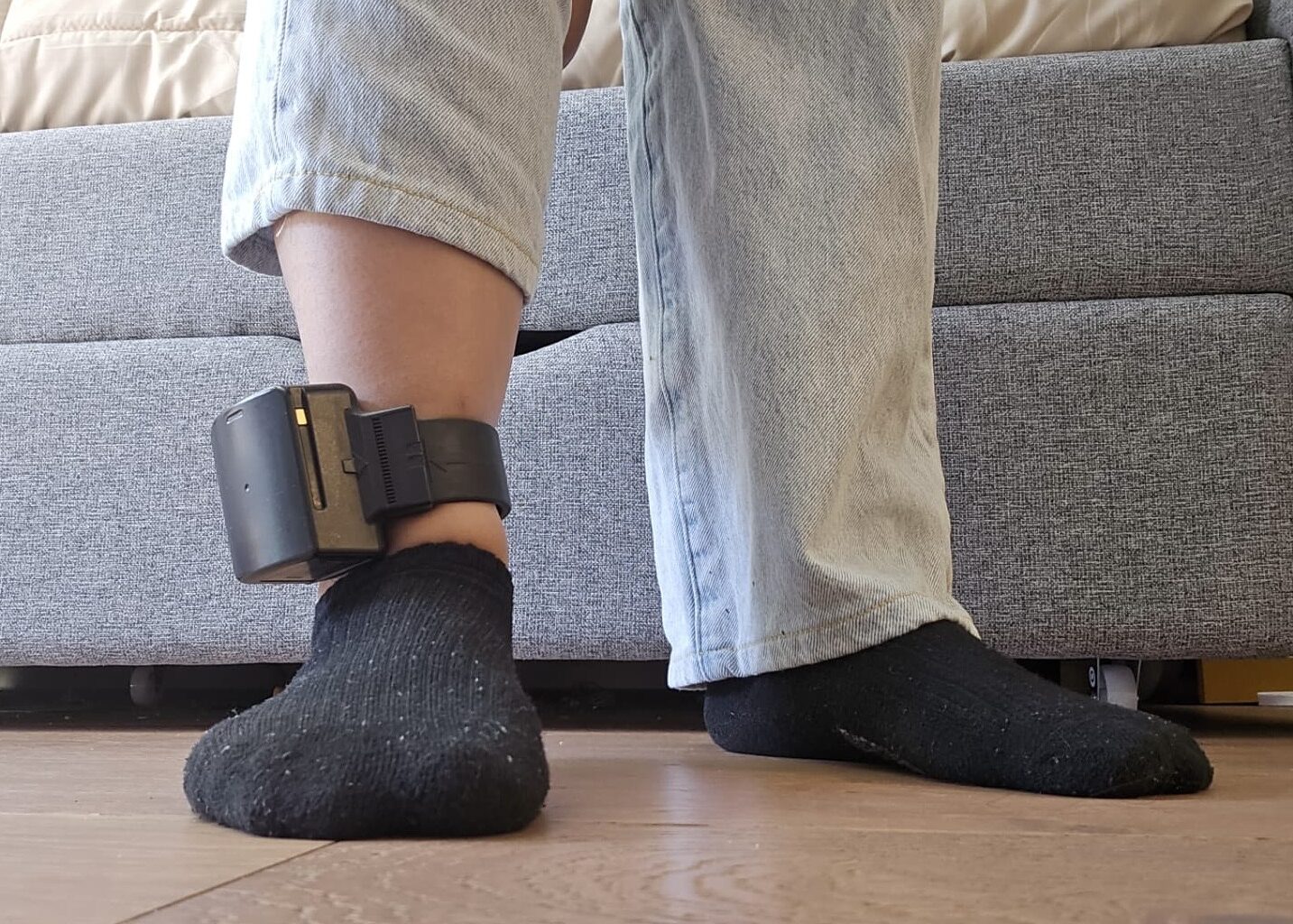
Immigrants in the San Francisco area – even those without a criminal record – are increasingly tethered to electronic monitors, according to immigration attorneys and federal data.
While the monitors intensively track them, which is what immigration officials want, immigrants find the devices confining and glitchy, and make it difficult to find or keep work. Under President Trump’s administration, lawyers say they are observing an increase in the amount of time immigrants are required to be tracked by these devices, as well as the frequency of their use.
Immigration and Customs Enforcement first piloted the Intensive Supervision Appearance Program, known as ISAP, in 2004. But it has been growing ever since. The program is operated by BI Incorporated, a subsidiary of GEO Group, Inc., which also operates for-profit detention centers.
Although all major metro areas have similarsurveillance of immigrants, under a program ICE calls “Alternatives to Detention,” the San Francisco ‘area of responsibility” has the largest number of active program participants in the country. The area includes all of Northern California, Hawaii, Guam, and Saipan.
All of the 20,804 immigrants who report to offices in this area are under some kind of surveillance. 16,765 use “SmartLINK,” a smartphone app that tracks their movements, 3,624 wear ankle monitors, and 415 wear “wrist-worn” devices, which look like bulky watches, according to a July data release by ICE.
“What we’re seeing under this administration is they’re increasing the restrictions and increasing the supervision so that it’s more difficult for people to comply, and so these companies can make more money,” said Milli Atkinson, director of the Immigrant Legal Defense Program with the Bar Association of San Francisco’s Justice and Diversity Center.
The justification for the varying kinds of surveillance devices is to ensure that immigrants who are released awaiting determination of their cases and are “not a threat to public safety” show up to court. According to a Congressional Research Report, risk assessment software looks at criminal history, alleged gang affiliation and community or family ties to determine which immigrants will be monitored.
Atkinson, when asked how BI Incorporated makes decisions on which immigrants will be monitored and how, said “it is about money and whatever directive they have coming down, it is not consistent.” Another attorney, Kelly Wells, called the decisions “arbitrary.”
A study from June of last year published by the University of Washington found that electronic monitoring only somewhat improved the likelihood of an immigrant showing up to court. (95% of those under monitoring attended their final hearings, compared to 83% of immigrants overall.)
The study also suggested that more than being monitored, having an attorney is likely the best measure of whether an immigrant will appear.
Life with an ankle monitor
María, 21, whose name is changed to protect her identity, arrived in the Bay Area from Guatemala two years ago, crossing the border while six months pregnant and requesting asylum.
She is now mother to a one-and-a-half-year-old girl and lives in Daly City with her partner, who works in construction. María and her husband (who does not have an ankle monitor), both have ongoing asylum applications and have complied with all deadlines and reporting requirements, according to her attorney Kelly Wells, from the San Francisco public defender’s office.
For almost the entire two years she’s lived in the Bay Area, Maria has had to wear an ankle monitor.
María used to work cleaning houses, but now, when she applies for jobs, she says prospective employers give her odd looks or ask questions — they see the monitor and assume she’s a criminal.
In fact, she’s never committed a crime, according to Wells.
The monitor also complicates Maria’s work as a house cleaner, since it imposes restrictions on how far away from home she can be. If there is a malfunction with her monitor, it could lead to further restrictions or more stringent reporting requirements. Employees of BI Incorporated will also sometimes show up in person to her home for check-ins, and she is expected to be there. Once, she said, she waited at home all day for them to come, and they never showed.
“I did nothing bad to have this,” she said in Spanish.
She says the monitor makes it hard for her to sleep. “It’s the discomfort of having it — of not being able to lie down properly, because it hurts,” she said.
María normally wakes up twice a night to feed her baby. Now she and her daughter are also woken every other night by the monitor’s vibrations, alerting her that it needs to be charged by plugging it into the wall. If the monitor is not charged or malfunctions, and she does not immediately notify the ISAP program, she may face increasing restrictions.
Atkinson says that in general, immigrants with ankle monitors often face malfunctions. The devices can also be physically painful – causing issues such as electric shocks or rashes around the ankle area when worn for extended periods.
“If you complain, they switch to the other ankle,” said Atkinson.
Checking in
ISAP is run by BI Incorporated out of a nondescript building on Tehama Street in SoMA, just blocks from the Yerba Buena Center.
Immigrants like María are required to show up to the office periodically, sometimes with their lawyers, for “check-ins” with BI staff.
In June, María and her attorney attended one of her monthly appointments. At the meeting, the two asked whether the monitor could be removed.
They were told she would need a doctor’s note stating the monitor caused medical problems.
“Why should she have to schedule an appointment and bother her doctor to get this stupid letter?” her attorney asked.
“I have never represented someone who needs to be on this monitor,” said Wells. “I really strongly believe that this entire system, including immigration detention, is a big corporate giveaway — this is an unnecessary program.”