
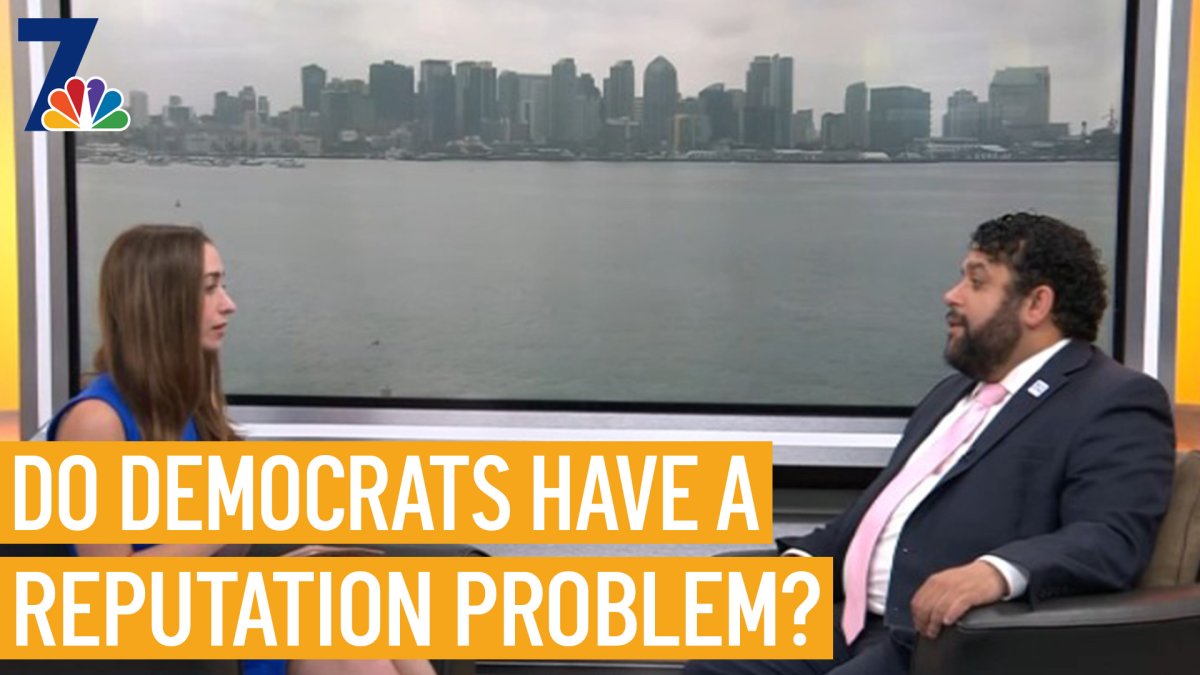
Democrats have only three months to win over voters. In San Diego, their chief concern is flipping Congressional District 48, a vital win if they hope to take back the House. San Diego Democrats Chair Will Rodriguez-Kennedy joined NBC 7 Political Reporter Joey Safchik on Politically Speaking this week to talk about the party’s priorities.
A transcript of the conversation is below.
Safchik: 90 days until the election, and it has been a big week for California Democrats, who convened to endorse a slate of candidates and some controversial ballot measures. Meanwhile, the National Party has been the center of some less than fabulous press. Will that impact turnout locally? Let’s break it all down with the chair of the San Diego Democrats, Will Rodriguez-Kennedy. Welcome back.
Rodriguez-Kennedy: Thanks for having me.
Safchik: What is your North Star between now and the midterms?
Rodriguez-Kennedy: 48th Congressional District and everything local. The national climate, it’s kind of chaotic. But in the grand scheme of things, politics is about the fundamentals. And here our politics are local. So we’ll be focusing on the local races and our battleground congressional district.
Safchik: So is CD 48 consuming the majority of your attention right now?
Rodriguez-Kennedy: I would say it’s a big factor in my attention. I have obviously a countywide responsibility. San Diego’s larger than about 20 states, so we have a lot of responsibilities. But in terms of the way to take back our country, the pathway to do that and take that, Congress is right there through Congressional District 48.
Safchik: And not just your attention, but the party’s resources. Is that where they’re being funneled?
Rodriguez-Kennedy: Well, the party’s resources are spread in a bunch of different things. We do have a lot of resources that will be coming in from the national and state party. In that district we’re opening up, we are about to open up our coordinated office. Actually, this week. So all of that is starting to come together. We have significant resources in general. San Diego is actually one of the strongest county parties in the state. It punches above LA in its weight. So we are ready to take this fight and to take back Congress.
Safchik: What do you mean by that? It punches above L.A.?
Rodriguez-Kennedy: We often, our expenditures are greater than the Los Angeles County Democratic Party.
Safchik: How confident are you you’re going to be able to flip 48?
Rodriguez-Kennedy: I’m very confident. The, you know, the Marine in me tells me to fight like I’m losing. And so I’m prepared to do that. Jim Desmond is a competent campaigner. But we have the girl on fire in Marni von Wilpert, who has flipped Republican districts before, so he has the energy behind her. She won a battle tested primary. The people have chosen her, and we are ready to fight for her.
Safchik: Will there be a reckoning in the party locally if you’re not able to flip the seat, even after redistricting?
Rodriguez-Kennedy: There would not be. I mean, if for some reason party leaders are not able to bring in their elections, that is possible. But in the grand scheme of things, this is a national trend election. And so what will happen? What will need to happen is that we will have to be coordinating with our national and state partners, which we are. And it’s all about the fundamentals. We’ve written this district in order to be a flippable district and we’re going to fight for that district.
Safchik: It leans left only by four points. This is still a fight. We’ve been saying that for months. What does she need to do to convince purple voters in the next 90 days that she should win their vote?
Rodriguez-Kennedy: She needs to do exactly what she did in District 5, in the city council district, which was the Republican seat historically until she flipped it. She needs to talk about the bread and butter issues, how to make people’s lives easier, how to make it so that things cost less. Everything’s too, too high. The rent’s too high. The gas is too high. The, you know, water rates, everything is too high. But now we have to talk about affordability. We have to talk about housing. We have to talk about health care. And if she stays on target on those issues, she will prevail.
Safchik: Are you expecting these midterms to be a referendum on the Trump administration?
Rodriguez-Kennedy: It’s hard to– with what we’re seeing on the national level, the cruelty of the Trump administration, the cuts to Medicare and Medicaid, their cuts to the VA. It’s hard not to see this as a referendum. We have 110,000 service members here in San Diego, about 300,000 350,000 defense connected jobs. And we have hundreds of thousands of veterans here. Every one of those cuts have hurt veterans here in San Diego. We have hundreds of thousands of people who are on Medicaid or food assistance. Every one of those cuts that happened in DC has hurt San Diego, and now San Diego has an opportunity to tell DC that we’re going to focus on our own issues. We’re going to focus on making sure people get their food assistance. They’re literally starving people from DC in the streets here in San Diego. That’s unacceptable. San Diego is about to be able to say something about that in November of this year.
Safchik: What more do Democrats need to do to convince voters that affordability is paramount?
Rodriguez-Kennedy: We need to deliver. We need to make sure that we’re focusing our candidates and we’ve staying on target. So I’m a Star Wars nerd, and it’s like the first Star Wars movie, “stay on target.” That’s basically what I have to tell all my candidates. We need to be talking about the issues that are important to voters. We do not need to be sidestepped, sidestepped by, or engage in side quests, whether it’s inter-party conflict or personal conflict or issues that aren’t important to voters, it should all be about cost of living, cost of housing, cost of health care, and bringing those costs down.
Safchik: And how does the party strike a balance between casting the blame for the high cost of living on the Trump administration and saying, okay, but here are my tangible plans to lower the cost of living.
Rodriguez-Kennedy: Well, just an example. Here in San Diego County, our rents are stabilizing. I just got a 10% reduction on my rent. We have the ability to do that on the policy level here, but we also have to make sure that we’re sensitive to the strains of our voters. We saw that when the city didn’t put forward a tax, a revenue measure in the November ballot. That’s because they’re listening to what voters are saying. We’ve been taxed too much. We have too much of our cost. Let’s talk about this next cycle. So at this point now, there are other things that that frees up for other initiatives like the county to get their tax, their revenue in order to help for health care and the Tijuana sewage repair.
Safchik: Democrats are in charge of the San Diego City Council, are in charge of the County Board of Supervisors. Four of the five members of the congressional delegation are Democrats. Why should voters trust that the party in charge here locally is going to lower the cost of living, when they haven’t really been able to do that yet?
Rodriguez-Kennedy: That’s true, that those factors in terms of Democratic prominence on those specific seats are important to note. However, these problems are generational and the creation of generations of time in Republican leadership, this city has people who have been lying to people about what it costs to run a city. They’ve been undercutting the cost of those costs, and they have been failing to invest in our local communities. An infrastructure problem doesn’t happen in one cycle. It happens after generations of deferred maintenance that started under Republican leadership. It will take time in order to make sure that we can undo the damage that has been done for so long. The price of housing doesn’t get started in a cycle or two. It’s a generation of multiple generations of policy decisions that were led by Republicans. That got us to the point where people can’t afford housing, where people where we have potholes on the street because we have deferred maintenance problems. Democrats have always been about investing in people, investing in infrastructure and investing in everyone and lifting all boats. That’s not been what has happened in San Diego County for literally 20 years. I mean, people used to die in office until we enacted term limits.
Safchik: Does your party have a reputation problem?
Rodriguez-Kennedy: The party I think, does best when it reminds people that their party of working people, we have too often strayed on some of these, some of the social issues in the wrong way. We need to lean in on, make sure that we back civil rights and human rights for everyone and the dignity of all people. But we also need to do better about promoting an economic agenda, which means we need to tell people that we are going to support the policies that make them, that put more money in their pockets, that make their lives easier, and that address their costs, their cost of living.
Safchik: Can the social issues still be a part of the conversation?
Rodriguez-Kennedy: 100%. And they have to be because they’re linked. We are a party that fights for social and economic justice, and what that means is that we can’t leave our communities behind, but we also have to make sure that we are supporting people’s economic problems as well. We can’t always be talking about social issues while missing the economic problems. So I’m not saying that we should not talk about social issues or civil rights. I’m saying that we have to do that while also painting an economic and economic message.
Safchik: There is certainly some dysfunction on the national level. The national party is in debt. How much pressure do you feel to distance the local party from that?
Rodriguez-Kennedy: All politics are local, so that’s just an easy thing to say. But in addition to that, it’s important to note that the facts of the spending and the accumulation of contributions from the DNC this year to 2018 is actually comparable. And in fact, they’re ahead. The reason that the National Party is having so many problems or is in so much debt is because they’ve been spending that money investing in the county, in the state parties, investing in actual organizing efforts.
Safchik: If you look, the California Democrats have cash on hand, you have cash on hand.
Rodriguez-Kennedy: Exactly. So if you look at that, what they’re doing is they’re decentralizing. And that’s what we should want. We shouldn’t want all the power and wealth to be centralized in D.C. We should want that money and that attention decentralized in the communities, because all politics are local.
Safchik: But the optics of that of them being in debt while the national Republicans are flush. What do people at home read into that?
Rodriguez-Kennedy: The optics are only allowed because unfortunately, the media at the national level have not done a good job about looking into the actual dynamics, like there is a factual record there and they have not painted that factual record. The Democratic Party is about taking those resources, not centralizing them, spreading them out to the communities so that we are activists in the field, and can actually do the work that they need. The Republican Party is about centralizing their resources so that they can spend it on consultants, on mail, on a digital, a digital, on TV ads. There’s a different approach where we’re organizing people, they’re organizing ads.
Safchik: But can the party distribute those funds in a responsible way that doesn’t leave them in debt, and having to ask vendors not to send the bill until after the election?
Rodriguez-Kennedy: That’s weird. The San Diego County Democratic Party does not do that. And we’ll say that right there. But what I will say is that the national party needs to do better on that. But it’s also important to note that it’s a common business practice to like, have expenditures or to have them on, on credit or to do it in, in a way where you structure the payments. So I’d have to look more into that specific instance that happened. But I’ll tell you, that wouldn’t happen in my party.
Safchik: And why should people trust you with their money, with their taxpayer dollars, if that’s what they’re seeing?
Rodriguez-Kennedy: Well, the reality is, that’s a single person in charge and on the other side of the country. I mean, let’s talk about Republicans and their spending. Have you looked at the deficit recently? The deficit has grown more times under Republican leadership. Every single time they come into office. And they say, oh, you know, we’re going to cut the deficit. We’re going to cut spending. What happened? They increase spending. They want to increase the defense budget to $1.5 trillion. They want to spend all the things that they want, while cutting it on the backs of working people. All the while, the wealthy get wealthier and the poor get poorer. They’re cutting all the all the, the food assistance programs, the health care programs, everything that benefits working people they are cutting. And why are they doing that? So they can give their wealthy, very wealthy donors another tax cut and so that they can spend more on their forever wars. The Republican Party has bankrupt this country time and time again. I’m a veteran of the United States Marine Corps. I fought in the Iraq War. I can tell you trillions of dollars and many American lives were spent because of Republican wars of choice. So I will not allow the Republican Party to lecture our party when the economy has always done better under Democratic presidents. The time the economies have been booming, have been under Democratic presidents, it’s been Republican leadership that have led to the deficits, the lack of spending and the lack of investment in our people.
Safchik: Well, let’s segue into the billionaire tax, so-called billionaire tax, Prop 40. You staunchly support it. Tell me why.
Rodriguez-Kennedy: Look, here’s the deal. If you look at how people are doing in this country right now, the wealthy are getting wealthier and the poor are getting poorer. So I want people to think about when there’s a crisis in a community. Right. Let’s say you’re going to church. One of our families are struggling, right? What happens when you do that? You pass around the house and you ask people to give it, to give in order to take care of that family among us. What’s happening now is that the Trump administration is cutting Medicare, Medicaid, VA benefits, all of that. They’re cutting. And that is going to lead to people starving. It’s going to lead to people not having health care. It’s going to lead to people struggling. What we’re doing is we’re passing the hat around to the billionaires who are doing well to give so that they can help those people get by.
Safchik: How do you address the concerns that those billionaires will just leave California and leave a gaping hole in the budget in their wake, that this could backfire?
Rodriguez-Kennedy: I would say to that. It would be an evil act, an act of absolute evil for a billionaire to uproot themselves to give 5% of their wealth one time to help people from dying, if that’s what makes them leave California, good riddance, because those are not people that we want to deal with. But I also believe that most billionaires or people who actually care about their communities, they when they move, they don’t move to just like live in a silo. They invest, they they give to nonprofits. They give to community philanthropy. I am not as cynical about their about their positioning. And I have to remind people across the political spectrum, whether they’re billionaires or, you know, working class people, they’re still people. And I think it would be very hard for me to believe that billionaires would just let people die because that’s what they be doing.
Safchik: This is a one time 5% tax on their assets. Why the narrow focus on health care? As for where the revenue would be directed?
Rodriguez-Kennedy: See, that’s a question that I don’t understand because we raise money for infrastructure, we raise money for education, we raise money for wars. Like this is the crisis of the day. The crisis of the day is the Trump administration is cutting Medicaid and Medicare. That’s going to cause our hospitals to close because they’re not going to get the reimbursements they need. It’s going to cause our veterans to not be taken care of because we’re not providing their health care, but also the county just has to cut– the city, the county, everyone has to cut their HUD. That’s vouchers, which provide for homeless veterans. We have to cut that because the Trump administration has cut the funding on that. That means veterans go homeless because of the Trump administration’s actions. It is important that the county has the resources that the city has, the resources the state has, the resources in order to combat that reality.
Safchik: I think what I’m getting at is, are you hopeful that having such a specific focus will help people get on board? Because it’s something that touches everybody.
Rodriguez-Kennedy: It does help. One of the things that we’ve learned in previous elections is that people don’t generally like taxes, that don’t have a dedicated purpose, right? So a general fund tax, it may be easier to pass, but people are distrustful of that. We’ve seen those types of taxes. The taxes fail. This is a specific tax on a very small group of people to address a very specific purpose. And by doing that, we are telling people and we’re being transparent with people about not only who we’re taxing, but also how we use those resources. So that’s why it’s easy to make that analysis and that discussion, because we’re telling the billionaires we want to do it for health care. We want to do it for food assistance. That is a very direct ask. And if you say no to that, that says a lot about your personality.
Safchik: Let’s talk about another ballot measure, voter ID, the GOP says that the language is misleading. Is it?
Rodriguez-Kennedy: I mean, I don’t think so. I mean, first of all, it would be rich for the Republicans to complain about misleading ballot language. I mean, they’re literally trying to make it harder for people to vote. That’s really what they want. California has the most secure election system in the country and in the world. The reason California takes so long to count is because we’re verifying our votes. And what people fail to notice is that in the last I think, several decades, there have only been a couple dozen examples of voter fraud or anything like that. So the whole focus on this, it’s an obsession with the Republican Party where voter fraud occurs is usually in Republican states where they have less they have less resources securing the vote counts.
Safchik: Is a couple dozen too many, though.
Rodriguez-Kennedy: A couple dozen over several years. That’s like, well, in a state of 40 million people. I mean, more people, like more people are billionaires than those couple dozen. So, no, I mean, every vote, every person who does that is committing a crime. But the reason we know about the committing a crime is because they were caught so that a couple dozen got caught, they didn’t affect any elections. And they’ve paid their dues to society.
Safchik: Would voter ID eradicate those few bad actors?
Rodriguez-Kennedy: Yeah. But it would also eradicate thousands, if not hundreds of thousands of voters who now, every person who got married and has to prove their citizenship. Do I get to vote? I have a hyphenated name. What if my birth certificate doesn’t match my current identification document? Happens all the time. People misspell my name with a G and a Q. Sometimes they forget the hyphen. Would that stop me from voting? Probably under this new system?
Safchik: Just to be clear, election officials say that the system is safe and secure. They welcome transparency. Why do you think this has become such a hyper fixation for the Republican Party?
Rodriguez-Kennedy: It’s become a hyper fixation because they think they’re going to lose the next elections. They think the people have turned against them, and they’re doing everything they can in order to stop that. They try to break us and fix the elections with Texas. California said, no, we’re not letting that happen. They’re trying it with other states. They’re trying it with gutting the Voting Rights Act, the Civil Rights Act. They are doing everything possible to prevent people from voting and specifically to prevent women and people of color from voting. That is their intent.
Safchik: Bigger picture. Let’s zoom out for a second. We have seen very progressive candidates taking on and defeating more establishment candidates throughout the nation. We’ll see if LA follows that trend in their mayoral election. What are you reading into that?
Rodriguez-Kennedy: Well, we’re a coalition party and I am welcoming, welcoming of people of all stripes who want to fight for social and economic justice. That could mean that could mean moderates and it could mean socialists. It could be progressives. We are a rainbow of people in terms of ideological and diversity and geographic or demographic diversity.
Rodriguez-Kennedy: So I’m welcoming of that. It’s important to note that we’re a coalition party, because that means when we win, we win by creating a coalition from the left to the center. That’s how we win. And so we have to be more inclusive of those voices, and we have to make sure that when those wins happen, that it means that there’s going to be a little bit of change and interplay among our policies. The best policy is determined among the tension between differing ideas and the debate that associates with that.
Safchik: Did you see that at the meeting last weekend?
Rodriguez-Kennedy: Yes I did see that.
Safchik: Is California, is San Diego running progressive enough candidates to keep young people in the party?
Rodriguez-Kennedy: We’re certainly trying. We have a whole breadth of different candidates right here in San Diego. We have moderates. We have leftists, we have socialists. We have all the whole spectrum of that. We also have a very diverse pool of candidates. There are more LGBT candidates compared to the population. There are more black candidates compared to the population. We have new and up and coming Latino candidates there. And then we have candidates of all colors and races and religions. We are making sure that we have candidates for everyone so that people, whoever they are, can look in their candidates and our field of candidates and see themselves in those candidates.
Safchik: I know that the immediate focus right now for the party powerbrokers is the midterm elections. It’s hard to see past that at the moment. But. Or does it give you pause at all that there is no clear frontrunner heading into 2028?
Rodriguez-Kennedy: I would say that it is not unusual for the party to have lost an election like 2024 to take some time to figure out where they are. And I think what we’re seeing is we’re in the process of finding that out. People who could be our presidential candidate may not be known yet, or they could be people who are, who are, who are proving themselves in this election or what they’re doing for other people or the organizing they’re doing, the messages that they’re saying they’re creating, that we’re going to have a very robust conversation in 2028, people didn’t see Barack Obama coming. He came from like out of nowhere. And I think what people should be prepared for is a contest of ideas. There’s going to be a broad contest. And then at the end of that contest, there will be a nominee, and that nominee is going to be someone we all at least can deal with and live with.
Safchik: Are you looking for a blue wave in the midterms? Do you think that that’s going to come to fruition?
Rodriguez-Kennedy: I am looking for a wave of working people to help us get that blue wave, and that means I have work to do. It means every Democratic leader has work to do. And so building a blue wave, it’s not a force of nature. It’s the work of our activists, of our organizers, of many, many millions of voters. And so my focus is on the mobilizing effort to get that blue wave going. And then I think if we do all our jobs, if we focus on the fundamentals, if we stay on target, I think we’ll win.
Safchik: Okay. Well, we will let you get back to work. Thank you so much for being here. Thank you.