
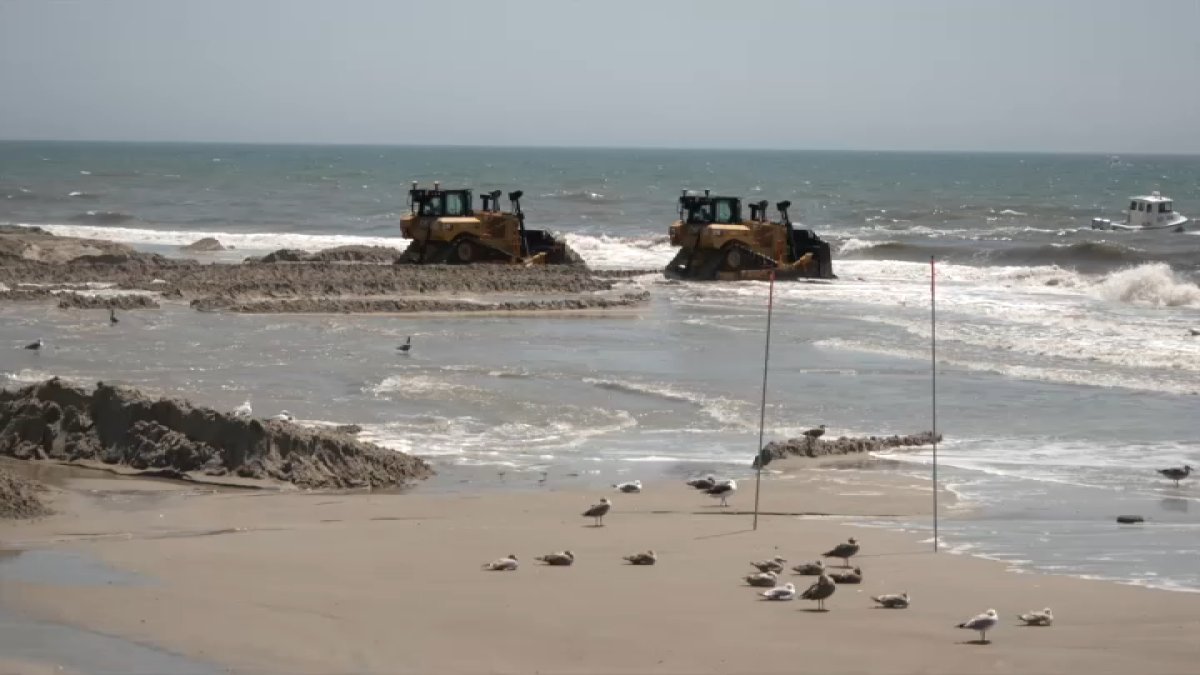
Several blocks of beach in Ocean City are off-limits as crews pump badly needed sand ashore to widen areas that have been hit hard by erosion.
“A couple weeks ago there was like really little space, like everyone is crammed and now it’s like everyone’s like spread out, has their own space and everything,” Gianna Greenberg, of Bridgewater, NJ, said.
The work comes as another heat wave sends crowds to the Jersey Shore, but advocates warn the outlook is much less certain for coastal communities still waiting on beach replenishment projects. They are launching a nationwide public campaign that includes a petition aimed at building support for continued federal funding.
Supporters of beach replenishment say continued investment is critical for communities that are vulnerable to erosion.
“This protects the beach that you go to, the memories that you form each year,” Dan Ginolfi of the American Coastal Coalition said.
Ginolfi recently briefed officials from several Jersey Shore communities about the ongoing uncertainty in Washington surrounding federal dollars for shore protection projects. He said legislation approved by the House does not provide enough funding nationwide, and the Senate has not yet released its version.
“This is probably the first year that we’ve gone over a year out of cycle for our beach fills,” Cape May City Manager Paul Dietrich said.
Without additional coastal funding, advocates say several Jersey Shore communities could wait another year for beach nourishment. They include Cape May, Atlantic City, Brigantine and Long Beach Township, along with other communities in Delaware, New York and Georgia.
“That means another year of hurricane risk, another year of lost tourism revenue, as well as any ecological benefits that result from those projects,” Ginolfi said. “Unfortunately the Corps of Engineers will have to choose winners and losers.”
For now, the wait for sand is over in some Jersey Shore communities, while others face a future that remains highly dependent on both the weather and decisions in Washington.
“We’re starting to see some more severe erosion in the southern part of our beaches right now, but we’re going to just have to hope that we can make it through the winter and into next summer,” Dietrich said.
This story was originally reported for broadcast by NBC Philadelphia. AI tools helped convert the story to a digital article, and an NBC Philadelphia journalist edited the article for publication.