
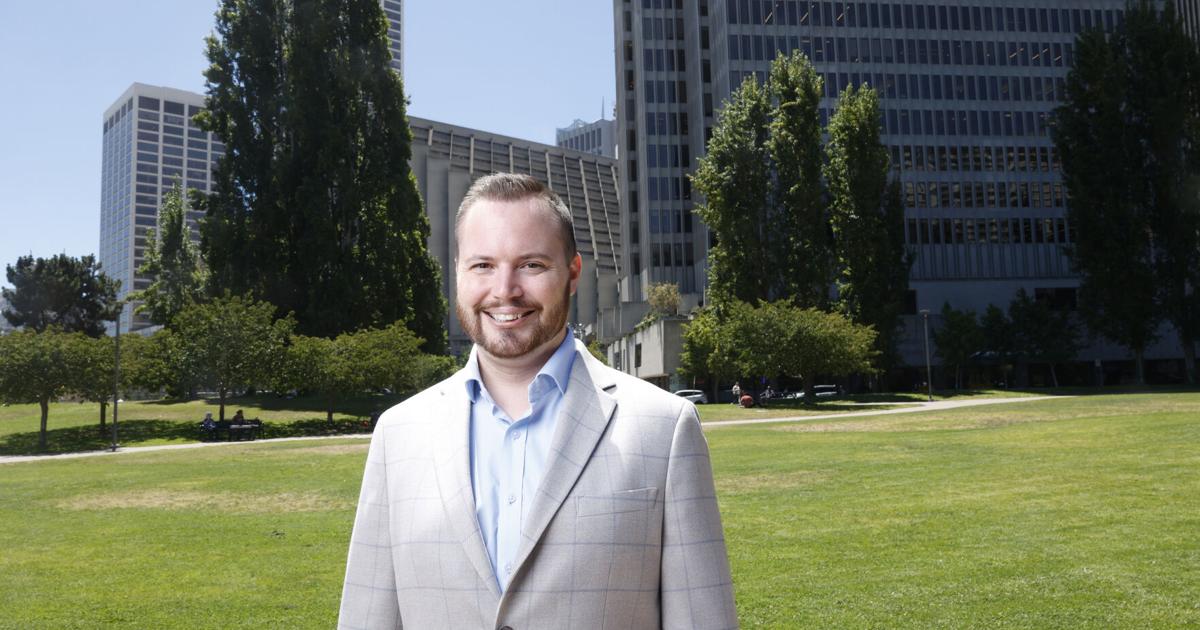
Robbie Silver is president and CEO of the Downtown SF Partnership, a six-year-old community-benefit district centered in the historic Financial District that just won approval from dues-paying property owners and city officials to expand farther into Jackson Square and to the waterfront.
The new boundaries include the Ferry Building and Embarcadero Park, which is slated to undergo a $40 million, publicly and privately-funded redesign.
When Silver took the helm of the Downtown SF Partnership amid the COVID-19 pandemic in September 2020, after having worked for similar outfits in Union Square and the city of Riverside, he had no office and was the only employee. The organization’s mandate was primarily to promote clean and safe streets.
Since then, the now 11-person nonprofit has morphed into “an urban placemaking and district management organization” that, among other things, launched the annual winter Let’s Glow SF projected-light festival, sponsors free weekly drag shows during Pride Month, and helped create the state’s first entertainment zone for outdoor alcohol drinking during special events on Front Street.
Community-benefit districts enable property owners to collectively fund neighborhood services that are overseen by The City. Downtown property owners recently voted overwhelmingly to renew the district 10 years early and expand its boundaries and services, for the first time including Port of San Francisco property.
Mayor Daniel Lurie last month signed legislation that will increase the agency’s budget from about $4.8 million to $11 million, the largest increase for any self‑assessment district in city history.
In the future, Silver’s nonprofit will increase cleaning and security services from 14 hours per day to 24, and it will provide programming and maintenance for the new 5-acre park that will combine Embarcadero Plaza and Sue Bierman Park.
In addition, the organization will expand its economic-development services and hire at least one homeless-outreach worker to try to connect people in need with services, among other things. The following conversation has been edited for length and clarity.
What’s going to change downtown as a result of your expansion? We’re doubling the amount of cleaning. We’re doubling the amount of power-washing. We’re adding a new homeless-outreach program. We’re adding overnight security.
We’ve been talking about how downtown needs to be a 24-hour destination for visitors, workers, residents, for education, and my property owners are putting their money where their mouths are. We were facing a reality in which there would be no more funding from [the city Office of Economic and Workforce Development] for events and activities. It’s definitely over $1 million in grants annually. That’s a big hit.
The timing could not have been more perfect for this renewal and expansion. Considering we’re about to have a $40 million Embarcadero Park project, we know that urban parks need sustainable funding for ongoing programming and activation, and so that’s built in.

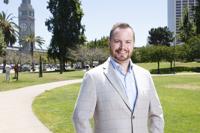
Robbie Silver, seen at Sue Bierman Park in July: “There’s been a disconnect between our waterfront and the core of downtown, and it can be a better public realm and pedestrian experience from an economic perspective. It can feel and be more connected.”
Craig Lee/The Examiner
There’s been a disconnect between our waterfront and the core of downtown, and it can be a better public realm and pedestrian experience from an economic perspective. It can feel and be more connected.
So all those pieces have come together. And over the last few years, our stakeholders and property owners have been asking us for more cleaning, more safety services, and also economic development. There are great first-generation, second-generation spaces, former restaurants, former cafes and bakeries with hoods, kind of plug-and-play and ready to go, but what’s missing is, I would say, a liaison to do matchmaking.
So, part of our renewal and expansion effort is going to be working very closely with our property owners and brokers and doing matchmaking services with businesses. We’ve taken an inventory of all our ground-floor spaces. We want to go to businesses around our beautiful neighborhoods in San Francisco and say, “Hey, coffee shop in the Castro or restaurant in the Mission, have you thought about opening up your second location, and why don’t you do it downtown for all these reasons?”
Why renew 10 years early? With Embarcadero Park coming online, there is a recognition of the need to connect our core better to the waterfront. More cleaning, more safety, and supporting Mayor Lurie’s overall plan for downtown. All this is going to require resources and money. We can sit here and talk, talk, talk about a 24/7 downtown. But we’re actually going to do it, and I am very thankful that my property owners voted for the highest self-assessment increase in San Francisco’s history. If that’s not confidence, then I don’t know what is.
Regarding leading programming for the Embarcadero Park project, what are you planning? It’s everybody’s park, and I want each San Francisco neighborhood to have its piece of it and identity into it, versus it feeling like downtown’s park. What that means is local artists from every stretch of The City and beyond should have an opportunity to perform and act and play in the park, and we want to be the conduit for that. Broadly, think about all different kinds of programming, from your concerts and raves to cultural events, food events, local musicians, Shakespeare in the park and everything under the sun.
Will anything change about the Ferry Building in terms of activations and that sort of thing? Or will it be mostly cleaning and ambassadors? There will be some enhanced cleaning and supplemental safety services, hospitality ambassadors to welcome people in and around the Ferry Building. There’s been a lot of success with the Big Art Loop and the new sculptures along the waterfront. We want to do public activations around those art pieces, like live music, artistic demonstrations, magic shows.
They worry about how cuts to the social safety net and changes to enrollment for undocumented immigrants will affect the most vulnerable patients
A 14% jump in apartment rents indicated a ‘significant shift’ fueled primarily by the artificial-intelligence investment boom in underway, a city report said
California already verifies voters, says incumbent Shirley Weber, and the popular vote-by-mail system slows counting
Office vacancies in the second quarter were still high (29.2%, down from the record high of 36.9% set in the third quarter of 2024, according to CBRE). What do you think the prospects are for that changing? Actually, I think we’re seeing that change right now in real time, mostly driven by [artificial intelligence] and startups. I will caution, though, that while it’s good to point at the changing of market conditions and offices filling up, we need to not put all of our eggs in the AI basket. Otherwise, we’re going to be right back where we started, and we’re still not going to have this inclusive, 24/7 feeling downtown.
What can you do to reduce The City’s vulnerability to a potential crash in the AI sector? We have to create the conditions for the vision that we want for downtown to happen — keep people in downtown longer, give them reasons to come downtown at night, come downtown on the weekends. It has to be a holistic approach.
There’s been a lot of effort by city officials to facilitate the transformation of office buildings to housing. Do you think it’s really going to happen and make a significant difference? The core of the Financial District would have been much more resilient after the pandemic if we had several tens of thousands of people living downtown. While we’re seeing a lot of optimism in the market, definitely more pedestrian activity, more people coming back to work, we still have a long way to go, and for many developers, the math still doesn’t quite pencil out.
The [former Mayor London] Breed administration and now the Lurie administration have made tremendous strides in trying to streamline and offer incentives and exclude certain fees, and we’re starting to see real projects. They just don’t happen to be in the Financial District yet, but hopefully those will show proof of concept and open the floodgates to real housing-conversion projects here.
Do you see that as being important to the future of the Financial District? It has to happen. We can’t have a 24/7, vibrant downtown without a thriving residential population. In the district that I manage, I have 315 condo units. That’s not a lot. Could we get to 10,000 to 20,000 in several years’ time? I think that’s definitely approachable.
How important is the San Francisco Downtown Development Corporation (the nonprofit formed at the mayor’s urging that has raised more than $60 million in private contributions and commitments)? The Downtown Development Corporation has brought critical attention and philanthropic support downtown and is helping to make possible key projects that need to happen. Embarcadero Park and Powell Street are two anchors that are going to completely transform the Financial District and the waterfront, as well as Powell Street and Union Square. I think once we see those shovels in the ground and we have our ribbon cutting ceremony, that is going to spur more capital development in the area.
What are some of the biggest challenges that downtown still faces? Our office-vacancy numbers — yes, they’re improving, but we still have high vacancy rates on the ground floor. As we’re thinking about a 24-hour downtown, I want to create spaces for more bars and restaurants and artists and experiential retail, creating a nightlife in the Financial District. How can we incubate that?
So we have a lot of challenges. There are still people struggling on our streets with alcohol and drug addiction and homelessness. We want to provide a proactive and compassionate approach. The time is now to bring all those pieces together, and that really was the impetus for our renewal and expansion.
Why is the district hiring a mental-health worker? We all have a part to play in handling negative street behavior, as well as trying to help people experiencing homelessness. We think we can play a role in providing case-management-type care, as well as just more compassionate outreach.
How has downtown changed since you started working at the partnership? It was a surreal experience to launch a new community-benefit district in the middle of a global pandemic, and at first being the only employee of the organization. There weren’t a lot of people downtown, but there were a lot of issues in terms of street cleanliness and safety.
We had the wonderful branded “doom loop,” and I think people fell for it across the country and across the world, that San Francisco would never come back. And here we are, six years later, going, “We told you so.” Now you walk around, there’s people out eating lunch, and it’s clean, it’s safe.
How has Downtown SF Partnership changed? We looked at the public realm as an economic development tool to amenitize, to create reasons for people to come downtown, and we’ve done successful pilots and events. We want to influence the new capital that’s coming downtown and coming into these buildings to try to influence more capital improvements downtown. That means better streets and sidewalks, beautification, shovels in the ground, cranes in the air.
Obviously, we can’t, as a nonprofit, fund all of those, but we can influence and be a leading voice and a convening partner. We currently have a staff of 11 and hope to grow to 17 to 20 over the next one to three years.
What are some Downtown SF Partnership achievements that make you most proud? I’m very lucky to have a board of directors that’s very bold in their strategic thinking and has said yes to a lot of our crazy ideas. When I approached them in the summer of 2021, still in the middle of the pandemic, they said yes to the creation of Let’s Glow SF.
It was a big test case. We asked the question: If we brought art and technology and created an event that’s family friendly, COVID friendly, outdoors, at night in the Financial District, would people actually show up? We’ve had several hundred thousand attendees over the last couple years and tens of millions of dollars in economic impact.
This last holiday season, people said in our survey that they flew to San Francisco specifically for Let’s Glow SF. We never would have imagined that would have been the case. The other example is the creation of our Front Street entertainment zone.
Clint Reilly, who died July 18, owned office buildings downtown, in addition to media properties, including The Examiner. What role did he play in the Downtown SF Partnership? Clint Reilly saw the value of having a community-benefit district, and he was a big convener and big architect for the creation of the organization. And without him, we probably would not have had a CBD form.
And did he keep pretty close tabs on what it was doing? Yes, he did.