WEST BLOOMFIELD/FARMINGTON — Residents across Oakland County considered a tax hike in the primary election Aug. 4 that aimed to support nearly 30 school districts with additional funding.
According to unofficial results from Oakland County the morning following the election, the proposal was narrowly defeated, with 51.01% voting “no” and 48.99% voting “yes.” The total count was 169,823 votes against the tax hike, and 163,120 votes for it.
The proposal, called the Oakland County Regional Enhancement Millage, was placed on the ballot by the Oakland Intermediate Schools after nearly 30 school districts in the area approved resolutions calling for the option. Together, the districts represent a majority of the county’s total student population — a legal requirement to appear on the ballot.
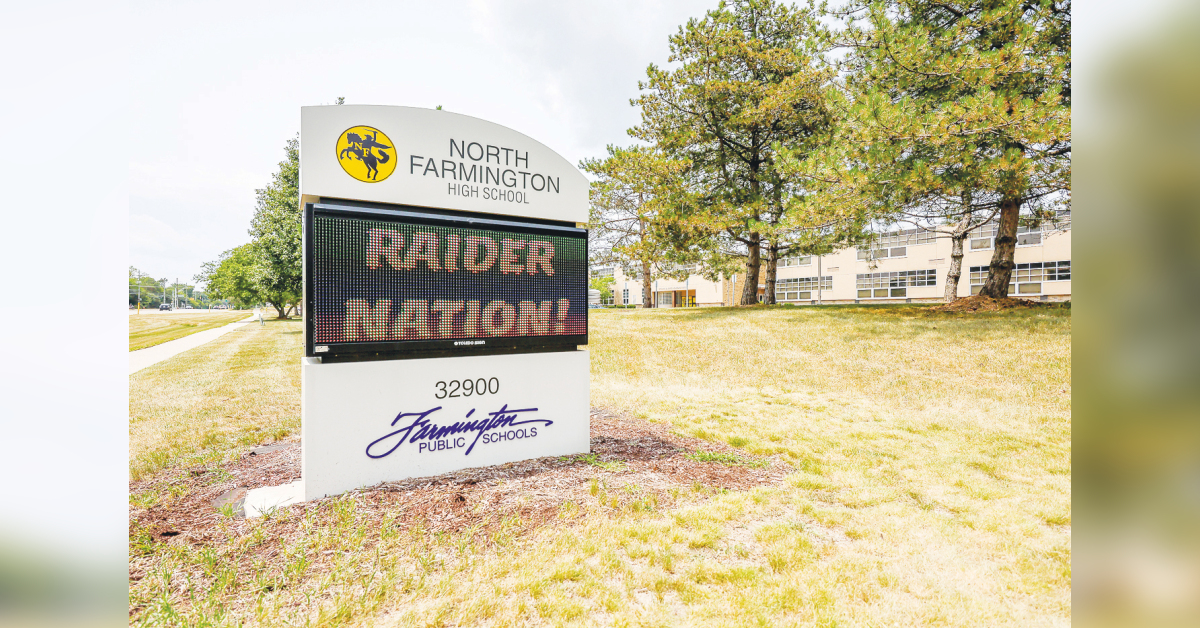
 A view of North Farmington High School. Voters narrowly defeated a countywide school millage during the primary Aug. 4. Had it passed, the six-year tax hike would have raised funds for nearly 30 districts, including the Farmington Public Schools and the West Bloomfield School District.
Photo by Patricia O’Blenes
Some local school districts that would have been supported by the millage include both the West Bloomfield School District and the Farmington Public Schools.
The proposal would have increased school taxes by 1.5 mills for a period of six years, running from 2026 to 2031, where $1 is collected for every $1,000 of a home’s taxable value, multiplied by the millage rate.
For a home with a taxable value of $100,000, this would have been a tax increase of $150 per year. But the taxable value of a property varies from home to home, depending on factors such as when it was last purchased.
The funds collected would have been disbursed back to school districts annually at a rate of about $781 per pupil, which is about $4,686 over the six-year period.
As a regional enhancement millage, the proposal was designed to generate funding beyond what schools already receive from the state under Proposal A, first approved in 1994.
According to Oakland Schools, school costs have been outpacing state funding due to inflation, and bonds and sinking funds have restricted uses. The school districts would have decided how to use the funds.
Some common uses expressed by local superintendents included stabilizing budgets, recruiting and retaining staff, rightsizing the number of staff per students, expanding programming, adding or improving services such as mental health counseling, and more.
FPS Superintendent Kelly Coffin previously said the funds also could’ve been used for career and technical education and additional teacher professional development.
“If approved, these funds would help Farmington Public Schools continue investing in people, programs and supports that have the greatest impact on student success,” Coffin had said prior to the election.
Following the election, Coffin said the district’s work will continue.
“We are grateful for the strong support the enhancement millage received from voters within the Farmington Public Schools community,” Coffin said. “While the countywide proposal ultimately did not pass, we respect the outcome and will continue to plan responsibly and transparently. As always, we will continue our work to support students, educators, and families.”
After the primary, WBSD Superintendent Dania Bazzi said in a statement that she wanted to sincerely thank the community for participating in the election and taking the time to vote.
“While the proposal did not receive voter approval, we are grateful to everyone who engaged in the process, learned more about the proposal, and exercised their right to vote,” Bazzi said. “Thank you to the clerks’ offices, election workers, volunteers, and the organizations that served as polling locations and helped make Election Day possible. Together, we will keep moving forward and support each student’s needs by providing the opportunities, experiences, and educational tools for their journey.”
Mark Kimble — a trustee with the Madison District Public Schools in Madison Heights — was a critic of the proposal.
“This would have hampered our ability to ask for help when we really need it in the future, because residents are already maxed out (with their taxes),” Kimble said. “We need to be very thoughtful of what we ask of the taxpayers.”