
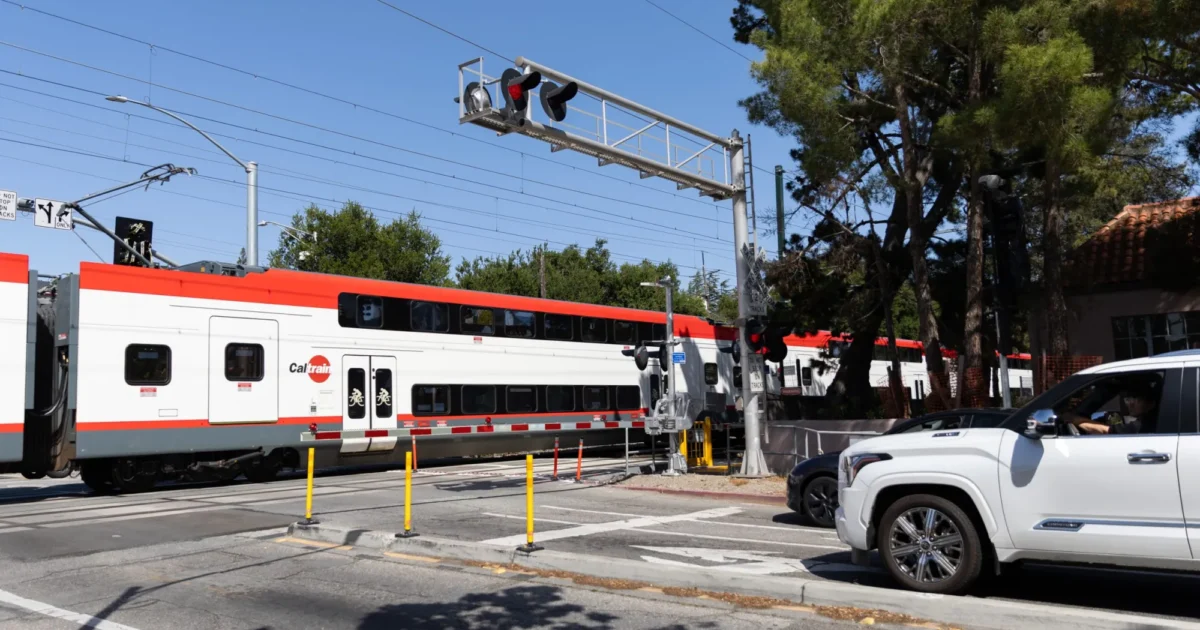
“Caltrain’s new RailSentry system identified occurrences where cars backed up from El Camino Real extended onto the rail crossing,” city spokesperson Meghan Horrigan-Taylor said, referring to the recently installed LiDAR system that tracks vehicle and pedestrian movements near the tracks. “This is obviously a problem with oncoming trains, and the city agrees with Caltrain that additional safety measures should be pursued prior to implementation of a quiet zone.”
To that end, the city has increased police enforcement near the crossing to monitor for cars illegally stopped on the tracks. Horrigan-Taylor said this is at no extra cost and is being used within existing police resources.
Additionally, City Manager Ed Shikada wrote in his summer recess report to the City Council that the city will continue to work closely with Caltrain, federal officials and the California Public Utilities Commission — which regulates all railroads in the state — to alleviate any outstanding concerns.
“These additional reviews and evaluations have extended the implementation timeline for the Quiet Zone while the City works collaboratively with the regulatory agencies to address the requested safety enhancements,” Shikada wrote in the report.
It remains unclear how much delay the additional review will add to the quiet zone implementation timeline. However, Horrigan-Taylor said the pavement striping to enhance safety at the crossing will fall within the existing fall 2026 project timeline.
The delays are specific to the Palo Alto Avenue crossing, and the quiet zone implementation at the other three are on different timelines, Horrigan-Taylor added.
As part of the budget process this year, city officials made quiet zone implementation at Churchill Avenue a priority and committed $1 million to the effort. This followed intense advocacy from the community that urged the city to close the Churchill crossing to vehicle and bike traffic altogether after a teenage girl died by suicide in February. Students, parents and educators at Palo Alto High School, which is steps away from the crossing, said it was triggering to hear the train horn multiple times a day because it reminded them of the classmate and friend they lost, and by closing the crossing to traffic, the horns would no longer sound.
While the City Council ultimately decided against closing the crossing, citing traffic congestion and logistical issues down the road, members decided it would become a priority to install more secure gates at the edge of the tracks so the crossing would be eligible to become a quiet zone. Council members were also concerned that closing the crossing, even temporarily, would jeopardize future quiet zone plans.
For the Palo Alto Avenue quiet zone, the next step is for the Federal Railroad Administration to issue a Notice of Establishment, according to the city’s project website.
“Once established, routine use of train horns at public crossings within the Quiet Zone will be restricted, enhancing the quality of life for residents while maintaining safety standards,” the website states.
This story originally appeared in Palo Alto Weekly. Riley Cooke is a reporter at Palo Alto Weekly and Palo Alto Online focusing on city government.