
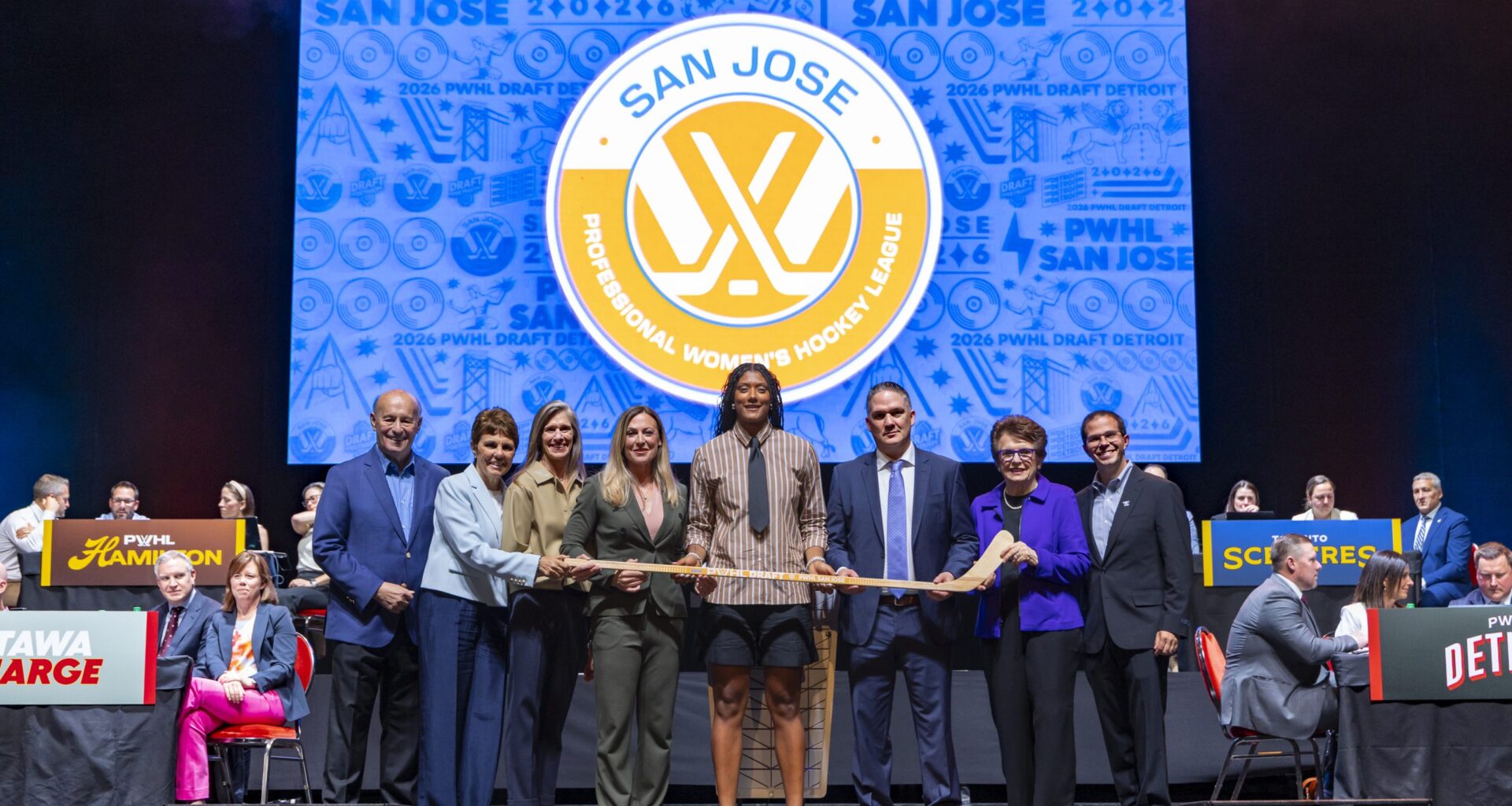
Just past midnight on June 18 — deep in the bowels of Detroit’s Fox Theatre — Troy Ryan began to share what was becoming a familiar story. Surrounded by a handful of reporters, PWHL San Jose’s dual general manager and head coach was asked about his decision to draft Northeastern’s Lily Shannon with the team’s fourth-round pick.
“She went a little bit later than I anticipated, so when we got to that point, we were like ‘we’ve got to take her now,’” Ryan said. “That she was still available at that point — we were excited, very excited that we were able to select her.”
As Ryan tells it, Shannon’s slide down the draft board to San Jose wasn’t unique. Instead, nearly every pick the expansion team made had a similar story. From No. 4 overall selection Laila Edwards to San Jose’s final addition, Reichen Kirchmair, Ryan’s explanation was roughly the same: When the clock got to San Jose, there was a name too good to pass up.
There’s another similarity between Ryan’s six selections — one that goes beyond his excitement to have them joining the newly constructed roster. All six played in a league in which Ryan has no previous coaching experience: NCAA Division I women’s hockey.
So how did Ryan — who admitted to putting hiring a hockey operations staff “on the back burner” to focus on expansion after being announced as PWHL San Jose’s general manager just 27 days before the draft — create his draft plan?
With the help of a pair of college hockey head coaches turned “draft consultants” — Clarkson’s Matt Desrosiers and Connecticut’s Chris MacKenzie — who for a month traded in their university colors for San Jose’s orange and blue.
“That draft would not be as successful if it wasn’t for those two people,” Ryan said. “Just being able to pick their brains, to be able to tap into the knowledge they have of the players’ families, their background, all those things were so valuable for me.”
Joining the Team
While Ryan may lack college hockey experience, he has plenty of college hockey connections. Thanks to his six-year reign as Canadian National Team head coach and his years in the national team’s U-18 program, Ryan’s roots stretch deep into the Canadian hockey world — one which relies heavily on college hockey to develop 18-to 22-year-olds.
Those connections don’t just include the players he’s coached — although that certainly helped him in both the expansion and draft processes — but also include the dozens of coaches who have joined him on the national team’s bench and at development camps. Needing help preparing for his first draft as a general manager, Ryan used two of those connections to build his draft team.
“I thought it would be the best way to do it. Instead of scrambling to put together a staff, hire people that are actively involved at the NCAA level,” Ryan said. “[They] have recruited these players since they were 15 or 16 years old, so they have a really good understanding of the players.”
From Desrosiers’ perspective, joining San Jose was a simple process.
“I just got a message from Troy. Troy and I have gone back a little ways, we worked at Hockey Canada together for quite a few years now,” Desrosiers — whose Hockey Canada resume includes coaching at the 2019 World Championship and a decade of work at various camps and junior teams — told The Ice Garden. “He just reached out and asked if I’d be interested in helping out with the draft.”
Muzerall’s assistants: Alison Domenico (Ottawa) and Marc-Andre Cote (Moncton)
Sunohara’s assistants: Matt Desrosiers (Clarkson) and Jennifer Wakefield (Penn State) https://t.co/IUxYCibjq5
— Kyle Cushman (@Kyle_Cush) July 30, 2026
MacKenzie’s story is similar. Alongside his 13 seasons behind the bench in Storrs, Conn. — which include a national Coach of the Year and a pair of Hockey East Coach of the Year awards — MacKenzie made his international coaching debut last summer with the Canadian National Women’s Development Team, where he served alongside Desrosiers.
“[Ryan] called me probably a month before the draft, maybe a couple weeks, it happened pretty quick. He was just asking about players, and one thing led to another,” MacKenzie told The Ice Garden. “I think what happened is a few other teams have hired college coaches to be consultants, and it’s something that I think caught his eye. He knew Matt and myself, so he asked us to help.”
🎉 COACH OF THE YEAR 🎉
Chris MacKenzie has been named @hockey_east Coach of the Year for the second straight season‼️
Big congrats to Coach Mac and his entire staff! 👏 pic.twitter.com/BRtHPwKrKp
— UConn Women’s Hockey (@UConnWHOC) March 5, 2025
Pre-Draft Planning
While this summer’s draft was Ryan’s first with San Jose, his three years as head coach of the Toronto Sceptres gave him experience prepping for the entry draft. After the list of 235 draft-eligible players was finalized, Ryan created a spreadsheet with each player sorted by position and other player-specific details. However, the goal wasn’t necessarily to create an overall list of the top 50 or 100 players. Instead, the three coaches focused on figuring out which players would line up with San Jose’s picks.
“It made sense to me how he wanted to do it: basically [to] have a group of players right around your pick, so that you know you’re gonna have an opportunity to take one,” MacKenzie said. “So as it leads up to your pick, you know what your needs are and you’re looking at anywhere from three to five players that you think you’re gonna take.”
With an understanding of what Ryan needed, MacKenzie and Desrosiers got to work.
 A view of Fox Theatre’s stage an hour before the draft began. (Photo credit: Eli Fastiff | The Ice Garden)
“A lot of [the pre-draft preparation] was going through the draft list trying to find out information on the players that were in the draft. Making phone calls to coaches that we know around the NCAA and getting background information on some players,” Desrosiers said. “Then, just trying to put together a list for Troy on where we saw players fitting in and where we thought they might go within the draft.”
This part of the process is where Desrosiers and MacKenzie’s time with the draft class made the biggest impact.
“I think with our experience in the NCAA, we know a lot of the kids from [both] our league and different leagues, since we’ve recruited them for years,” Desrosiers said. “We were able to build relationships with them and their families throughout the [college] recruiting process.”
Once the trio finally arrived in Detroit with their draft lists, they came together to finalize the draft-day strategy. In addition to comparing their varied player rankings, they also discussed San Jose’s roster needs.
What do Troy Ryan and #PWHLSJ need to target in tonight’s draft? Here’s an attempt at lines based on @PWHL_SanJose’s current 10 players:
Wheeler – tbd – tbd
Connors – O’Neill-Cherkowski
Mlýnková – tbd – tbd
Guilday – tbd
Keopple- Hartmetz
Pejsová- tbd
Schroeder
Tbd https://t.co/V1V2wvntQZ
— Eli Fastiff (@Eli_Fastiff) June 17, 2026
“We sat down together … and had conversations about certain players and what Troy was looking for with his draft picks,” Desrosiers explained when asked about how the group created its final draft board. “What type of players he wanted, what the main priorities were position-wise, and certain things like that.”
The biggest priority? Finding a center. San Jose entered the draft with just one rostered center — 28-year-old Kristin O’Neill — and the brain trust recognized that “there was a need for centermen and … players that had a little bit of flexibility and were able to play center and wing,” Desrosiers said.
Draft Day
Ryan, MacKenzie and Desrosiers’ preparation efforts paid off. Of the draft’s first 36 picks, MacKenzie remembers only one being “off the grid of where we thought they would go.”
Desrosiers, who like MacKenzie was participating in his first PWHL draft, described the trio’s attitude during the draft as “calm.”
“The way we had our draft board laid out, it ran pretty smoothly,” Desrosiers said. “Surprisingly, it was pretty close to the way that we thought it was gonna go down.”
After Edwards, San Jose’s second pick was Sloane Matthews, a center from Ohio State who the group had circled early on in their scouting process.
 Sloane Matthews stands alongside Troy Ryan after her selection by PWHL San Jose. (Photo credit: PWHL)
“[Matthews] was someone we liked right off the bat from this whole process,” Ryan said. “We were like, ‘Where do we have to position ourselves to find a way to get Sloane?’ We were really very happy that it landed that way.”
From there, MacKenzie and Desrosiers’ impact became obvious. The final four picks of San Jose’s draft all hailed from Hockey East or ECAC Hockey, Connecticut and Clarkson’s conferences. That run began with the selection of one of MacKenzie’s former players, goaltender Tia Chan.
Wow! #PWHLSJ takes goaltender Tia Chan with its third round pick. San Jose already has Corinne Schroeder on its roster, so Chan will likely start the season backing up the former Torrent. pic.twitter.com/sDlXp82S3Z
— Eli Fastiff (@Eli_Fastiff) June 17, 2026
Unlike in drafting Edwards (a major offensive weapon) or Matthews (likely a future top-line center), the reigning College Hockey Goalie of the Year didn’t fill a position of need going into the night. But the availability of a netminder that high on San Jose’s draft board was irresistible.
“I thought she would have been taken sooner,” MacKenzie said. “I really thought she was going to go to Detroit.”
“We didn’t go into the draft thinking we [needed to] draft a goalie early,” Ryan said the night of the draft when asked about the decision to select a goaltender despite already signing Corinne Schroeder. “As the draft went on, we still saw some players on the table that were going to be available later, and we thought what an opportunity to take someone of that caliber at that point in the draft.”
After grabbing a backup goaltender, the group returned to its primary draft-day goal: finding PWHL-ready centers. San Jose’s final three picks — Shannon, Mckenna Van Gelder and Reichen Kirchmair — all served as centers in college, and all were familiar to MacKenzie and Desrosiers.
“At that point in the draft we wanted a centerman or two,” MacKenzie said. “Shannon was a pretty good option at that point in the draft. Kirchmair was the last pick, she was a Player of the Year in the conference at one point. So I was familiar with those players. Van Gelder was a Cornell pick. I think Matt was a little more familiar with her.”
“Mckenna was a player that obviously played against us for four years. I’ve had some previous experience with her at Hockey Canada camps as well, and she’s a player that was tough for us to play against,” Desrosiers said. “She could fulfill a lot of different roles.”
With his advisors having plenty of experience with San Jose’s final picks, Ryan seemed eager to talk up all of his selections after the draft, noting he got emotional after Shannon told him “thanks for believing in me” after her selection, how Van Gelder is “my type of player” thanks to her reliability from the faceoff dot and leadership (“her old coach said she’s the best leader they’ve ever had”), and the strength of Kirchmair’s shot (“there’s very few people that shoot like she does”).
Lessons Learned
While Ryan exited the draft process with six selections and plenty of new knowledge on the Class of 2026, both Desrosiers and MacKenzie returned to their campuses having learned important lessons as well. The two are now part of a small group of college coaches with PWHL experience.
“It was great to work with Troy and get an understanding of the inner workings of the league itself,” Desrosiers said. “There was definitely a lot I was able to take from it.”
In fact, getting a better grasp of the fundamentals of the PWHL was one of the main reasons Desrosiers agreed to consult.
“That was a big reason why I did it. I wanted to help Troy out … but for myself, I’m always looking for ways to learn and get better,” he said. “This was a great opportunity for me to learn some of those things through this process.”
On the other hand, MacKenzie’s main conclusion from the experience wasn’t a new revelation.
“I think I confirmed that you really don’t know what’s going to happen with a player that’s coming from college to pro,” he said when asked what he’d learned working for PWHL San Jose.
While MacKenzie usually has four or five seasons to watch his players grow and develop, PWHL front offices sometimes have just a single season to get the most out of a player. So if a team’s locker-room environment, coaching staff or development program mismatches a player’s preferences, there isn’t always time to adjust.
“You don’t have to have that much patience,” MacKenzie said about the difference between putting together a college and PWHL roster. “You can sign someone for one year, and if it doesn’t work, you can move on to the next situation.”
PWHL San Jose fans hope that won’t be the case for any of the team’s six draft picks. And on that summer night in Detroit, it was easy to imagine how all six players might fit into Ryan’s budding roster. But only time will tell if relying on a pair of college hockey coaches with no previous professional women’s hockey experience to build a PWHL roster will pay off.
Related