
After years of meandering closed-door negotiations and a string of big changes to one of the biggest real estate deals in Alameda County history, the sale of the Oakland Coliseum to a group of private developers appears to be on track.
To prove that things are going in the right direction, the man financing the deal has emerged to talk about it.
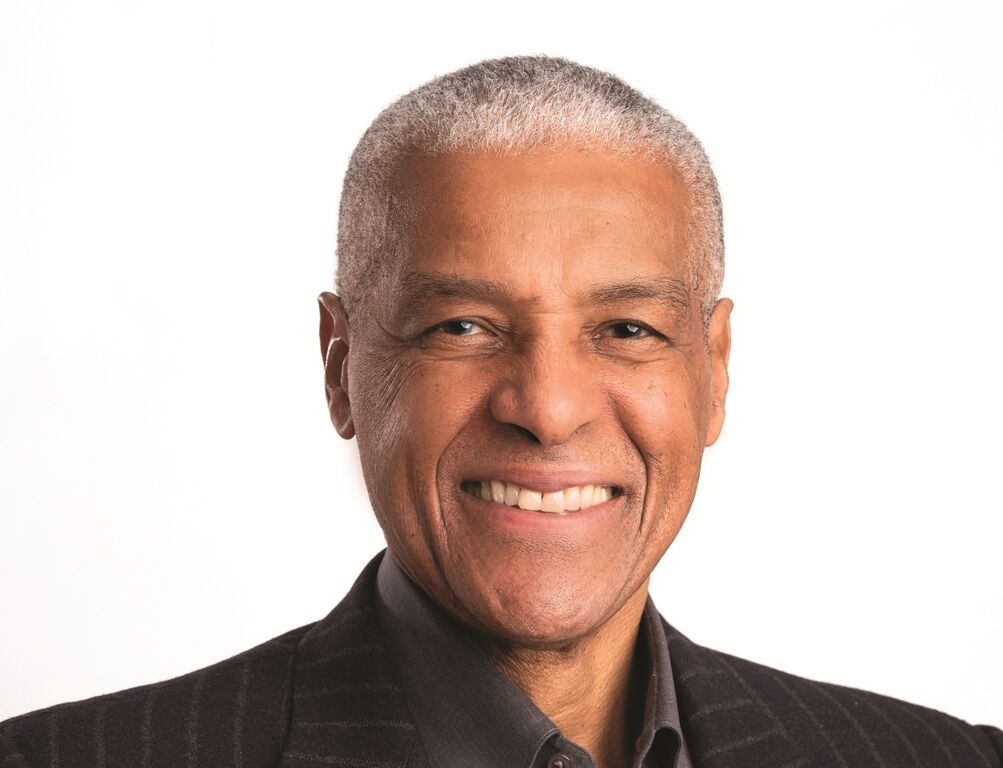
Jim Reynolds, the founder and CEO of Loop Capital, a Chicago-based investment bank is a key member of the African Americans Sports and Entertainment Group, which has been in negotiations with the Alameda County and city of Oakland to purchase and transform the Coliseum.
Reynolds has avoided the limelight, leaving AASEG’s frontman, Ray Bobbitt, to handle ceremonies, press conferences, and to generally answer questions about the many twists and turns the complex transaction has taken, including a failed attempt by former Oakland Mayor Sheng Thao to link the deal to city budget-balancing maneuvers.
Recent positive developments have prompted Reynolds to surface. Last month, Oakland approved an updated agreement to sell the city’s 50% stake in the Coliseum property, which will theoretically net the city $50 million as early as September, depending on when the sale is closed. And Reynolds and his team plan to sell the Arena property to Oak View Group, a company founded by the music mogul Irving Azoff. Reynolds says that the county is close to finalizing their side of the deal also.
“We feel like we’re getting close to the goal line,” Reynolds told The Oaklandside on Thursday.
The following interview with Reynolds and Bobbitt has been lightly edited for length and clarity.
You’re a Chicago investment banker. Lots of people in Oakland had never heard of you until you joined AASEG to pursue the Coliseum redevelopment. Briefly, what draws you to Oakland and this partnership with AASEG?
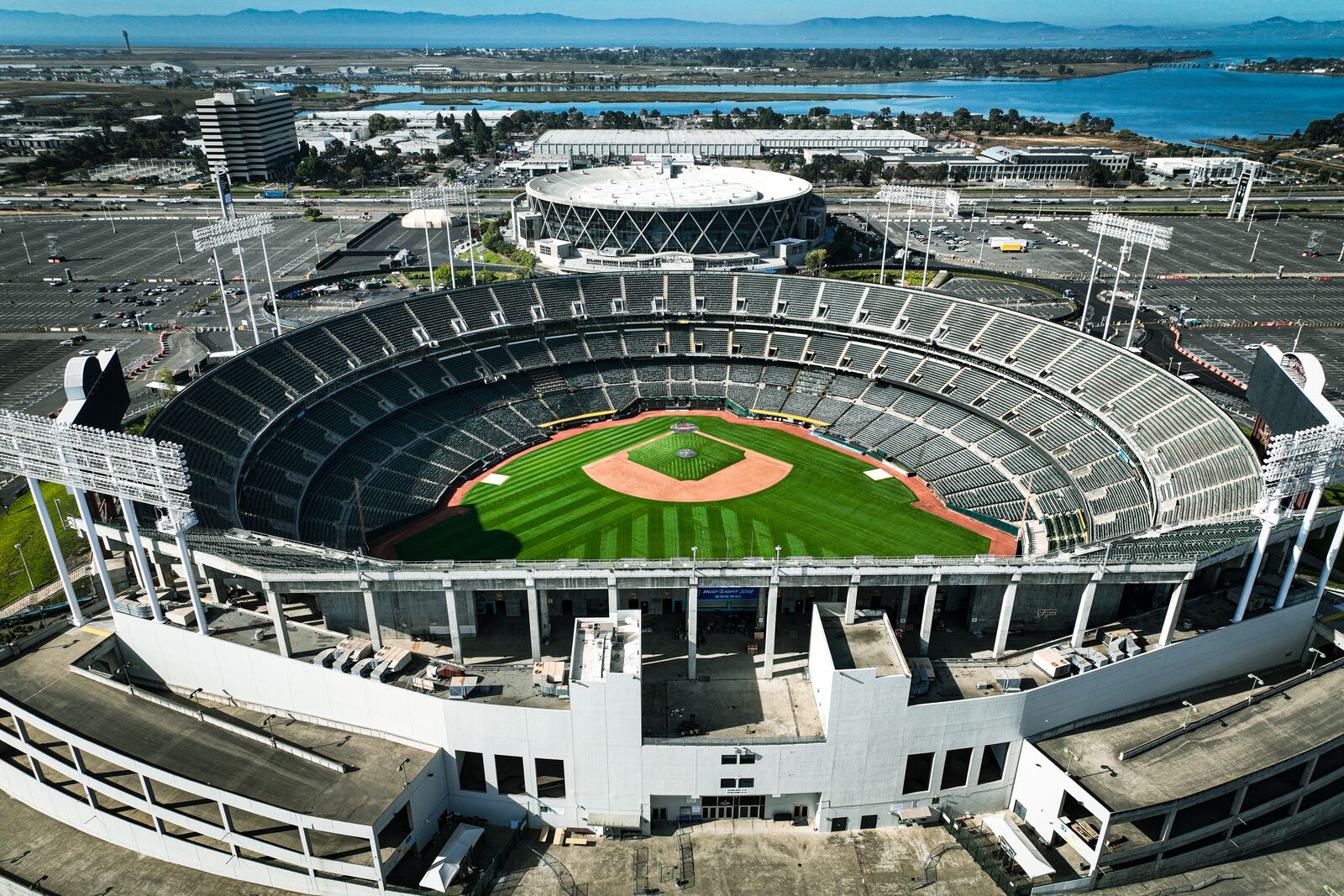 An aerial view of the Oakland Arena and Coliseum on Oct. 4, 2024. Credit: Richard H. Grant for The Oaklandside. Credit: Richard H. Grant
Reynolds: Well, I’ll tell you what drew me initially — Ray. When we started out, five, six years ago, Ray Bobbitt and a gentleman named Bill Duffy called me while I was in the dentist chair under anesthesia. Ray persuaded me to come to Oakland to work with him to try to get a football team back here. The Raiders had gone. That morphed into the league not supporting that and that not happening.
Then Ray presented to us the real estate opportunity here. That was initially how I learned about the opportunity.
After visiting Oakland it really didn’t take long for me to realize — you don’t get to where I am and not be able to spot value, spot a gem, when you see one. I had never been to Oakland before. I had never really thought a lot about the city itself. I just saw and was aware of a lot of the amazing people that came out of Oakland, as Ray and I talked about. I thought Oakland was so much bigger because it punched so far above its weight, with the artists, the sports, the other celebrities that came out of here that were just amazing. Chicago is similar, but Chicago is bigger.
And so I got to Oakland and saw what was going on, particularly with this site, particularly with this city. The attractiveness of it, I just couldn’t believe it. I fell in love with it. I knew there was something here that could develop and could be better. And Ray and the team came together, and this is where we are.
There’s been a lot of twists and turns in this deal. Where do things stand exactly right now with the City and the County? What’s needed to finally lock in the agreement and move to the development phase?
Reynolds: This was complicated because it’s the first deal that I’ve ever done where you negotiated with two parties, over the exact same interest, I guess.
I’ve bought land, and we’ve done deals where two people own parts of the land or own parts of the company and you buy their share, and you may or may not buy the other share. But here it’s not like that. It’s two parties that have an undivided interest, 50% each. So you can’t actually do anything with either of them unless you own all of it. You can’t develop half of the site because you actually won’t own half the site. So it got very complicated when we first got here, because at that time the city and county not only had 50% undivided interest in the site, they didn’t like each other or speak to each other. Which was kind of news to me, and to try to navigate a negotiation like that was difficult.
One of the things that really provided a significant breakthrough was Barbara Lee becoming mayor. A serious individual, a worldly individual, who knows how to get things done and has done them at another level, a bigger level. Very disciplined.
We’ve also had a great relationship with county supervisors Nate Miley and David Haubert. That also was a breakthrough, because those two were able to talk together, and the administrations of each side talked together.
One of the reasons you’re talking to me is we feel like we’re getting close to the goal line. We’ve negotiated the final terms with the city. That was signed a couple weeks ago.
Now, the job is to do that same thing with the county. The good news is that when we started negotiating with the two of them, the county wanted to see us get the deal done first with the city. And then the county would look at the term sheet we put together with the city and see if we could largely mirror that. So right now, that’s exactly what we’re doing. We’re gonna start talking with the county in earnest, looking at the terms we’ve agreed to with the city, and seeing how they fit with the county. And we think we should be pretty close.
You’re talking about taking that term sheet the county’s leaders approved in May and turning that into a formal purchase and sale agreement?
Bobbitt: I think the city process is pretty straightforward. We were already in a purchase and sale agreement. So we got a second amendment to that agreement. Now that’s approved by ordinance, so that gives the city the right to negotiate to completion.
With the county, we have a nonbinding term sheet. Now we have to go to long form there, and then we’ll have one more approval. It’s very similar, but we’re tracking the same length.
And the other piece that Jim didn’t compliment himself for was being able to get the Coliseum Way Partners to be very cooperative, and Communities for a Better Environment.
All of those pieces had to come together before there could be certainty about the transaction.
Editor’s Note: Coliseum Way Partners is a business entity affiliated with the Athletic’s baseball club. Alameda County initially planned to sell its stake in the Coliseum to Coliseum Way Partners. County officials had to undo that deal so they could sell to AASEG’s Oakland Acquisition Company. The nonprofit environmental advocacy group Communities for a Better Environment sued the county for allegedly bypassing the Surplus Land Act. Per the terms agreed to in May, the Oakland Acquisition Company will secure the dismissal of that lawsuit.
Have you ever handled a real estate transaction that was as complex as the Coliseum deal?
 A rendering of what the transformed Coliseum property could look like under the AASEG and Loop Capital. Rendering provided by Loop Capital and Gensler.
Reynolds: No. When I’ve talked to developers and told them what we were doing — including developers from Chicago, New York, other parts of California — we were told we were crazy and we’d never get it done. I didn’t have any experience with what they were talking about. I really didn’t understand what they were saying. I subsequently learned exactly what they were saying.
One of the things that helped us a lot was Ray, and Ray’s family, his legacy here, his support in the community. I think the community is really the unsung hero in this transaction. When we speak to the county, when we speak to the city, if there’s an open forum, that place is filled with folks that know Ray, and his family, and they know his commitment to helping build the city of Oakland. When that many people come out and speak consistently, the political leadership has to listen.
Beyond that, we’re talking about thousands of jobs. We’re talking about transforming businesses. We’re talking about building Black and Hispanic and female businesses to levels that really haven’t been built before. We’re talking about building youth.
I come from Chicago’s South Side. When I got here, I heard people in Oakland talk about crime. I know a little bit about crime, coming from Chicago. I heard people talking about the finality of it, but not the changing of it, not bending the curve of it, not creating jobs, job training, and skills, and putting money in the hands of more people, such that crime isn’t as attractive an option as it may be if you don’t have those things.
When we look at this, and look at how we’re thinking about Oakland, I’m thinking about how there’ll be thousands of new jobs created. Hundreds of millions of new dollars in city coffers, from the economic development that will occur there and taxes that’ll be paid there. The amount of savings to the city and state from people who may be on the social roles, that are actually gonna go on the economic activity roles. The GDP that is gonna grow out of Oakland with the activity at that site. There are so many exciting things that will come up out of that site that now sits fallow. There’s nothing much moving there right now except the arena. So we’re excited.
Bobbitt: I think that’s a great point. We haven’t been able to tell the story from Jim’s perspective. I’ve been really front and center. Primarily because there was no there there. It was such a complex deal that we could never say with certainty it was completed. We might say it’s completed, and celebrate, and then we’d have to have another celebration for another completion. I know there were always questions from an economic and financial perspective, but we never wanted Jim out until we saw we were on the precipice of this deal.
So I would say the arena is a great example of a first phase. You have to understand: It was Loop Capital and its affiliates who brought Oak View Group. We needed to invest in the arena to keep it competitive with the Chase Center in San Francisco. Chase is brand new. We also needed to make sure the investment that’s gonna happen at the South Bay arena didn’t make us noncompetitive.
Irving Azoff’s company Oak View Group is positioned to buy the arena. Assuming that goes through, you guys will be working elbow to elbow. It sounds like there was a relationship with him? What’s your plan for working together?
 Music mogul Irving Azoff wants to buy the Oakland Arena from a group of developers who are in the process of trying to purchase the entire 112-acre complex from the city and Alameda County. Credit: Eli Wolfe/The Oaklandside.
Reynolds: I think it’s a symbiotic relationship. We have to work together.
The entire site has to be complementary with itself. Clearly we wouldn’t have Oak View Group in an arena, and then we put another concert venue a few feet away. With Oak View Group coming there, creating probably one of the most visited attractions in Northern California, with the acts he’s going to bring via LiveNation, we’re going to have a visitor roster that actually fills up restaurants, hotels, entertainment venues, and the like.
So we’re going to build things that not only complement, but also accentuate the value of what we’re bringing to the arena. We’ll work very closely together on that development. Remember, it’s one development. It’s not just an arena that sits there by itself. The entire Coliseum project is one development that is going to be very complementary to each other.
Are you able to talk about what is going to happen to the stadium itself? What is its fate?
Editor’s note: Reynolds and Bobbit declined to speak on the record about this.
Some skeptics of this deal have asked if Loop Capital has the money to bring this project to fruition. What can you tell us about Loop’s financing? How are you going to raise the money to complete the project?
Reynolds: There’s nothing complicated about this project. It’s funny, I said to Ray, we joke about the thousands of deals I’ve done, and trillions of dollars I’ve raised, never once, and I’ve been doing this for 30 years, never once has anybody ever asked us, do we have the money? I mean, not one time. That includes deals that are significantly larger than this.
The financing capability here is not an issue. One of the reasons those questions came up is because the finance part of Ray’s team was not present. Folks know Ray as a community organizer, a community person at the highest level, and they elevated him to actually doing everything on this project. Loop is actually the financial arm of this project. So the ability to raise the purchase price of this land is not a big purchase price. It’s $240 million all in. We’ll sell $100 million of that. So it’s only $140 million of that. That’s not a big ask and not a big lift.
When we move forward with this during the phasing, it’s probably going to be a $3- to 5-billion-dollar phasing project, including investing in all of the housing, the business, the entertainment, the restaurants, hotels, and the like. That’s really more of something that is of scale. But not the purchase price of this land.
One of the reasons we’re doing these interviews is so that folks can see the depth of this financing team, and the experience of it, and the amount of financing we raised in the past.
Bobbitt: One of the things I gladly took on is — I’ve taken a lot of bullets for that question. Because of the sometimes unstable environment of Oakland, from a municipal perspective, and the uncertainty of completing a deal of this complexity, I wanted to make sure that Jim and Loop were never in a position to be criticized directly. So I took that hit.
But then I had to be very careful about talking about that type of thing, because clearly I’ve never said I was going to personally write a check for that amount of money.
I always wondered: they created this thing called Google, where you could just google Loop Capital. And you could see the level of capital they raised and worked with.
Speaking of the city’s coffers, one question on a lot of people’s minds is when is the first tranche of money supposed to come through? I believe between September and January you’re supposed to pay that first $50 million. Will that happen in September? Or later?
Reynolds: We talked about the complexity of the deal. So the strategy was to get the city’s deal done first. Which we’ve done. We actually don’t have the deal until we get the county’s deal done. We understand from the county that the terms would largely mirror the terms we’ve agreed to with the city.
So now we’re going over to the county to get that deal done. As soon as we have successfully acquired both parties’ interests, we’ll have 100% of the site. Immediately thereafter, we’ll sell the arena to Oak View Group.
The plan is to get the county’s deal done as quickly as we can. We’re hopeful that could be a week, two weeks, three weeks. That’s the plan.
What did you think of Sheng Thao’s proposal in 2024 to link the sale of the Coliseum to the city’s need to balance its budget? Did that surprise you? What were you thinking at the time, and what do you think now? I’m giving Ray a migraine.
 AASEG founder Ray Bobbitt, Oakland Mayor Sheng Thao, and City Administrator Jestin Johnson signed a term sheet for the sale of Oakland’s stake in the Coliseum on July 30, 2024. Credit: Eli Wolfe / The Oaklandside.
Reynolds: That’s why I’m going to let Ray answer that. He was rubbing his head. Let’s let Ray answer that.
Bobbitt: Let me just start by saying we are on our fifth mayor since we started negotiating this project. I think that process was very, very challenging. And I think the concept of paying that amount of money to the general fund, with no incremental conveyance, and no ability to take any ownership in the property as you made the payments, made it very, very complicated.
As you’ve seen, we initially agreed with the $5 million, which is nonrefundable. But we quickly went to a first amendment, which we had to figure out. Now, we did put $10 million into a single custody escrow just to make sure the city knew we had it. But from that point forward, we had begun to work with the city to do what finally happened, which was for them to pass an ordinance in May of 2025, where they terminated the installment, and they kind of got back to a regular form for the deal.
And I’ll end with this: it was complicated, it was stressful, it was difficult, because the way that deal was constructed, everybody in the real estate industry, the development industry, they couldn’t believe that was even being proposed.
Paint a picture for me of the Coliseum site’s future — what are people going to see when you guys are done?
Reynolds: That’s the part of this whole journey that’s most exciting. It’s the part that’s kept me very interested and engaged. In my travels, I go to a lot of places, and I think Oakland is one of the most beautiful cities I’ve ever seen. I think there’s no limit to the potential of Oakland, there’s no top. The people here, the talent there, the beauty here, there’s just nothing like it naturally.
We’ve got drawings, and you’ll get drawings; we’ve actually put those together. There’ll be thousands of jobs created. By the time we’re done, the business community in Oakland will be larger, particularly the Black and brown business companies here will be bigger. We think the youth will be much more engaged. The vitality of the city, the GDP of the city and the county will be significantly higher. The housing stock will be far superior to what it is now. And the vitality in and around here will be significantly bigger than what it is now.
Bobbitt: In the last four years, we sponsored a field trip for Castlemont High School’s architectural program, and for the rest of the semester, they worked on three-dimensional designs of what they would like to see the Coliseum to be. Right at the end of the semester, we sponsored and funded a showcase where all their family and parents came.
And the last time we were at a meeting with the county in May, one of the students — we didn’t even know she was coming — showed up with her 3D design for the Coliseum, and specifically talked about how important the growth was, and how so much of Oakland is painted in a negative picture, and this project seemed like a light to her. It was a beautiful display of Oakland’s cultural consciousness coming from one of our kids. And I think it was derived from the thoughtfulness we put into this project.
“*” indicates required fields