
Over six weeks this summer, a labor union’s push to amend Chula Vista’s governing charter split the City Council, drew accusations of a backroom deal between the mayor and a union representative, and then collapsed under the weight of public backlash — all before it ever hit the ballot box.
What began as a 13-point package promising modernized government — including pay raises and extended term limits for council members, as well as contract advantages for the city’s public safety employees — ended instead in dueling narratives: a mayor who says he was offered a quid pro quo, a union leader who calls that accusation absurd, and four council members who insist they never wanted any of it in the first place.
The paper trail — and the people whose actions it recounts — tell a messier story.
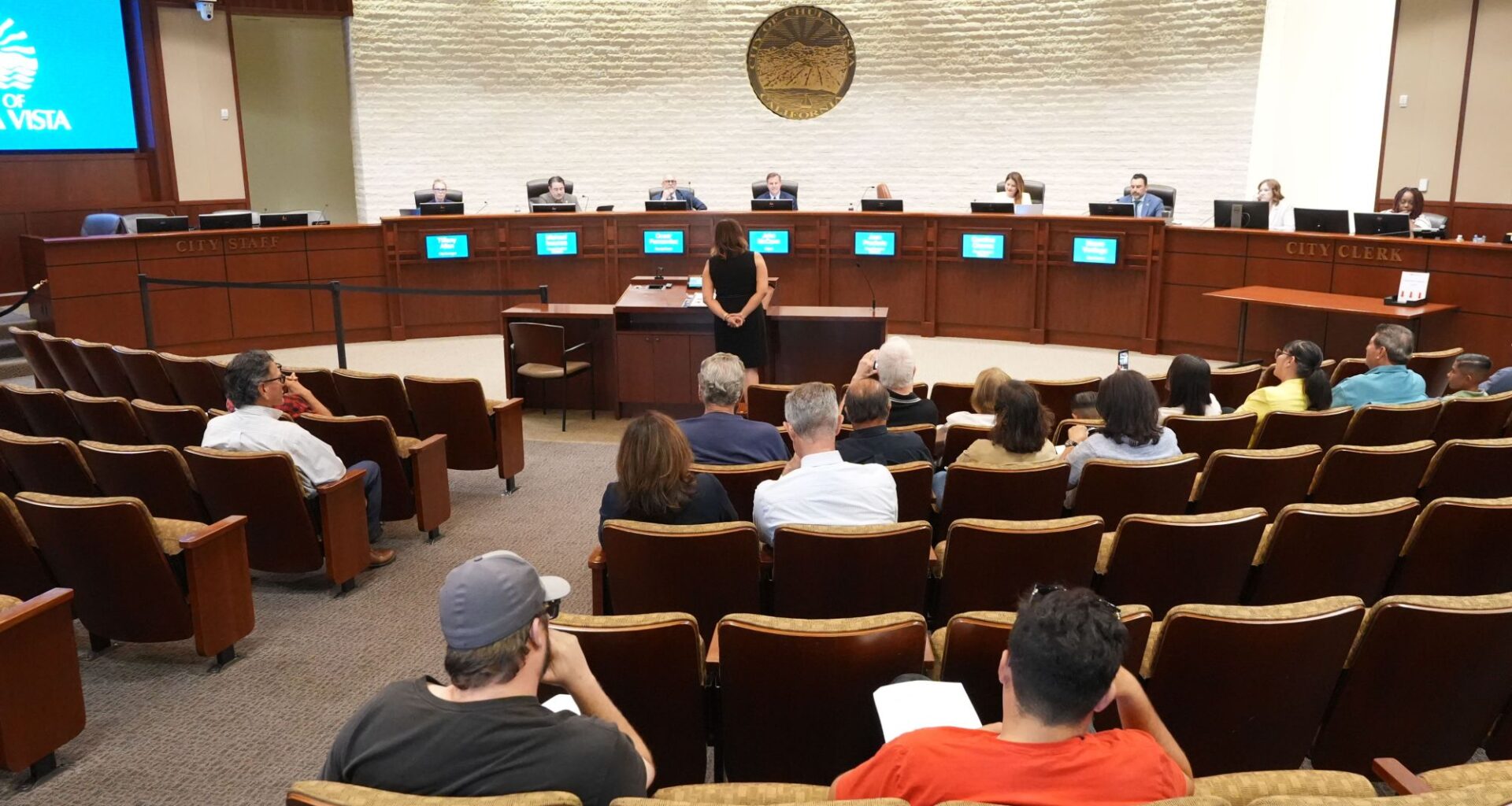
The Chula Vista City Council voted 4-1 on July 21 to pull the charter package from the November ballot, sending it instead to the Charter Review Commission with no timeline for its return. A second 4-1 vote barred the commission from even considering the measure’s proposed pay raises or a shift to full-time council status.
The package, submitted by the Laborers’ International Union of North America Local 89, would have raised council salaries from roughly $64,600 to $110,000 a year while allowing council members to keep their full-time jobs, extended term limits from two terms to three, created a new Salary Setting Commission to determine future salary increases for elected officials, given the Ethics Commission subpoena power, imposed new lobbying disclosure rules and granted binding arbitration to police and fire unions in contract negotiations.
City spokesperson John Cihomsky said in an email that elected officials first received the proposal June 16 — the same day LIUNA presented it during public comment.
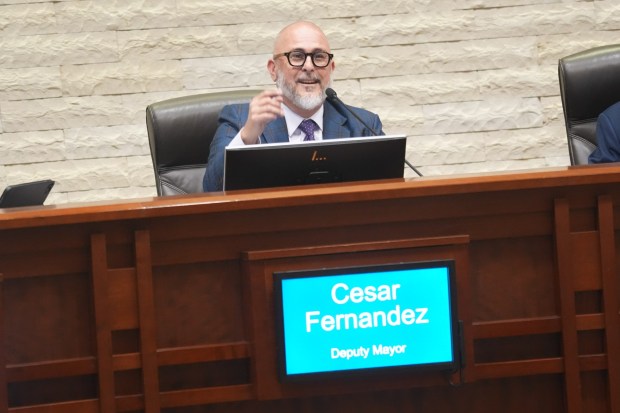 Chula Vista Deputy Mayor Cesar Fernandez speaks during the city council meeting at Chula Vista City Hall on Tuesday, June 2, 2026 in Chula Vista, CA. (Michael Ho / For The San Diego Union-Tribune)
‘There’s a lot here’
LIUNA policy director Kelvin Barrios said in an email the union spent months researching charter amendments and reviewing “best practices from charter cities throughout California” before bringing the proposal to Chula Vista. The goal, he said, was to encourage the city to “modernize its Charter and ensure it reflects today’s expectations for transparency, accountability, and effective local governance.”
Deputy Mayor Cesar Fernandez, who moved to formally agendize the proposal during his council comments at the end of the June 16 meeting, said LIUNA first reached out in March, and by the time a full draft landed in his inbox on June 16, the scope caught him off guard.
“Whoa, there’s a lot here,” Fernandez said in an interview prior to the July 21 council meeting.
All members of the City Council interviewed for this report, as well as Barrios, maintain that Local 89 crafted this package independently of council or city support.
The measure was then first heard at a July 14 council meeting, where Mayor John McCann’s motion to strip the proposed pay raise failed to receive a second and a separate motion to route the package through city commissions before any ballot action also stalled. City Attorney Marco Verdugo also chimed in during the meeting and said he could not provide legal counsel as the salary increases would also impact him.
“My office is working on an agreement with outside counsel to advise on any aspect of the proposal that impacts the city attorney’s salary structure,” Verdugo said.
The council took no formal action that night. The proposal then returned July 21 and was struck from the ballot.
Brian Adams, a political science professor at San Diego State University, said unions like LIUNA hold outsized sway in local politics less because of the size of their donations than because of their ability to mobilize votes and fund challengers against officials who don’t align with their interests.
“Their endorsement does matter for their members,” he said, adding that police and firefighter unions in particular wield significant influence locally because of their capacity to deter opposition.
Adams said he was nonetheless surprised by the scale of this particular push, calling it “over the top” compared with how major campaign contributors typically operate. He said public officials are underpaid compared with other comparable jobs, but called the proposal’s structure — a six-figure salary for a still technically part-time job, allowing officials to keep their current day jobs — “crazy.”
“Usually I think the powerful interests are a little bit more sophisticated in how they go about doing these things,” he said.
Former City Manager Dave Rowlands, who ran Chula Vista from 1998 to 2006, was far less charitable, saying the entire process sidestepped the public hearings and charter review scrutiny that normally accompany such changes.
“They gave (the public) no time and tried to jam this in at the last minute thinking no one would notice,” Rowlands said. “This is a textbook example of how you do not do it.”
The council’s take
McCann said his council colleagues supported the measure, only reversing course after fielding public opinion on the matter, which was largely against it.
“As public pressure grew, the council reversed course at the July 21st meeting and supported removing the measure from the November ballot,” he said.
At both the July 14 and July 21 council meetings, dozens of residents packed the chamber to voice their opposition to the measure. Erica Brancato, a resident of Chula Vista speaking at the July 21 meeting, expressed concern with salary increases for what would still be considered a part-time position, as well as the term-limit increases.
“Massive salary increases when times are tough? It’s deeply concerning to see this council consider doing that,” she said. “If you’re looking for a place to suspend our hard-earned tax dollars, look out our window. Our community has real needs.”
After the July 14 meeting and prior to the July 21 vote, Fernandez said he liked the transparency provisions — strengthening the Ethics Commission, tightening lobbying rules — but wanted the term-limit reset stripped out. As for his own pay, he was careful not to tip his hand, citing possible Brown Act concerns prior to voting on the measure, though he didn’t hide where his sympathies landed.
“I’ve got residents in my district that are struggling to make rent and put food on the table,” Fernandez said. “I don’t need to be increasing my pay at the city.”
Councilmember Michael Inzunza put it more bluntly, rejecting any suggestion the council ever backed the measure.
“The City Council was never in support of this ballot measure,” he said, calling the term-limit reset “absurd” and the pay raise for a still-part-time job something he “would never support.”
Councilmember Jose Preciado, meanwhile, said he was legally barred from coordinating with LIUNA while they spent independently to support his re-election campaign during the spring primary.
“They’re a large part of South County politics,” Preciado said of LIUNA, adding he was not made aware of the proposal prior to receiving the ballot measure on June 16. “You just assume they’re working on stuff.”
Asked whether that money spent on his re-election campaign bought influence over him, Preciado said he was going to oppose the proposal at the initial July 14 meeting — but that he was absent due to a health-related matter.
“I was (going) to say no, no pay raises, no full-time, that’s what I would have advocated for, but I wasn’t there,” Preciado said.
Preciado ultimately joined the majority on both July 21 votes, supporting the measure’s removal from the ballot and backing the motion barring the Charter Review Commission from considering the pay raise or full-time status.
City Councilmember Carolina Chavez, who is running for re-election in November and has benefited from independent expenditures made on her behalf by LIUNA, did not respond to several requests for comment.
The union’s political spending is a matter of public record.
Campaign filings show a LIUNA-sponsored committee, San Diego Labor Coalition, poured $158,811 into supporting McCann’s opponent, Francisco Tamayo, this year. The union spent $48,131 to back Chavez and $28,142 on Preciado during the same period. Filings show the union used funds to pay for text messages and mailers, as well as “Design & Voter File” — covering the cost of pulling voter contact lists and designing the actual campaign mailers or ads sent to them.
All three campaigns started receiving that money on or around April 30 for the spring primary — weeks before the charter package was submitted, and weeks before a private June 12 meeting between McCann and LIUNA’s Barrios that would later become the center of the entire controversy.
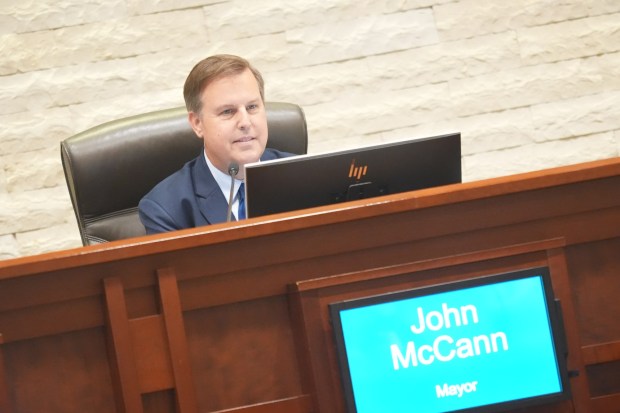 Chula Vista Mayor John McCann speaks during a city council meeting at Chula Vista City Hall on Tuesday, June 2, 2026 in Chula Vista, CA. (Michael Ho / For The San Diego Union-Tribune)
’A money grab’
McCann says that meeting amounted to an improper offer, though in written responses he declined to spell out what was actually said, or by whom. On the dais during the July 21 council meeting, McCann said he was told LIUNA would not support Tamayo if he supported their charter amendment package.
In his written responses, McCann said he has “notified the appropriate law enforcement agencies of my concerns and threats against me.” McCann did not say whether he notified the city’s Ethics Commission, the District Attorney’s Office or another agency.
Barrios flatly rejects the quid-pro-quo framing. LIUNA had already endorsed Tamayo and put real money behind him before the meeting ever happened, he said, making any offer to switch sides “false and politically motivated.”
“We have never supported John, and it certainly was not going to start now,” he said, describing the meeting as a courtesy briefing, not a negotiation.
LIUNA, which largely backs Democratic candidates, has spent heavily against McCann, a Republican, throughout his career, favoring Democratic opponents such as Tamayo, Preciado and Chavez.
On the question of pay raises, McCann said his July 14 motion to strip the pay raise died without so much as a second from his colleagues, signaling his colleagues’ support for the proposal.
“Their silence spoke volumes,” he said, calling the whole package “a money grab.” He maintains a “clear majority” backed the measure that day — a claim Inzunza rejects outright.
McCann further alleges Inzunza voted to preserve the salary increase at the meeting where the package was ultimately pulled. Inzunza tells it differently: his dissent in a 4-1 vote on McCann’s motion to remove pay raises and full-time consideration, he said, was about defending the Charter Review Commission’s independence from council interference, not about the money at all.
“As a former volunteer on the Charter Commission for five years, I took offense that the mayor was trying to bully or mandate or prevent the Charter Review from discussing items that should be under their own autonomous control,” Inzunza said.
Behind the political theater sat a more technical fight over binding arbitration. Chula Vista Police Officers Association President David Martinez said LIUNA approached police and fire unions before submitting the package, seeking their backing specifically for that provision. The unions’ shared attorney drafted the arbitration language.
Everything else in the package, Martinez said, came from LIUNA alone.
Martinez said the city has long resisted binding arbitration at the negotiating table, since it forfeits leverage the city holds by virtue of police and fire being barred from striking. Under binding arbitration, if the city and a union reach an impasse in contract talks, a neutral third-party arbitrator steps in to decide the terms, and both sides are bound by the outcome.
“The city will never give us binding arbitration,” he said, adding that without arbitration, if the two sides can’t reach an agreement, the city can just tell the union to take what’s offered or go without a contract. “It would be like, ‘Well, this is all you’re going to get. You can take it or leave it.’”
Cihomsky, the city spokesperson, offered a more measured take: binding arbitration, he said, technically “can be negotiated” without any charter change at all.
Adams, the SDSU political scientist, said the whole approach struck him as unusual.
“I can’t think of another example” of a union pursuing binding arbitration through a ballot measure rather than negotiation.
‘Public opinion matters’
Barrios said the union also examined a similar effort underway at the county level, which proposed extending term limits from two terms to three, and concluded Chula Vista voters should have the chance to weigh a comparable change locally.
He said LIUNA did not propose requiring council members to serve full-time, though the union believed any salary-setting body should account for “the significant time commitment and responsibilities of the office.”
Cihomsky said neither the city charter nor the municipal code requires a proposed charter amendment to go through the Charter Review Commission or any other city body before the City Council acts — the commission’s role, he said, is strictly advisory.
He also confirmed the charter places no numerical limit on how many provisions may be amended at once, noting the city’s 2022 Measure K similarly overhauled multiple charter sections in a single vote.
In the end, Adams said, the council’s reversal was less a mystery than a reflex.
“Public opinion matters to elected officials,” he said. “When the public does pay attention, when they speak up, elected officials do listen.”
For now, the measure sits in the hands of the Charter Review Commission, with no guarantee it resurfaces before Chula Vista voters — if at all — until 2028.