
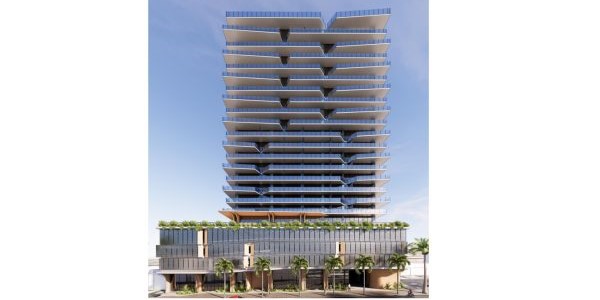
While the city of San Diego and the developer behind the proposed 23-story complex on Turquoise Street not far from La Jolla’s southern boundary — known as the “Turquoise Tower” — still find themselves in a cycle of project reviews and resubmittals, a local advocacy group continues to rally against the project.
Neighbors for a Better California, formed in response to the proposed development roughly two years ago, held a virtual meeting Aug. 4 to discuss the status of the project. Moving forward, similar informational meetings are expected to take place every month.
The project and where it stands
Real estate investment firm Kalonymus Development Partners LLC filed a permit application with the city’s Development Services Department in August 2024 for the $185 million high-rise project planned for 970 Turquoise St.
Locals, including in La Jolla, have since dubbed it the “Turquoise Tower” and have protested its size, which, at 239 feet, would dwarf the city’s 30-foot coastal height limit. It would do so via a state density bonus law that supersedes local voter initiatives and planning rules, allowing developers to add to their projects for including certain number of units that are considered affordable for lower-income residents.
Ten of the proposed 214 residential units are designated for very-low- to middle-income households. A large portion — 139 units — is described as visitor accommodations, or hotel rooms, though the developer has said it plans to use those units as market-rate apartments. The plan also includes ground-floor shops and 311 parking spaces.
Thus far, the project has not advanced beyond city review.
As reported by the La Jolla Light in January, a letter dated Dec. 23, 2025 from Development Services assistant directors Keely Halsey and Gary Geiler told Kalonymus that “insufficient and conflicting information” in the application has “frustrated the city’s ability to make a determination as to the applicant’s requests for incentives and waivers under state density bonus law.”
A key issue, according to the letter, is that “the plans assign the land-use label ‘visitor accommodation’ (a type of commercial use) to refer to 139 … units and use the label ‘dwelling unit’ (a type of residential use) to refer to the other 75 units. The applicant’s strategy is to call the units commercial for some purposes and residential for other purposes, but the city needs clarity in order to perform its duties. … In its next resubmittal, the applicant needs to choose which is accurate. … The applicant may revise its project … or demonstrate how the non-residential units would in fact be used for visitors.”
The developer has not backed off the project, with multiple resubmittals being filed since December. The most recent city review took place on April 29 this year, followed by another request for resubmittal by the city in June.
“The applicant fundamentally disagrees with the city’s assessment of the project and its current review status and believes (city) staff is on the verge of setting a dangerous precedent that sends a message to every homebuilder and developer that the city is willing to politicize its ministerial approval process even if you play by the rules,” Kalonymus spokesman Matt Awbrey said in a statement earlier this year to The San Diego Union-Tribune. “The applicant looks forward to continuing to work with city staff on this project and is therefore in the process of providing a formal response to the city.”
Kalonymus also invoked another state law, Assembly Bill 130, to try to force the city to issue the building permit. The law, which went into effect last summer, requires public agencies to make a decision within a set timeframe on housing development projects that are being reviewed ministerially — without public hearings — and deems failure to act as an approval.
Kalonymus has claimed the project should be considered approved because the city did not act within 60 days of the project’s third submittal. The city disagrees, with a representative saying they “reviewed each submittal and provided detailed comments to the applicant explaining where the plans are inadequate, unclear or incorrect.”
The city representative continued, “It is wholly unreasonable for an applicant to draw out the review process by failing to make corrections after being told multiple times, and then claim that the passage of time gets them out of having to make the corrections. This is not a good-faith tactic. The city has a responsibility to the public and future users of the building (to ensure) that it actually complies with code.”
When asked to comment on the current status of the project, Awbrey shared on behalf of Kalonymus that “the applicant is continuing to work through the permitting process with the city in good faith.”
New monthly meetings
As a means of updating the community on the project’s status and its involvement in the fight against it, Neighbors for a Better California hosted a meeting Aug. 4. And it won’t likely be the only meeting of its kind.
Neighbors for a Better California chairwoman Marcella Bothwell said the August session was the first of what will now be monthly meetings. Future meetings are expected to take place at 5 p.m. on the first Tuesday of the month.
Each meeting will be recorded and available for residents to later distribute. Attendees are encouraged to send in questions ahead of time so the board can respond.
“This thing changes periodically, but (details presented at these meetings are) going to be the most timely, best information we have,” Bothwell said.
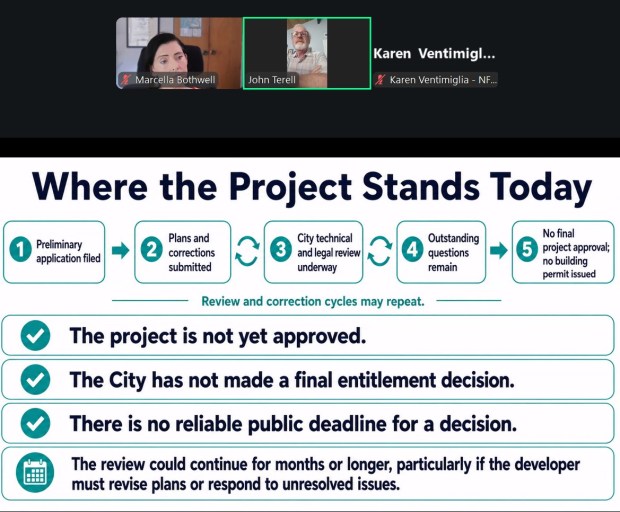 John Terell, legislative chair for the Neighbors for a Better California board, shares updates on where the Turquoise Street plans stand at this moment. (Screenshot by Noah Lyons/presentation by Neighbors for a Better California)
Pacific Beach Planning Group Chairman Karl Rand, also on the Neighbors for a Better California board, explained as part of the meeting that the group is preparing for future litigation.
He said the group is actively filing public records requests; looking into the potential hiring of financial, economic, safety and traffic experts to push back against the application; and raising funds to prepare for legal challenges.
So while the group has long preached the importance of collaboration between Neighbors for a Better California and the city, he said they’re ready to push back against the city if need be.
“We’re ready to challenge (the city) on these things if they don’t interpret things the way we think they should,” he said.
The inaugural Zoom was attended just shy of 50 people, including Neighbors for a Better California’s six board members.
A Congressman weighs in
In late July, just prior to the Neighbors for a Better California meeting, U.S. Rep. Scott Peters (D-La Jolla) wrote a letter to San Diego Mayor Todd Gloria and San Diego City Council President Joe LaCava, asking them to deny the “indefensibly and inappropriately huge” project application altogether.
“In my conversations with constituents over the past several months I have been struck by the unity and anger over this proposal,” he wrote. “The thought of a 23-story tower in this location, I imagine, was likely what set off the same furor that drove the adoption of the 30-foot height limit more than 50 years ago.”
U.S. Rep. Scott Peters (D-San Diego) speaks during a House Budget Committee meeting in May in Washington, D.C. The Congressman recently penned a letter to Mayor Todd Gloria about the proposed 970 Turquoise Street project. (Anna Moneymaker / Getty Images)Beyond aesthetics, he says there are “legitimate” concerns about the ability of the two-lane street to handle traffic related to the development, and the ability of emergency first responders to access the area.
“We should absolutely redevelop unused or vacant properties in our neighborhoods with smart, sensible projects consistent with community planning and state law,” he continued. “Neighborhoods deserve to be improved by those developments, not insulted. And certainly, they should not have their traffic safety jeopardized. This proposal misses the mark, to say the least.”
LaCava said in a statement shared with the La Jolla Light that he appreciates Congressman Peters’ interest in local land use matters.
“We need everyone to lean in on matters that affect our mutual constituents and the neighborhoods we serve,” LaCava wrote. “I continue to believe that local government alone cannot address the complexities of such unprecedented projects. More voices from recognized leaders serves us all.”
Peters is the most recent elected official to weigh in on the project over the last year.
He is joined in opposition to the project by state Sen. Toni Atkins (D-San Diego), who formerly represented the La Jolla-Pacific Beach area; state Assemblywoman Tasha Boerner (D-Encinitas); and state Sen. Catherine Blakespear (D-Encinitas). Boerner and Blakespear’s districts include La Jolla and Pacific Beach.
Blakespear took things a step further, introducing Senate Bill 92 in January, which would amend the state’s density bonus law that is being used to enable that project to reach 239 feet tall.
The legislation prohibits developers from benefiting from the density bonus law when building projects that “don’t include significant amounts of housing,” according to a statement issued by Blakespear’s office. It was signed into law Oct. 10, 2025 and went into effect earlier this year.
The bill does not apply to projects like the Turquoise Street project that were already proposed prior to its passage.
— La Jolla Light editor Ashley Mackin-Solomon and The San Diego Union-Tribune staff writer Jennifer Van Grove contributed to this report.