
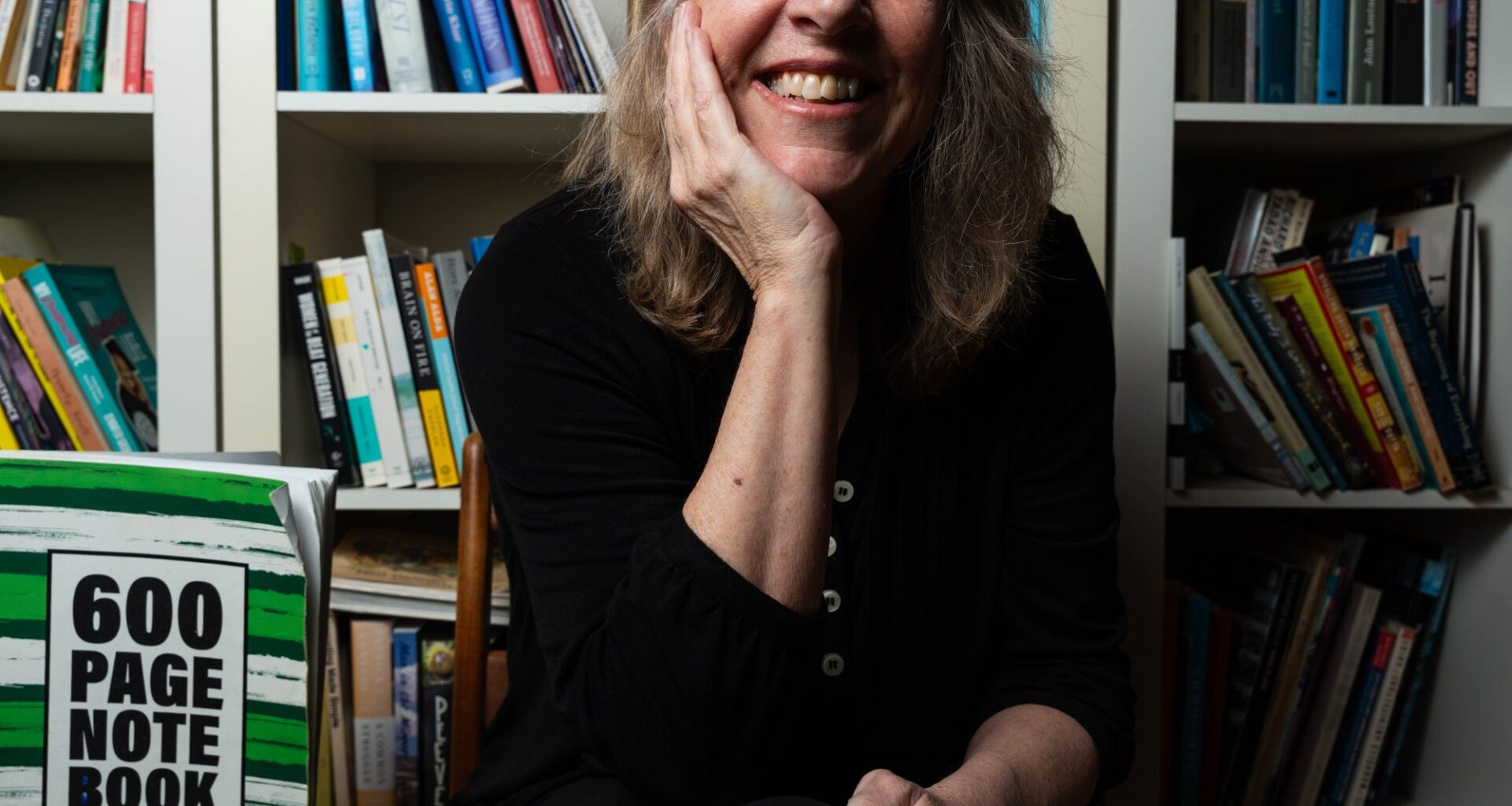
Rebecca Chamaa has spent years talking about living with her mental health diagnosis — sharing her story with law enforcement agencies to medical professionals to her work as a public speaker for the National Alliance on Mental Illness. So, when she saw a notice from a local arts organization requesting writers to participate in a companion event for an art exhibition, she had to do it.
“I looked at the images they had from the artists in the exhibit, and we were supposed to respond to one of those; it’s called ekphrastic writing (studying an artist and their work, and writing from a prompt about a particular piece),” she says. “I looked at them for several days, and I liked Jeff Bergman’s piece, ‘Sutured.’ That was the piece that I decided to write to, and I wrote about having schizophrenia. Because the title of the event is ‘Come as You Are: Stories from “Seen & Whole,”‘ I felt like my experiences are going to fit with that theme quite well.”
Before her diagnosis of chronic paranoid schizophrenia, she was diagnosed with bipolar disorder with psychotic features in her 20s, she writes in “I Hid My Schizophrenia for 20 Years. Here’s Why I Stopped,” a personal essay she wrote for HuffPost in 2023. Back then, when she disclosed her diagnosis, the people in her life disappeared, leaving her feeling rejected and unsupported. She had also internalized the stigma and negative social messaging around her diagnosis. It’s taken work to learn about her symptoms, treatment, and ideas around identity and self-worth. Fortunately, she’s had a supportive and loving partner in her husband, Jean-Claude, and her own commitment to her writing, speaking, artwork, and role as a facilitator to help people understand that a mental health diagnosis is not the entirety of a person. She plans to share that story in the “Come As You Are” storytelling event from 7 to 9 p.m. Friday at the Congregational Church of La Jolla, presented by Living Proof Stories and San Diego Art Directory. Inspired by the “Seen & Whole” exhibition on display at the church through August, this event features original works of poetry, fiction, and nonfiction performed as live readings by local writers (space is limited and registration is recommended).Chamaa lives in Banker’s Hill with her husband, is a certified Medi-Cal peer support specialist, serves on the Lived Experience Advisory Council for UC Davis’s Early Psychosis Intervention California (EPI-CAL) program, and works for NAMI San Diego. She took some time to talk about her piece in “Come As You Are” and what it means to her to be seen today. (This interview has been edited for length and clarity.
Q: As one of the featured performers in “Come As You Are,” you were inspired by a work of art titled, “Sutured,” by Jess Bergman. Can you talk about that piece and what came to mind for you when you saw it? What were you thinking and feeling, and how did that lead to the writing that you did?
A: It’s pretty dramatic. It’s got a white square and then a black square, and then it has a piece of metal sticking out through the black square. Then, there are these, like, stitches. Well, I call them stitches because that’s how I wrote about it, but it’s more like barbed wire, I think. I haven’t seen the piece in person, so I don’t know, but I think he used barbed wire to wrap around the outside of the lines of the piece. It’s abstract, it leaves a lot to the imagination. It’s a very good piece to write to, and I like the piece, too. I genuinely like it and would hang it in my house.
I mostly I talk about the sutures, and I write about the stitches, and I write about that metal piece that’s sticking out. It just reminded me of people and their stories. I deal with stories all the time, so it reminded me of people and their stories, their healing stories and the wounds that they carry. So, that’s what I wrote about, I wrote about the wounds that I carry and then how look at other people because of that.
Q: When were you diagnosed with chronic paranoid schizophrenia?
A: I was diagnosed with severe mental illness in my 20s. It was a long journey; a diagnosis is a very long journey, and I didn’t get my accurate diagnosis until I was 40 years old. I’ve had it for 20 years now and everything about it — the medication, the treatment — all of that is right for me, but I lived for a long time with the diagnosis of bipolar disorder with psychotic features because a lot of mental illness has a lot of overlap with other things. It’s not the easiest thing to decide, initially, what someone’s diagnosis is because there’s so much overlap.
Q: What does this diagnosis mean?
A: For me, I want to be clear that it doesn’t mean this for everyone, but for me it means that I have certain kinds of hallucinations. I’ve had episodes of psychosis where I’m completely out of touch with reality, and then hearing voices when I’m psychotic. I hear voices, and other times when I’m not psychotic, the most common symptoms I have on a daily basis are olfactory hallucinations, which are smells. I don’t know if you know this, but you can hallucinate through all five of your senses, so you can see things, you can hear things, you can smell things, you can taste things. The two most common hallucinations I have on a daily basis, when I am not psychotic, are smell and taste. The taste one is called gustatory hallucination and the smell one is olfactory, and those are the two most common. Then, I have symptoms of paranoia. Those are the most common things that impact me day-to-day, and psychosis is life-changing when that happens. Generally speaking, smoke is the most common olfactory hallucination for me, so if someone’s home, I can ask, “Do you smell smoke?” If my husband is home, he’ll say no, but if no one is home, I go down the hallway and check, I go outside of my condo and check because it’s a scary thing and it can be so frustrating because you really do smell it.
Q: What was your perspective of schizophrenia before your diagnosis? How did that change after your diagnosis?
A: That’s exactly what my piece is kind of about. I talk about what getting that diagnosis was like. At first it was like getting a punch in the gut. Bipolar disorder doesn’t have as much stigma; it has stigma, but not as much as schizophrenia. Schizophrenia is one of the most stigmatized mental illnesses there is, and I had all of the stereotypes in my mind. It really crushed my self-esteem, and it really crushed my image of myself as a capable and productive and person. It just really scared me, and it took a long time for my husband and I to work through it. When I came home from that appointment and said I have chronic paranoid schizophrenia, I was devastated. and he said, “You’re no different today than you were yesterday.” Now, the difference is, if my life was a pizza, schizophrenia would be one of the smallest pieces. I do have to manage it, I’m constantly managing it, and I take my treatment very, very, very, very seriously, but I have a big life besides that, too.
Q: In your personal essay for HuffPost, you talk about keeping your mental health condition a secret from friends, family, and coworkers, and the rejection and shame you’ve experienced when you have shared your diagnosis. What do you find that people tend to misunderstand about schizophrenia? And, what do you hope they learn about it?
A: I have a 28-piece exhibit right now at the Hervey Library in Point Loma. It’s 28 abstract faces of the 28 most common symptoms of schizophrenia, and it’s called “Symptoms of Schizophrenia.” It’s just an educational piece, in my opinion. I wrote down the 28 most common symptoms of schizophrenia, and then I did an abstract portrait of each one. Education is primary for me, but the thing that I’m really trying to do right now is change the narrative. I’ve spent years as an advocate for schizophrenia, and I’ve spent years describing my symptoms. I would tell people like the FBI, the negotiators, the police about how to deal with people in psychosis, but I was also talking to people who had schizophrenia in crisis houses and stuff like that. I would always say to them, “You are so much more than your diagnosis.” So many times, because of the symptoms of my diagnosis, I felt like I became my diagnosis. Like schizophrenia was how I defined myself. It had overtaken my whole life, even though I always told people you’re more than schizophrenia. So, I’m really in a transition phase right now. I have a fellowship coming up with the Center for Faith and Justice, and when I was writing the application for the fellowship, I wrote that I really wanted to look at the intersection between severe mental illness, faith, and justice; that’s the transition I’m going through now. I’m really going into a broader story. I want to tell a story of schizophrenia that’s bigger than just the symptoms. For instance, if someone is diagnosed with schizophrenia, I want them to have mentors who are vocal in the community. Like, I’ve been married for almost three decades, and when I would go to crisis houses and stuff like that, they would say that that was the most hopeful thing I said to them. That was the thing they would be taking with them because we all want to be loved, we all want to be accepted, we all want to belong. So, for me to say I’ve been happily married for almost three decades was like, ‘Oh my gosh, that could happen to me, too. I could have that, too.’
I think people think that schizophrenia is debilitating to everyone. It is debilitating to some people; I know people with schizophrenia who do not live an average life because the illness is so severe, but it’s not debilitating for everyone. With proper treatment, and I always say this because I take my treatment very seriously, you can live a very meaningful and purposeful life. They think that everyone with schizophrenia is constantly hearing voices, there’s a symptom of schizophrenia where you don’t make sense when you talk, a deficit of speech, and they think we’re dangerous. The reality is that most people with schizophrenia are not dangerous, nor will they ever be dangerous.
Q: In addition to all of your other work in mental health, you also earned a certificate from Columbia University in narrative medicine. What is narrative medicine?
A: Narrative medicine is something that is in healthcare settings. Rita Charon (executive director of Columbia University’s program in narrative medicine and “widely recognized as the originator of the field,” according to the Association of American Medical Colleges) wrote a book on it, and she was often a speaker in my classes, and she said that artwork could really change the practice of medicine. It’s about paying attention, it’s about seeing a poem or a piece of artwork and paying attention to what you see. Really focused attention, and then writing about it expressively for a given amount of time. In school, we only did seven to 10 minutes a lot of times, but I often give my students much more time to write. It’s about paying attention to the story. There are three pillars of narrative medicine: attention, affiliation, and representation. It’s teaching you to look at things in a different way, and it’s used to help people in their practice with patients, but it’s also used to help doctors or nurses avoid burnout and stuff like that. It helps them pay closer attention to the story of their patients and what their patients are saying, and just be better doctors, in general.
Q: What are some ways you’ve been able to use narrative medicine in your own life?
A: I have a narrative medicine group that I run, and I’ve been running it for four years. There are six or seven of us and we meet every Monday night on Zoom. The benefits of art and and the benefits of writing are very conducive to supporting well-being, the group is just lovely. We’ve supported each other through a death of a husband, death of pets, a suicide by a boyfriend; we just read poems and look at artwork and write about whatever is going through us, and then we share it together. The narrative medicine groups that I do are not exactly how Columbia teaches us; I’m not dealing with medical professionals, I’m bringing it to the community instead. Each of us is a witness to each other on those Monday nights. We’re witnessing the pain, we’re witnessing the joy, we’re expressing it. It’s being seen by other people and having space held for you to express any emotion you want to express.
Q: “Come As You Are” is described as “creat(ing) a conversation about identity, belonging, resilience, and what it means to be truly seen.” As you’ve gone through your process of living with schizophrenia and doing advocacy work around mental health, what does it mean to you to be truly seen? Particularly as Rebecca today, versus Rebecca in her 20s?
A: What it really means for me to be truly seen is that people might know that I have schizophrenia, but when they think of Rebecca, they say, “Oh yeah, Rebecca’s a writer. Oh yeah, Rebecca’s married to Jean-Claude. Oh yeah, Rebecca works at NAMI,” and there are 10 to 15 things that come up before, “Oh, and she happens to have schizophrenia.”