
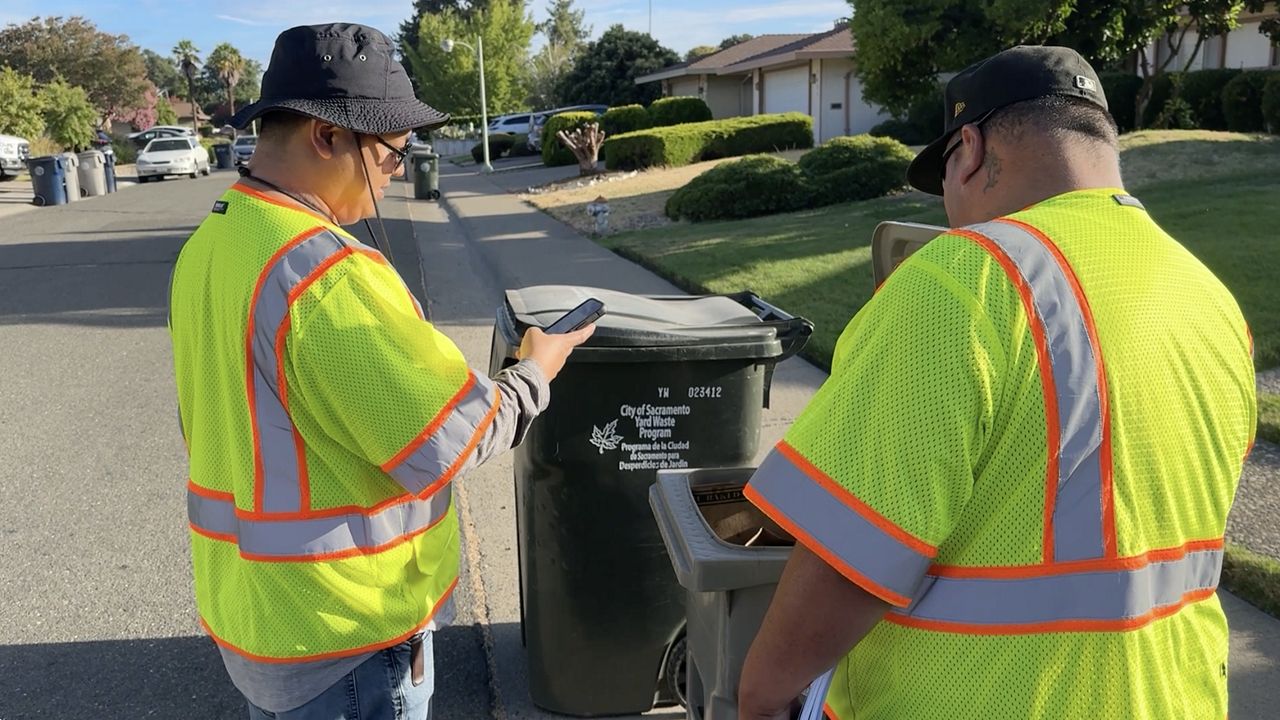
SACRAMENTO, Calif. — While many people are just getting their day started, Andrew Vue with the city of Sacramento is already busy examining people’s trash.
“What we’re doing is we’re inspecting for SB 1383, which is the state mandate to make sure that all waste is source-separated,” said Vue, a code enforcement officer.
California’s 2022 Organics Recycling Law requires certain businesses to donate surplus edible food, and businesses and households to separate organic waste like food scraps and yard trimmings from the landfill to reduce methane emissions.
Decomposing organic waste in landfills accounts for 20% of California’s methane emissions, according to the state’s waste recycle department, CalRecycle.
As Sacramento works to comply with the law, public education is a major focus, Vue said.
“For the most part, we see a lot of [trash] cans are pretty good,” Vue said. “So there’s two stickers. There’s one that’s, let’s sort it out, to basically highlight different items in a bin that needs to go into the bin correctly and then you can sort it that way. And then we have great job tags, which are containers that have like zero to no cross-contamination.”
The City of Sacramento said it hasn’t issued any fines and doesn’t plan to.
Since the law took effect, jurisdictions have faced implementation challenges, and one of the nation’s largest organics recycling facilities near Los Angeles filed for bankruptcy in 2023 after saying it wasn’t receiving enough material from municipalities, before later reopening under new ownership.
CalRecycles’ goal was to cut organic waste sent to landfills 75% below 2014 levels by the year 2025.
As that deadline has come and gone without success, reaching that reduction target remains a challenge, said UC Davis food science professor Ned Spang.
“We don’t necessarily have enough compost and anaerobic digestion facilities available to handle this huge amount of waste that we’re now trying to divert from landfills,” Spang said.
The latest CalRecycle data shows 11.2 million tons of organic waste was diverted in 2022, but to reach the 75% reduction target, the state says about 27 million tons must be diverted annually.
CalRecycle said progress is being made, with 97% of required communities and 75% of required businesses now participating in organics recycling programs.
In Sacramento, City of Sacramento spokesperson Jesa David said organics collection has increased by nearly 2,500 tons since 2022.
“That’s the success, really, is how much is not going to the landfill,” David said. “How much of these materials are turning into compost instead? We have also implemented a compost giveaway program the last couple of years.”
Spang echoing sentiments of the progress so far is a step in the right direction.
“We’re behind the targets, but I think we’re better off than we were a few years ago as a result of the legislation.”
Vue said they’re always happy to help people better understand what they need to be doing.
“The source separation guide is really good because it gives you a visual,” Vue said. “But we have also a city website that can talk about source separation.”
And hopes, he said, to continue seeing improvements that will help achieve the state’s climate goals.