
Eighty-one years ago in early August, America’s armed forces were fighting on the front lines of World War II. A key turning point came on Aug. 6 and 9, 1945, when the United States dropped two atomic bombs over Japan. Days later, on Aug. 14, President Harry S. Truman announced Japan’s surrender.
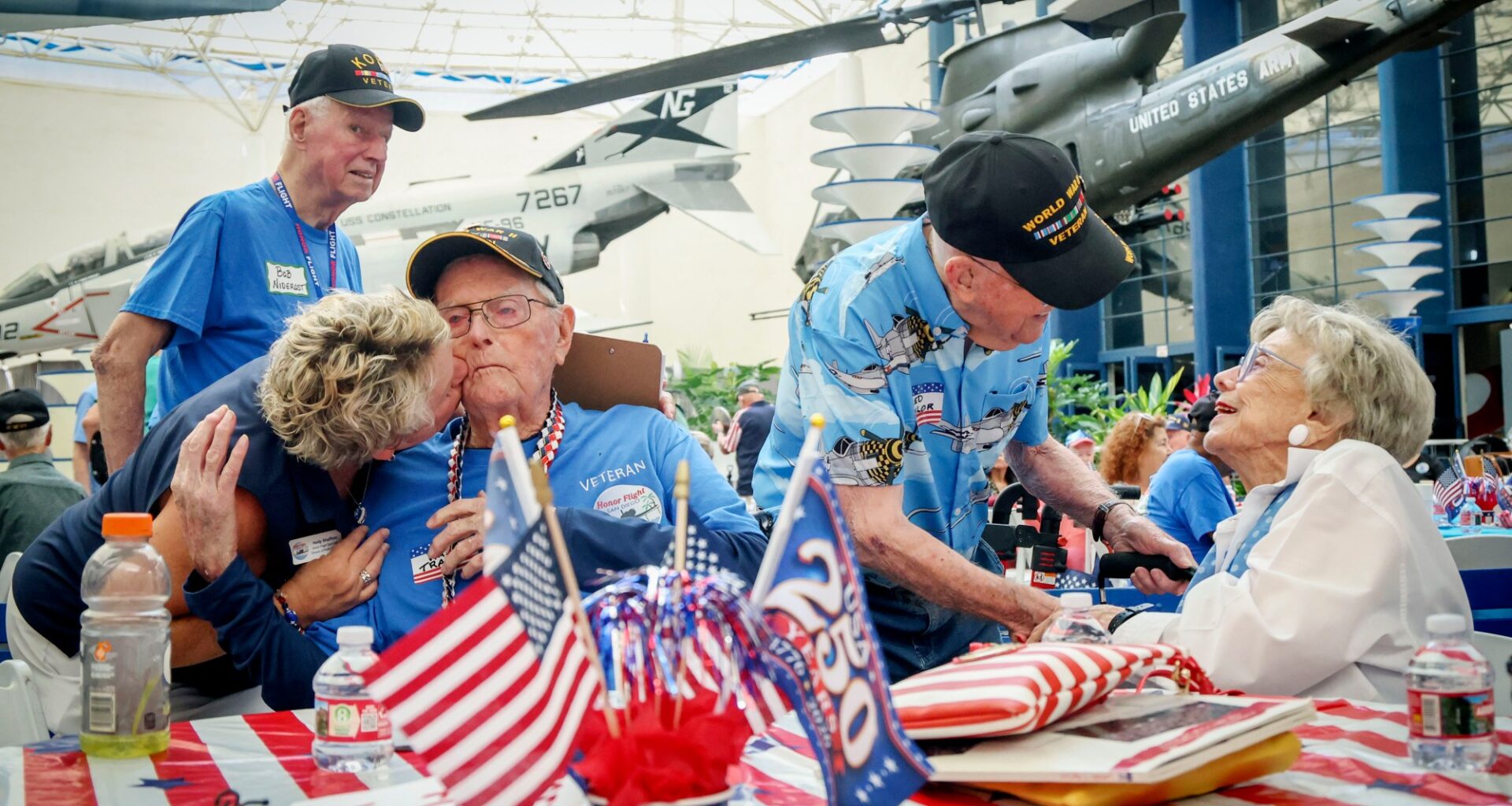
On Sunday morning, around 30 veterans of that war, as well as veterans of the Korean and Vietnam wars, gathered in a Balboa Park museum to remember and to be remembered. Around 550 veterans attended.
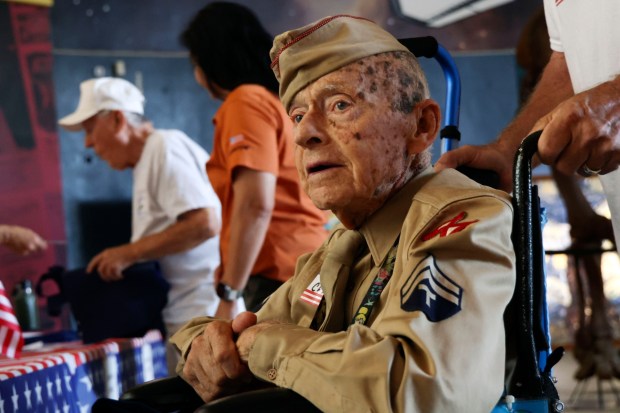 World War II Army veteran Andre Chappaz during a celebration of the 81st anniversary of the end of WWII at the San Diego Air & Space Museum in Balboa Park.
“I think we should remember what happened during the war,” said Bob Wilson, a retired U.S. Navy commander who served in Africa and Europe, including in Normandy as part of the D-Day invasion. He was on 30 days’ leave, on a break at home in Missouri, when the United States dropped two atomic bombs on Hiroshima and Nagasaki. The blasts were responsible for more than 200,000 deaths and led to that country’s surrender days later.
“I hate to admit this. I cheered. I was happy,” Wilson said. He was “very happy,” he added, when the war ended shortly after.
At 106, Wilson was the oldest veteran present at Sunday’s “Spirit of ’45” celebration and luncheon honoring the end of the war, organized by Honor Flight San Diego.
The event, held in the rotunda of the San Diego Air & Space Museum under vintage planes, doubled as a reunion for San Diego-area veterans who have participated in the nonprofit’s periodic flights that take veterans to Washington, D.C., for free to celebrate their military service. The next one takes place in September.
At Sunday’s ceremony, some veterans used wheelchairs and walkers, and many wore red, white and blue clothing to mark the day. Some donned commemorative military baseball caps and pins.
Navy veteran and Command Master Chief Wayne Thompson, 76, went on a recent honor flight and said the experience was “the most wonderful thing ever.”
It was meaningful to him, he said, because the trip made him feel appreciated and lauded in a way he had not felt when the Vietnam War ended.
Vietnam veterans were sent to the war and went to serve the country, but still faced disapproval from some of the U.S. public when they returned home, he said. He ended up remaining in the military well after that war ended.
“I thought, ‘I’m more liked over there than I am over here,” he recalled. He continued to serve in places as far as Antarctica, and closer to home, in Nevada.
The honor flight “made you feel welcomed. And you got the homecoming you never got in Vietnam. And it wasn’t the people that were the problem. It was what was going on in the States at the time,” he said, alluding to anti-war sentiment that led to protests.
Recognition, long overdue, also came to one of several women present Sunday who furthered the nation’s wartime manufacturing efforts, taking on tasks that earned them the nickname of “Rosie the Riveters.” Ena Reynolds Slaughter, 101, was awarded a Congressional Gold Medal in a ceremony during Sunday’s event. Slaughter also served in the U.S. Coast Guard, during World War II.
More than 5 million women ended up assisting in the wartime manufacturing campaign.
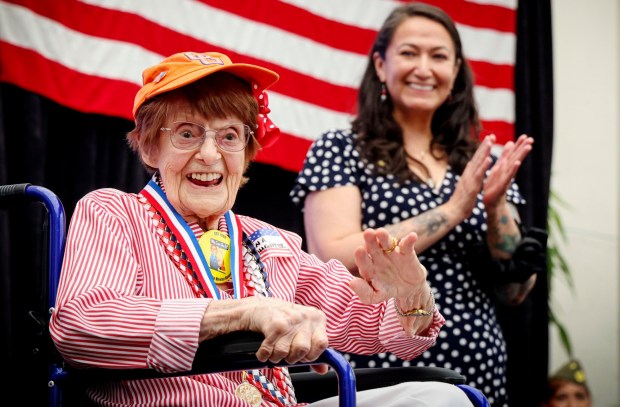 Ena Reynolds Slaughter, who served in the Coast Guard and was a”Rosie the Riveter” waves to attendees at the the Spirit of 45 “A Celebration of the 81st Anniversary of the End of WWII” on Sunday at the San Diego Air & Space Museum in Balboa Park. (Photo by Sandy Huffaker for The San Diego Union-Tribune)
Another veteran, who was both a “Rosie” and a retired U.S. Marine sergeant, Randy Tidmore, 104, told The San Diego Union-Tribune about the work she did, assembling the wings of Martin B-26 Marauder bombers.
She recalled challenges she faced as a woman in the military. One was being posted to a training base whose general told those in his command he did not want “dogs or women on his base.”
The day the war ended, she and about 800 other women who were serving at the base were told to stay off San Diego’s streets, to avoid possible harm.
“They were going crazy,” she said of the boisterous Navy sailors celebrating when the end of the war was announced by Truman.
Tidmore said she doesn’t think any special attention should be paid to people who contributed what she did.
“I don’t think they should be giving us medals,” she said. “Because everybody — everybody did something for the war. I say everybody, but there were a few that went to Canada. Conscientious objectors, we called them. But most everybody was collecting stuff for the war: grease, or tin foil, rubber bands. Everybody was doing something.”
Along with a moving tribute to the U.S. flag and a short film about the war’s end, a highlight for the crowd appeared to be nostalgic music sung by a live trio, including “Mr. Sandman” and an Andrews Sisters song that included these bittersweet lyrics:
“Don’t sit under the apple tree with anyone else but me. Till I come marching home.”