
Eliu Ramirez has been a street vendor in the Long Beach area for 16 years. He has developed friendships with customers and people in the community, and is known as the “Ice Cream Man.”
But last month, while selling at his usual spot on the Fourth of July at the Belmont Veterans Memorial Pier, he was assaulted. He was confronted by an angry man telling him that he could not sell there, Ramirez said, and later was brutally assaulted by several men. The assault left Ramirez with several injuries, including a fractured nose.
Ramirez’s story is not unique for many street vendors – even in Long Beach. He decided to share his story on social media to hopefully bring more attention to these attacks on vendors and make city leaders aware of the need for stronger protections to keep vendors safe.
Many vendors are assaulted, robbed and attacked, but can be afraid to speak up, according to community advocates. While Long Beach officials say they have resources available, street vendors and community advocates say more needs to be done.
After the attack, Ramirez, 51, said that he feels uneasy going out and doing his job. He has noticed people have become more hostile towards vendors recently, he said.
On the Fourth of July, a man approached him who claimed he owned the beach and told the vendor that he was not allowed to sell there and had to leave, Ramirez said. The vendor noticed police officers nearby and told the man that if the officers asked him to leave, he would.
When the man spoke with the officers, they told him that the beach is public and that Ramirez was allowed to continue selling. But the man became angry, Ramirez said, and told him that if he didn’t leave, he was going to get someone to remove him. A short time later, several men arrived and told Ramirez that “the boss” had sent them and then they assaulted him.
“With this incident, honestly, I feel afraid,” Ramirez said in Spanish. “I feel like one day, I’ll go out to work and then won’t come home. Especially with these types of people who think they are owners of a public place.”
A police report was filed and Ramirez said he is receiving medical care. The investigation of the battery incident, which occurred in the 100 block of 39th Place, remains active and ongoing, according to an LBPD spokesperson.
Ramirez said he carefully considered posting his story on social media for fear of his safety, but he also wanted to make others aware of the dangers that street vendors face — and to hopefully hold those who attacked him accountable.
“I really thought about it for my well-being, for the well-being of my family, and for the well-being of my fellow colleagues who are street vendors and are facing similar issues,” he said. “I hope that there is a thorough investigation about what is happening at the beach or in other areas that could threaten other street vendors just trying to make a living.
“I’m sharing my story because today it was me,” Ramirez said, “but tomorrow it could be someone else.”
Ramirez said he was grateful for the support he has received from the Long Beach community. He teared up when speaking about the experiences he’s had with people lately showing their support, especially children and families whom he has grown to know. His GoFundMe page, which was started by a neighbor, has reached more than $20,000, which he will use for his medical expenses, as well as rent, groceries and other essential bills.
“I thought that I was alone, but I’m not,” he said. “Behind me are so many people (who) appreciate me, and I didn’t even know that. I really appreciate the community that has shown me their support in many ways, from words of encouragement to financial support, in a moment where I needed it most.”

Street vendor Eliu Ramirez says his face and vision are slowly healing since the Fourth of July attack near the Belmont Pier in his Long Beach apartment on Saturday, July 18, 2026. (Photo by Howard Freshman, Contributing Photographer)

Street vendor Eliu Ramirez, who was injured during a Fourth of July attack while working, stands outside his Long Beach apartment complex on Saturday, July 18, 2026. (Photo by Howard Freshman, Contributing Photographer)

Street vendor Eliu Ramirez, who was assaulted on the Fourth of July while working, manages a laugh at his home in Long Beach on Saturday, July 18, 2026. (Photo by Howard Freshman, Contributing Photographer)

Street vendor Eliu Ramirez recants the Fourth of July attack that left him injured on Saturday, July 18, 2026, at his home in Long Beach. (Photo by Howard Freshman, Contributing Photographer)

Street vendor Eliu Ramirez reflects on a Fourth of July attack that left him with facial bruises on Saturday, July 18, 2026, at his home in Long Beach. (Photo by Howard Freshman, Contributing Photographer)

Street vendor Eliu Ramirez reflects on a Fourth of July attack that left him with facial bruises on Saturday, July 18, 2026, at his home in Long Beach. (Photo by Howard Freshman, Contributing Photographer)

Street vendor Eliu Ramirez displays a photo of his bruised face taken the day after he was injured in an unprovoked Fourth of July attack on Saturday, July 18, 2026, at his home in Long Beach. (Photo by Howard Freshman, Contributing Photographer)

Street vendor Eliu Ramirez displays a photo of his bruised face taken the day after he was injured in an unprovoked Fourth of July attack on Saturday, July 18, 2026, at his home in Long Beach. (Photo by Howard Freshman, Contributing Photographer)

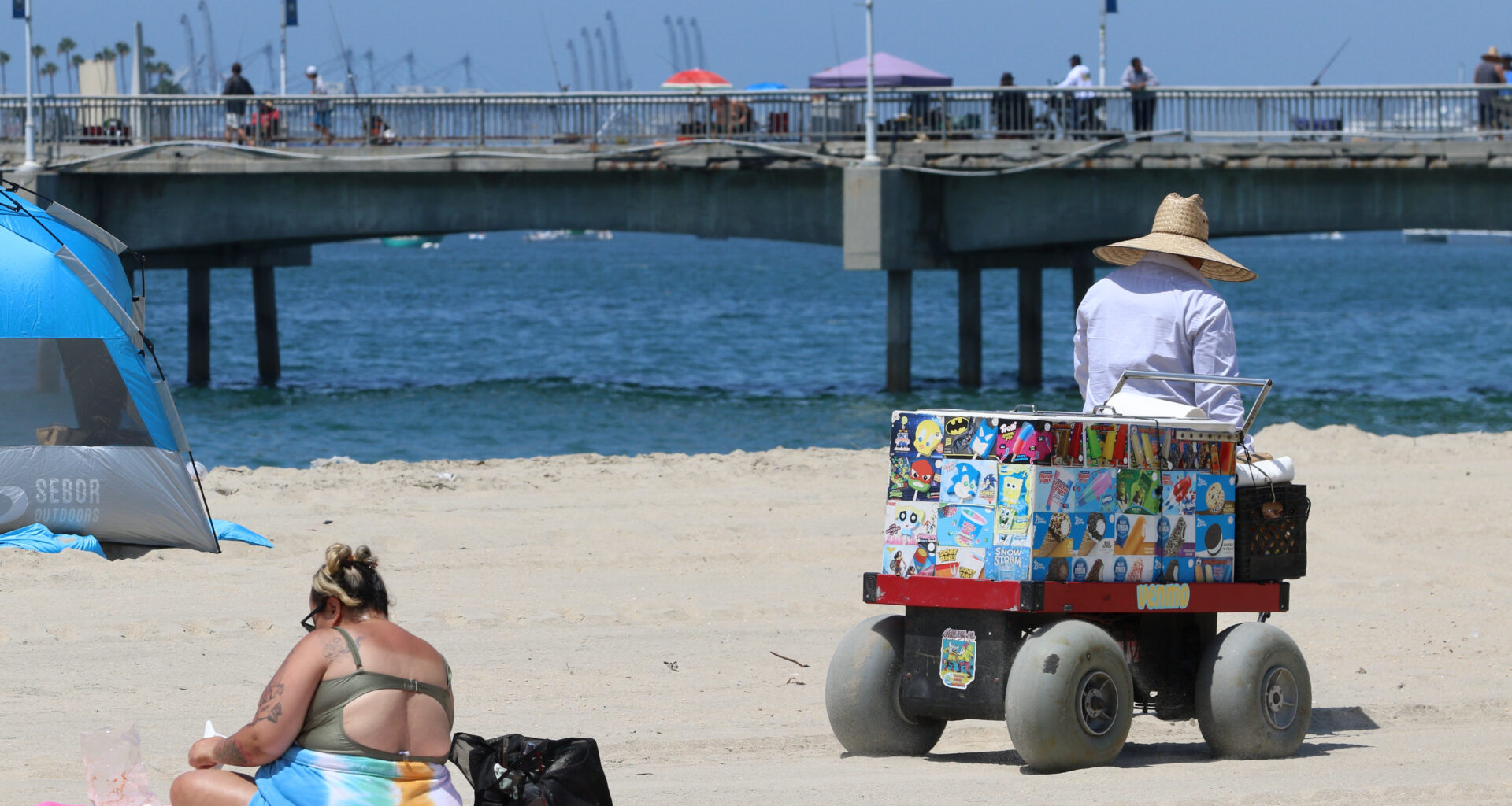
A vendor sells ice cream and snacks near the Belmont Pier in Long Beach on Saturday, July 18, 2026. (Photo by Howard Freshman, Contributing Photographer)

A vendor sells ice cream and snacks near the Belmont Pier in Long Beach on Saturday, July 18, 2026. (Photo by Howard Freshman, Contributing Photographer)
Show Caption
1 of 10
Street vendor Eliu Ramirez says his face and vision are slowly healing since the Fourth of July attack near the Belmont Pier in his Long Beach apartment on Saturday, July 18, 2026. (Photo by Howard Freshman, Contributing Photographer)
The city, in a statement, said the Long Beach Police Department is available to ensure the community, including sidewalk vendors, remains safe, and always encourages people and businesses to report crime and request police assistance when needed.
“The city,” a Long Beach spokesperson said in an email, “has been and continues to be proactive in ensuring businesses, including sidewalk vendors, have access to resources and support necessary to operate safely and legally in Long Beach.”
The LBPD also routinely provides sidewalk vending safety tips in several languages to help educate vendors on ways to reduce their risk of becoming victims of crime, according to the city.
When an incident impacting a local business, including sidewalk vendors, occurs, the Department of Economic Development and Opportunity’s Long Beach Workforce Innovation Network and BizCare teams conduct outreach to provide support, information and resources to the impacted business, the Long Beach spokesperson said.
Street vendor safety has been an ongoing concern, said Jessica Quintana, executive director of nonprofit Centro CHA.
“We have had a lot of street vendors assaulted, robbed and attacked,” Quintana said. “It’s terrible what’s happening because they do contribute to our economy. They’re only working to help their families and themselves.”
Centro CHA provides street vendors who have been attacked or assaulted with emergency housing assistance and food assistance, Quintana said. The nonprofit helps vendors with any essential services that they would need, including food, rent or utility assistance.
Besides Ramirez, another incident garnered attention on the Fourth of July as well. Pedro Castellanos-Aguilar, a 33-year-old deaf and non-verbal ice cream vendor in Long Beach, lost his cart in a hit-and-run. The car immediately fled the scene and left him emotionally vulnerable ,and his specialized tricycle completely destroyed, according to a GoFundMe post made by his sister.
These attacks have a physical, emotional and financial toll on vendors, Quintana said. Other vendors that they have supported have faced being sprayed with chemicals, and even being whipped and robbed on camera.
These attacks could be happening because street vendors can be seen as vulnerable, unprotected and easy targets, Quintana said — but it can also be racially motivated.
“(We are) advocating that they have safe places for them to vend,” she said. “The reason why we have advocated for the Mercado that is with the Latino Cultural Center is that we can create that safe space for vendors to be at.”
The Mercado, part of the larger Latino Cultural Center initiative, is currently in the planning phase. Centro CHA recently entered into an agreement with the city to operate the Latino Cultural Center at the Jenny Oropeza Community Center. The initiative is intended to build out cultural programming, expand community engagement, and support local entrepreneurs and vendors.
Currently, the Mercado concept’s focus is on special events and coordinating resources and services to help vendors build their businesses and operate in the city. Long Beach and Centro CHA will continue providing updates on this initiative as plans are finalized. Once plans are implemented, any lessons learned will help inform any potential future initiatives in other areas of the city, according to a Long Beach spokesperson.
“We need to have stronger supports for our sidewalk vendors,” Quintana said. “Our city really needs to do that. Our city legislation, along with our police, really need to have a stronger policy and protection for our vendors, not just a reaction. We need to be proactive.”
Long Beach has moved to try and bring more protections for street vendors. In June 2021, the City Council approved a request to provide assistance and recommendations to improve the safety and security of sidewalk vendors in Long Beach. The multi-departmental efforts included safety recommendations and education from LBPD, Digital Inclusion Initiative supports, and business assistance from EDO.
This effort led to the city’s Sidewalk Vending Program and ordinance in 2024, which regulates and supports sidewalk vendors operating in the city, and provides resources, education and a clear path for prospective sidewalk vendors to conduct business in Long Beach safely and legally, according to the city.
The ordinance also provides important protections by ensuring licensed vendors can participate in the local micro-economy and access opportunities across business districts, special events and tourism areas throughout the city. Long Beach also strengthened its support for vendors by assigning dedicated staff to coordinate the program, provide assistance and help vendors navigate processes and requirements.
Through the Sidewalk to Success Program, the city offers sidewalk vendors support such as permit and insurance fee coverage, one-on-one business navigation and multilingual educational resources, as well as a free cart giveaway – which recently closed applications.
“These efforts underscore the city’s commitment to supporting vendors,” the city’s spokesperson said, “and keeping them and the community safe.”
EDO, meanwhile, continues exploring new strategies and partnerships to expand support for microentrepreneurs. These efforts aim to increase access to resources, strengthen business resiliency, and help entrepreneurs start, grow and sustain their businesses.
“The Sidewalk to Success program remains active, and the city is committed to supporting vendors as they move into legal operation,” the Long Beach spokesperson said. “Vendors continue to have access to one-on-one guidance from business navigators, multilingual educational materials and step-by-step permitting resources, and funding to cover first-year permit fees and insurance reimbursements. These ongoing supports reinforce the city’s dedication to helping vendors succeed in the licensing process.”