
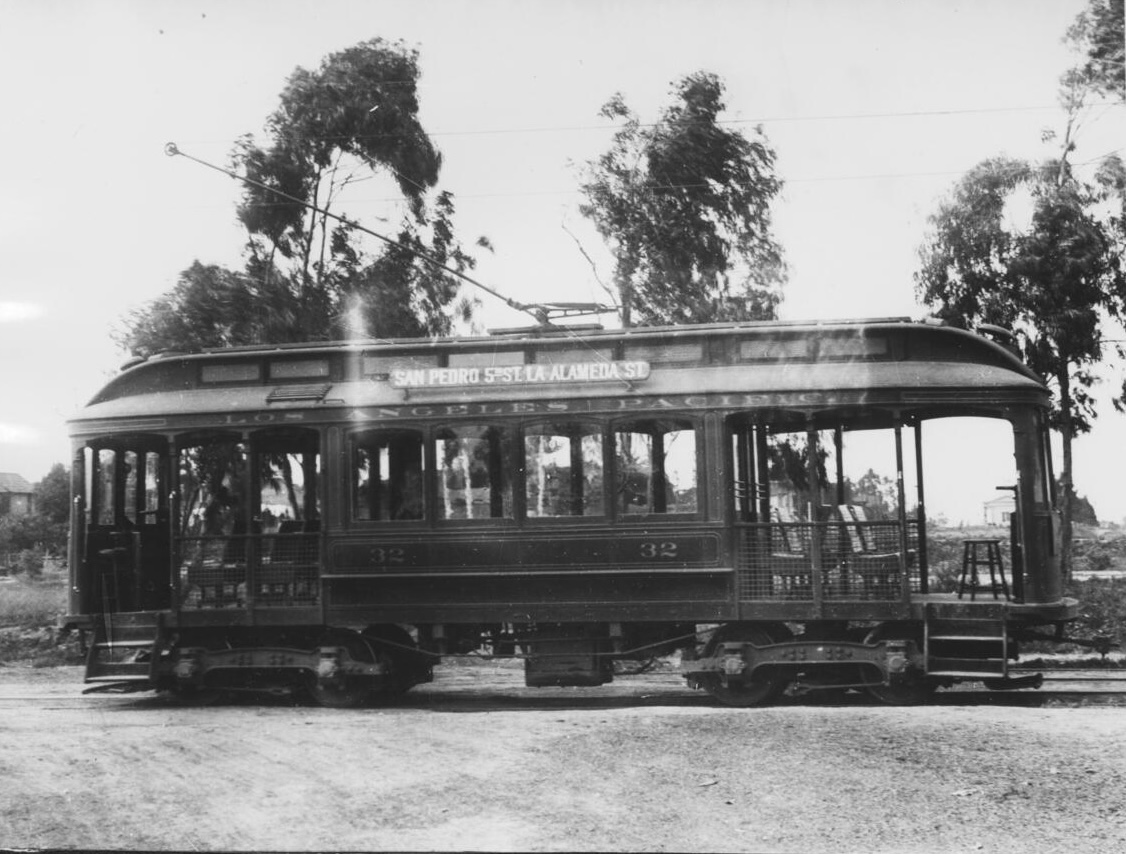
By the 1920s, it became possible to hop aboard a commuter train at Sixth and Main streets in Downtown Los Angeles, ride it to Los Angeles Harbor, switch to the Catalina Island Terminal line in Wilmington, and, at that terminal, catch a ride aboard a steamship over to the island — all without using a car.
Or you could stay on the train into downtown San Pedro, if that was your goal. The Pacific Electric Railroad’s Red Car system made it all possible.
Railroad baron Henry Huntington, president of the Southern Pacific Railroad Co., envisioned a separate passenger railroad system in the early 1900s. SP trains already were in operation in the region, hauling cargo to and from Los Angeles Harbor, but Huntington saw the need to add an integrated passenger railroad system.
He formed the Pacific Electric Railway Co. on Nov. 10, 1901. By the next year, he’d completed the first segment of his plan, a long line from Los Angeles to Long Beach. The 20-mile link opened on July 4, 1902. The popular route was the first to open to passengers, and would be the last to close in 1961.

A San Pedro line Red Car sits on the tracks near 14th and Beacon streets in 1911. (USC Digital Library, California Historical Society collection)

Portrait of Henry E. Huntington, founder of the Pacific Electric Railway. Undated. (Los Angeles Public Library Photo Collection)

The San Pedro Pacific Electric Railway depot, located at 510 S. Harbor Boulevard. 1921 photo. (Los Angeles Public Library Photo Collection)

Map of San Pedro area Pacific Electric Railway routes prepared by Caltrans in 1981. (Caltrans)

Pacific Electric Railway cars are piled up at a Terminal Island junkyard in 1956 to be dismantled and sold for scrap metal. March 19, 1956, Los Angeles Times photo. (Wikimedia Commons, UCLA Digital Library, Los Angeles Times collection)

A restored Pacific Electric Red Car runs along San Pedro’s waterfront. The revived trains ran between 2003 and 2015. Undated, circa early 2000s. (Daily Breeze staff file photo)
Show Caption
1 of 6
A San Pedro line Red Car sits on the tracks near 14th and Beacon streets in 1911. (USC Digital Library, California Historical Society collection)
Huntington sold his interest in Pacific Electric to Southern Pacific in 1910. The larger company reorganized the railway, which continued to operate under the Pacific Electric name.
The San Pedro Red Car line was a natural, providing transportation for workers to and from their jobs in the bustling Harbor Area, in addition to passengers headed for the area’s beaches and other recreational offerings.
Despite a high volume of passengers, in its early days, the “station” at Fifth and Front streets was a ramshackle one-room wooden building with neither seats inside nor benches outside for waiting passengers. (Front Street became Harbor Boulevard after a 1912 revamp.)
This left groups of passengers standing around and in the street, which often snarled traffic in the area. After more than a decade, the San Pedro News Pilot, then called the Daily Pilot, addressed the issue on the front page of its issue of Nov. 30,1917:
“It is probable that there are few, if any railroad terminals in America where so little convenience is afforded patrons as right here in San Pedro. The San Pedro terminal is a monument to inefficiency and inconvenience.”
The railroad was slow to react, but it eventually did. By 1919, plans for a new mission-style, two-story depot had been drawn up, and construction began on the building at Fifth Street and Harbor Boulevard, near the present-day Los Angeles Maritime Museum, began on March 16, 1920.
It opened later that year, and was by all accounts a first-rate facility that smoothed out the earlier traffic problems and eased the drama of making connections to various Harbor Area destinations.
By then, the Red Cars had become an established mode of transport for thousands of people, and would remain so for the next couple of decades.
Once the system was established, tweaks could be made to it when special needs arose. The rise of the defense industry in the Harbor Area with the arrival of World War II made it necessary to facilitate the flow of employees to wartime shipbuilding plants on Terminal Island.
California Shipbuilding, a wartime producer of military ships, employed as many as 40,000 people during the war. A joint venture between industrialist Henry Kaiser and Todd Shipyards, Calship needed to find a better way to get its employees to work.
Pacific Electric responded to the situation by connecting an extension of its line to the Catalina Island Terminal building across to Terminal Island and the Calship plant in 1943. It operated for the final two years of the war before being closed in 1946. It would be the last new line built by the railroad.
By that time, several regular lines had been shut down in the South Bay, including lines serving Torrance, Gardena and Redondo Beach in 1940. The rise of the automobile led to the funding of more highways, including the beginnings of the freeway system with the opening of the Arroyo Seco Parkway in 1940.
The writing was on the wall in 1947, when the California Public Utilities Commission issued stark warnings on the shaky financial condition of the commuter rail system. Ridership was down sharply following the war, and Pacific Electric was unable to make the necessary changes to survive.
A last-ditch effort to integrate the Red Cars onto median strips of the new freeways being built was shot down by the Los Angeles City Council. Though it limped on for a few years, the system was too weak to survive..
The San Pedro line and its Catalina Terminal branch line closed for good on Dec. 7, 1958. The Long Beach line, the last to be shut down, made its final run on April 8, 1961. The San Pedro Pacific Electric depot building was torn down in February 1961.
Nostalgia for the Red Cars runs deep. A group of enthusiasts pushed for the reopening of a 1.7-mile-long section of the Pacific Electric line from the World Cruise Center south to 22nd St. in San Pedro. They succeeded for a time; it operated from 2003 to 2015. Periodic attempts to revive it have been made, but have yet to come to fruition.
Sources: Los Angeles Times archives. “1981 Inventory of Pacific Electric Routes,” California Dept. of Transportation (Caltrans), February 1982. Pacific Electric Red Cars (unpublished manuscript), by Bob Petersen, Redondo Beach, 1992. San Pedro Bay Historical Society website. San Pedro News Pilot archives.