
When people think of ancient civilizations that paved the path toward modernity, the Greeks and Romans are often top of mind. But before Rome dominated the Mediterranean, another culture laid the foundation for the West: the Etruscans.
Populating much of Italy some 2,500 years ago, the Etruscans gave rise to many innovations that are often erroneously credited to the Romans. The numbering system we call Roman numerals is derived from Etruscan counting. Iconic Roman arches and advanced hydraulic engineering for aqueducts stem from Etruscan engineers. Even the toga and the English words “person” and “arena” trace back to the Etruscan civilization.
But despite their contributions, the Etruscans often get overlooked, said Lisa Pieraccini, an art historian and archaeologist at UC Berkeley who specializes in the ancient material culture of Italy. History, as the saying goes, is written by the victors, and the victors were the Romans, who subjugated the Etruscans to their way of life as they expanded an empire. Much of the Etruscans’ written record was destroyed, rendering them a footnote in modern history books.
Pieraccini is on a mission to change that.
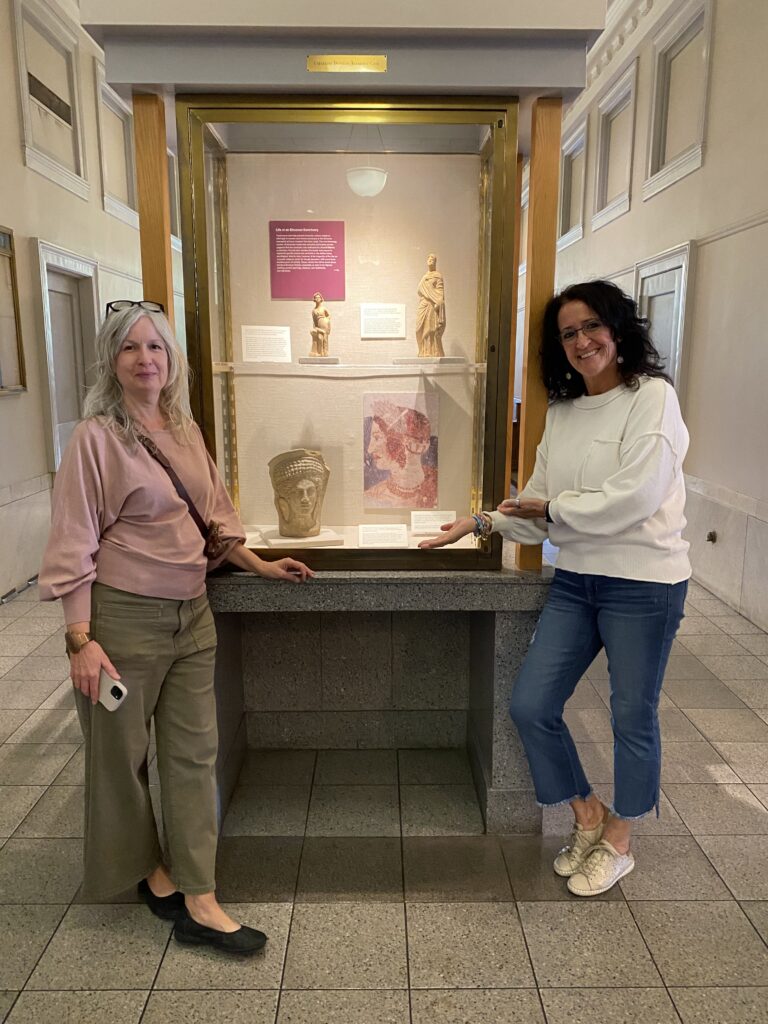 Lynn Cunningham, left, and Lisa Pieraccini curated the exhibit in Doe Library with students.
Courtesy of Linda Waterfield
UC Berkeley’s Phoebe A. Hearst Museum of Anthropology houses the largest collection of Etruscan artifacts in the country, the result of Hearst’s passion for ancient cultures and her collaboration with an antiquities adviser, Alfred Emerson, at the turn of the 20th century.
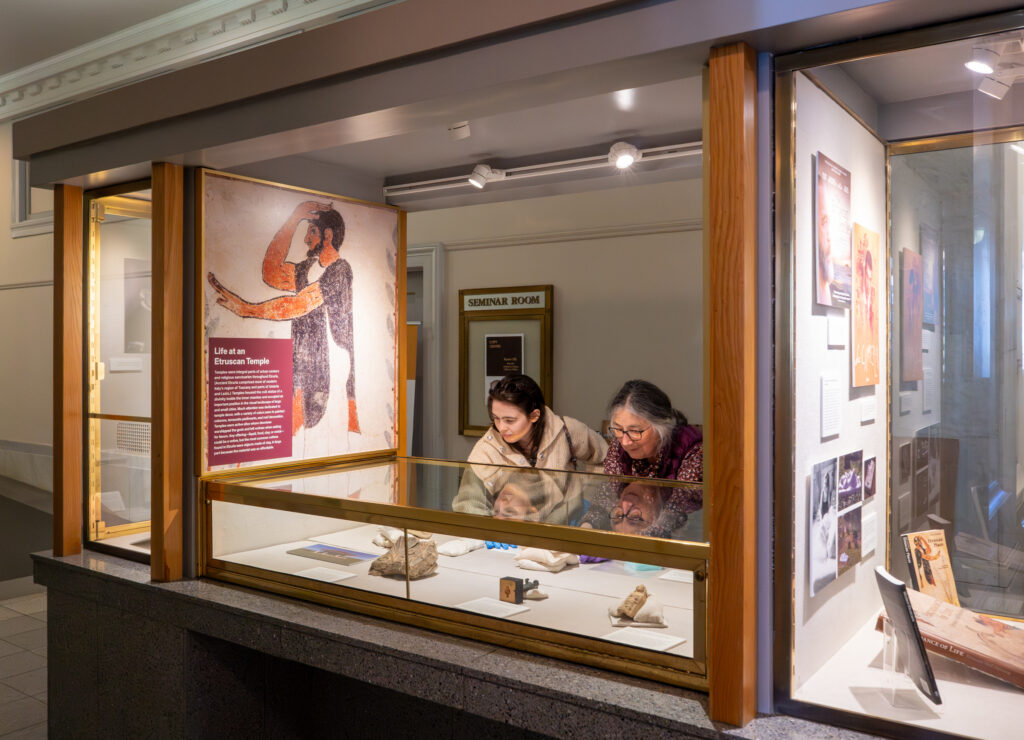
Now, through Aug. 31, small statues, pottery and jewelry buried some 2,500 years ago — and tucked away in the museum for the past 125 — are accessible to the public in “The Etruscans Uncovered,” a pop-up exhibit in the Bernice Layne Brown Gallery in the Doe Library lobby. Pieraccini co-curated the exhibition with art librarian Lynn Cunningham and students from her 2025 seminar, The Etruscans: Pasts, Present and Futures. Additionally, a companion exhibit at the Hearst Museum was co-curated by Pieraccini’s students from her 2025 fall seminar, Etruscans in the Museum.
These campus exhibits complement a more expansive exhibition running through Sept. 20 at the Legion of Honor in San Francisco. Pieraccini spent a decade helping consult on the project, which brings together items from 30 international museums — including the Hearst Museum — in what she calls “the most formidable Etruscan exhibition to ever open in the U.S.”
“We are just so intricately connected to our past, no matter how advanced we want to talk about ourselves or Silicon Valley. History repeats itself,” Pieraccini said. “There are gaps in our understanding of the ancient world, and it’s time we fill those gaps.”
On a recent afternoon at the Doe Library exhibit, Pieraccini spoke with UC Berkeley News about what research has taught us about the Etruscans, why they’re not as mysterious as they’re often portrayed and the importance of public institutions like Berkeley in helping preserve and teach courses about ancient civilizations.
This film by the Fine Arts Museums of San Francisco features Pieraccini and reveals how Etruscan innovations and customs were the foundation upon which the entire Roman world was built, and how their legacy continues today.
UC Berkeley News: I’m by no means a scholar of ancient civilizations, but I was shocked by my lack of knowledge about the Etruscans. We all learn about the Romans and the Greeks in history books, but there’s a gap for Etruscans. Why?
Lisa Pieraccini: America has modeled itself on Greece and Rome. European and American academics were self-absorbed with the Greco-Roman past, especially with empires. They sort of erase, ignore or consider marginal those cultures that were not empires. It has been a fixation, which in large part is due to scholars in the past who cherry-picked history for mainstream education, focusing largely on empires.
The Romans stood on the shoulders of the Etruscans. They borrowed their alphabet. They borrowed so much of Etruscan engineering, architecture and their art, their wall-painting, and then they turned it into what we now call Roman art.
The Etruscans wrote extensively. They were a highly literate people. They wrote poetry, prose and histories, but precious little has survived. We have to remember the very first people that the Romans colonized were the Etruscans. They were systematically taken over by Rome, who made Latin the legal language as they forced assimilation on the Etruscans.
Etruscans are often called a “mysterious” people. But is that really the case?
They’re not mysterious! We know a lot about them.
Their language was considered mysterious in the 18th century because it is not related to Greek, it’s not related to Sanskrit, and it’s not related to Latin. It’s a non-Indo-European language. It was considered incredibly strange. And if it was strange, then it was mysterious. If it was different, it was mysterious.
That word, mysterious, also got its momentum from Etruscan funerary practices. The Etruscans believed in the afterlife and packed their tombs with items that the deceased could take into a life beyond the walls of their tomb. That also was considered to be mysterious.
But calling the Etruscans mysterious reinforces a trope.
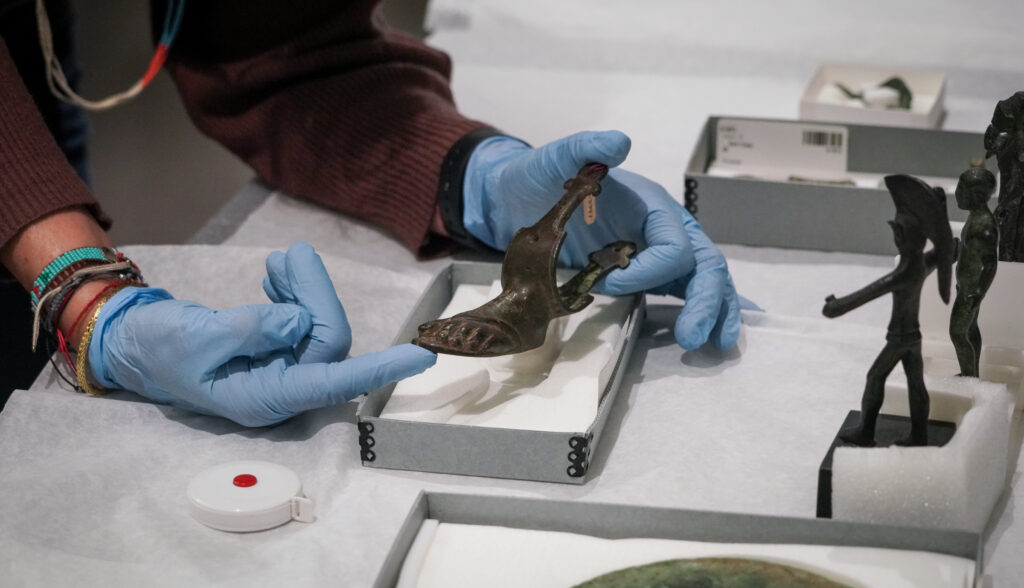 This Etruscan furniture foot, shaped like a human foot, is among the items held in the Hearst Museum’s collection. The item is from the fourth century B.C.E.
Jami Smith/UC Berkeley Library
What was the significance of Etruscan temples? Is that where most artifacts are recovered?
The whole purpose of a temple for an Etruscan, Greek or Roman was to house a cult statue of the divinity that was being worshiped. So as an archaeologist, you don’t necessarily find the cult statue — that’s going to be one of the first things that gets looted. But you will find the votives left by devotees.
Votives were left all around the temple. And priests would then pile up all the votives, dig a pit and put them all in and cover it up. Think of present-day memorials and all of the flowers that are left behind. Instead of those being flowers, imagine they were terracotta statues or other tangible objects. You don’t throw it away, because it’s sacred material. You keep it on the premises — burying it was an easy way of removing it to give room for more votives to be placed.
We have about 800 votives at the Hearst Museum from a single site, ancient Caere, or modern Cerveteri. This sanctuary was home to a female divinity, if not divinities, dedicated to fertility, fecundity, childbearing and the success of childbirth.
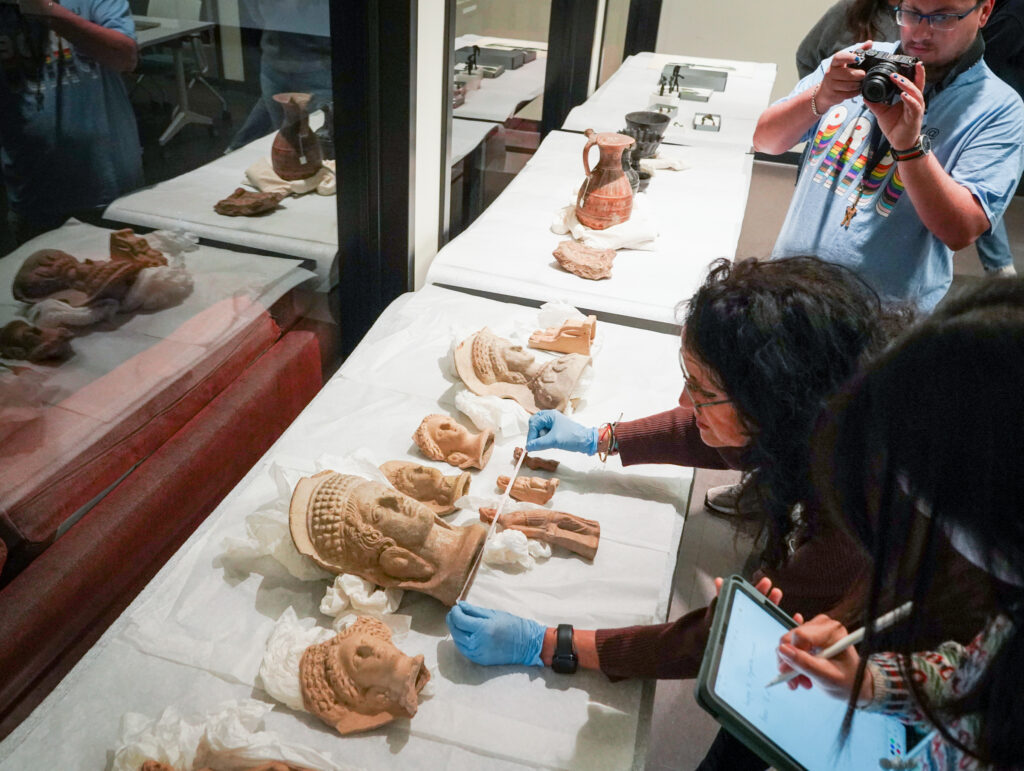 Votives, like these terracotta figures, were left all around ancient Etruscan temples. There are about 800 votives at the Hearst Museum from a single site, ancient Caere, or modern Cerveteri. Figures like these would have been painted, but the colors have faded in the past 2,500 years. “We might be looking at personifications of female divinities who reigned at the site,” said Pieraccini, middle, who worked with the items alongside her students.
Jami Smith/UC Berkeley Library
And they’d carry these from their home to the temple as part of a ceremony?
Imagine you’re going to the temple to pay homage to a divinity who has just blessed you with a healthy child. You’re going to thank this divinity for your healthy child and say, “I hope my child is healthy. I hope my child eats well and grows.” You just don’t go to a temple empty-handed; you leave a votive for the divinity who will help you.
Much like today in modern Mediterranean culture, you never go to someone’s house empty-handed.
That’s why votives were so important. If you had a lot of money, you could afford a bronze votive. But if you’re middle class, you’re going with terracotta all day, any day.
The detailing on these terracotta votive faces seems similar, but there are also some distinct features. Who were these women?
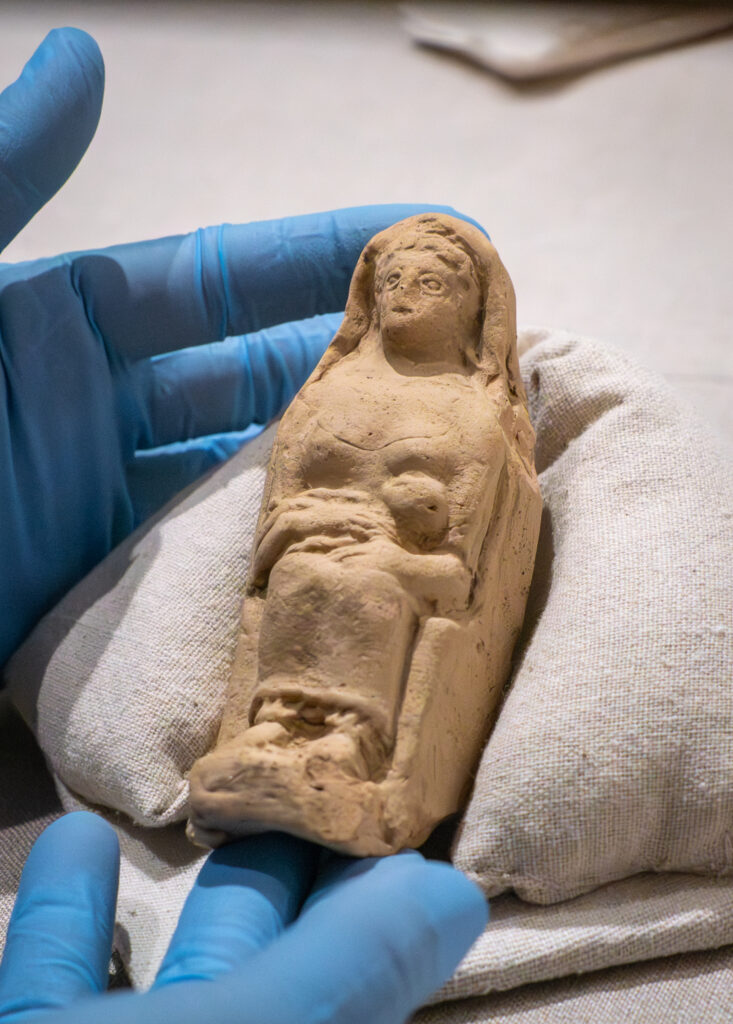 A terracotta statuette of seated woman nursing an infant is one of the items on display in “The Etruscans Uncovered.”
Jami Smith/UC Berkeley Library
You might not like this answer: We don’t know. But I love it when we don’t know. As an archaeologist I just feel like far too often we come across people who will say, “Well, it has to be so and so, based on our modern conceptions.”
We might be looking at personifications of female divinities who reigned at the site. Some may be portraits, but these are so generic-looking that we’re probably looking at personifications of certain divinities.
They’re mold-made. Sometimes the earrings are added, hair can be embellished. These would have been really colorful, but all the paint has faded.
When you look inside — this is my favorite thing to do — you can see the tiny finger marks of the child, probably, who’s worked in this workshop and pressed the clay into the mold. Those handprints are really remarkable.
Tell me about the student involvement in this. What made you want to involve them in the curation process? What was most memorable about working with them?
My desire as an archeologist here at UC Berkeley is to use this collection — which is a public collection at a public university — for the benefit of the students so that students can learn firsthand about ancient cultures.
It was thrilling to see students just light up. You could visibly see the enthusiasm when they were able to study an artifact, look at it up close, research it and write a museum label for it. How do you define an object in three sentences and not make it dry? There were lots of challenges, but it was such a great learning moment for students.
I see this collection as a lab, if you will, for students in the humanities, just as we have labs for students in the sciences. For me as an archaeologist, of course, this is what I do, so I find it really thrilling. But to have a student in class who’s a biology major or astrophysics major who tells you that this is one of the most amazing things that they’ve ever done in their undergraduate career, it doesn’t get better than that!
This interview has been edited for length and clarity.