
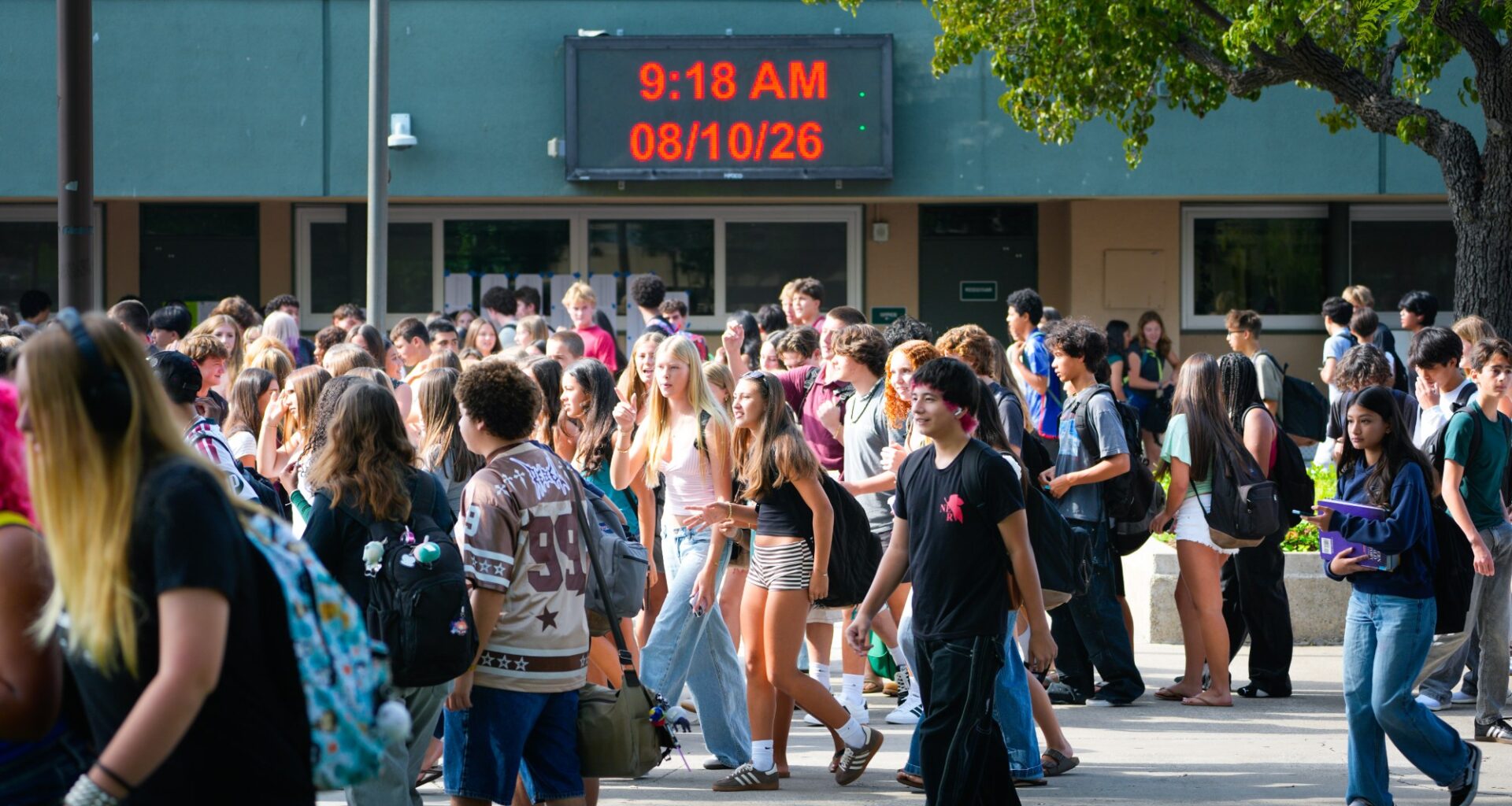
Tens of thousands of San Diego Unified students have returned to school, as district officials touted the impact of their college and career readiness efforts, their ongoing implementation of a math curriculum and the nascent plans for a new literacy curriculum.
District leaders highlighted recent years’ progress and plans Monday morning at Patrick Henry High School, the district’s largest comprehensive high school — and one whose successes they’ve been studying, explained Superintendent Fabiola Bagula.
With new student enrollment more than double what they had hoped for, the mood among San Diego Unified leaders was upbeat, five years after students returned to school fully in person following the disruptions of the COVID-19 pandemic.
This year, the focus in the county’s largest school district is on improving students’ wellness, literacy, math fluency and readiness for college and careers.
Although math performance is still below state standards, San Diego Unified students have improved for several years straight and are stronger than the statewide average, according to the California School Dashboard, used by the state to measure schools’ performance.
A similar pattern holds true for college and career readiness, another key metric, and one toward which the district aims to expand work-based learning. According to the district, more than 71% of 2026 graduates were considered prepared for college or career.
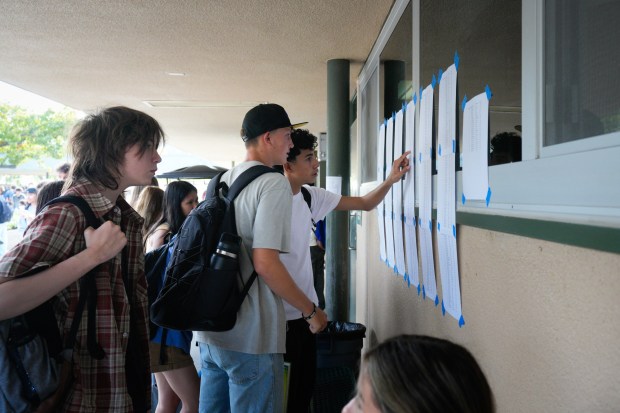 Incoming freshman students from Patrick Henry High School check which class they have for their first period at the start of the 2026-2027 academic year. (Nelvin C. Cepeda / The San Diego Union-Tribune)
Patrick Henry offers its roughly 2,500 students seven different career and college preparation pathways for students, in areas from architecture to engineering to education.
On Monday, in the early morning, cheerleaders flanked the entrance to the courtyard, cheering and shaking their pom-poms as their classmates filed in, showing varying degrees of enthusiasm.
At a demonstration, engineering and architecture students showed off a robot they had designed and constructed to compete in a sort of robotic sports game, picking up yellow balls and shooting them across the courtyard into a hub.
Ruby Aguilera, a 17-year-old senior who worked on the robot, said her robotics team was generally better at placing games than shooting games, and it had to do a lot of prototyping for Monday’s effort, spending more time on design than building.
“That was the hardest part for me,” she said.
She is completing two college and career readiness pathways — computer science and engineering technology — and said joining the robotics team had taught her a lot.
Next year, she hopes to head to Boston University to study biomedical engineering, with a particular interest in work on diabetes and a long-term goal of getting a doctorate.
Tina Hague, 17, who worked on programming on the robot, hopes to go to the Massachusetts Institute of Technology and study neuroengineering, or computer engineering and neuroscience.
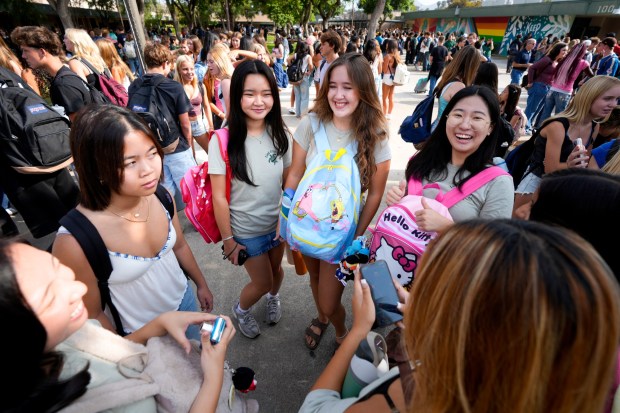 Students from Patrick Henry High School wait for the start of their first class period on Monday, Aug. 10, 2026, marking the start of the 2026-2027 academic year. (Nelvin C. Cepeda / The San Diego Union-Tribune)
As it works to improve graduation rates and graduates’ readiness for college and careers, the district is also two years into implementing a new math curriculum for elementary schools.
This math curriculum, designed around state grade-level standards, prioritizes deeper understanding, rather than memorization, to help students develop conceptual understanding over time, said district spokesperson James Canning.
To help students become more fluent in math, a relaunched sixth-grade curriculum aims to integrate online, paper and hands-on activities, and at the high school level, instruction will center on real-world and project-based learning.
The district is also preparing to develop a new elementary-school literacy curriculum this school year, with the help of new state funding.
A law passed last year, AB 121, steered $200 million to a literacy coaching grant program to develop literacy instruction and implement targeted support for students who need it, such as English learners.
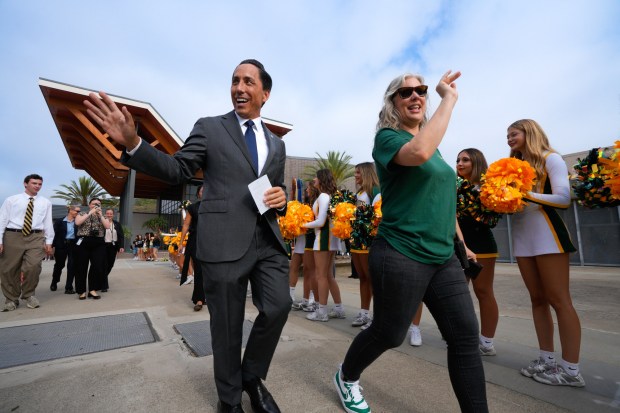 Patrick Henry High School Principal Melanie Kray, along with San Diego Mayor Todd Gloria, welcomed students back to school on Monday, Aug. 10, 2026, marking the start of the 2026-2027 academic year. (Nelvin C. Cepeda / The San Diego Union-Tribune)
“We adopted a new math curriculum last year where we provided robust professional development,” said San Diego Unified trustee Shana Hazan. “We saw some increased achievement, and we know we have work to do in literacy.”
To Bagula, it’s important for the curriculum to balance reading comprehension with the science of reading, a form of instruction that tends to focus more on phonics and letter sounds than on whole words.
“We need the children to have phonemic awareness, and yes, the science of reading teaches all of those things,” she said. “What we need to make sure is we’re building people that love to read.”
Bagula added that she wants the development of a new curriculum to involve the district’s top officials for multilingual education, data insights, literacy and special education, along with teachers — and she wants families involved.
“That’s actually what I’m pressing,” she said. “How are the parents and community voices there?”