
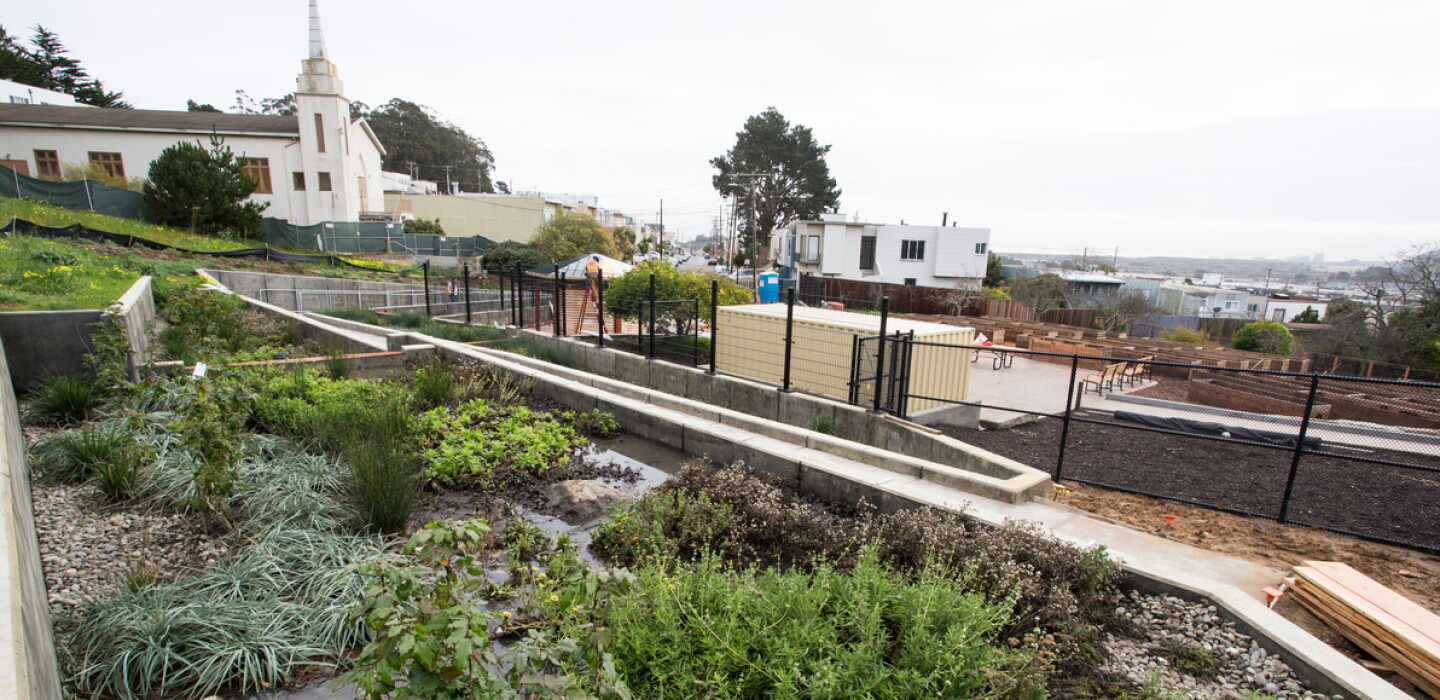
Hundreds of rain gardens have been installed in San Francisco to help with stormwater management.
The San Francisco Public Utilities Commission funded a study to find out if they could help keep microplastics and emerging contaminants out of the San Francisco Bay.
Researchers found significant reductions in all contaminants studied in water leaving the rain gardens.
Controlling stormwater flow has extra urgency in some cities. In those with a single system of pipes collecting both stormwater and wastewater, too much stormwater can exceed system capacity.
If this happens, untreated and incompletely treated wastewater can be released into rivers and lakes. This adds to concerns about lawn chemicals, heavy metals, oil, fecal matter, soaps and other material carried in rainwater runoff.
There are about 700 communities in the U.S. with “combined” sewer systems. The great majority are in the Northeast. (See map.)
San Francisco’s combined system is the only one on the California coast, says Willis Logsdon, senior watershed planner for the San Francisco Public Utilities Commission. (A “watershed” is a land area that drains rainfall and melted snow into creeks and rivers that feed bodies including lakes, bays and oceans.)
San Francisco’s Public Utilities Commission has invested in nature-based approaches to stormwater management (“green infrastructure”) to reduce the chance that stormwater will overwhelm sewers. The city has built or initiated 575 green infrastructure projects that put it a third of the way toward a goal of capturing 1 billion gallons of stormwater each year.
These projects include hundreds of “rain gardens,” patches of soil, rocks, mulch and plants lowered enough to capture rainwater and allow that water to go into the ground instead of down storm drains.
A recent study by scientists at a local nonprofit, developed in partnership with the city, found evidence of another significant benefit. They can help keep stormwater contaminants that are causing new worries among researchers from flowing into San Francisco Bay.
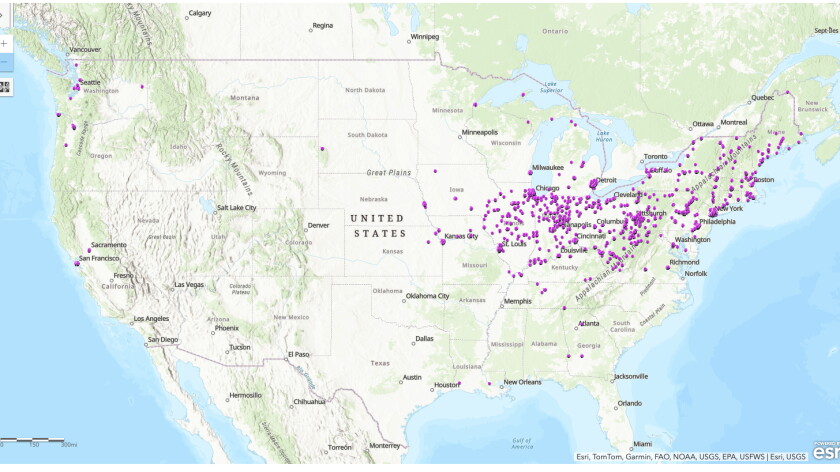
The vast majority of combined sewer systems (purple dots) are in the Northeast. The one in San Francisco is a Pacific Coast rarity.
(US EPA)
Emerging Contaminants
Most of San Francisco’s green infrastructure is designed to capture runoff from large impervious surfaces such as roadways and parking lots, Logsdon says. The study was designed to investigate how well rain gardens filter out contaminants in water running off these surfaces.
Logsdon worked with scientists at the San Francisco Estuary Institute to select monitoring locations and facilitate access to them. (Estuaries are places where salt and fresh water meet; the San Francisco Estuary is the largest in California.)
Samples of water going into the gardens and coming out of them were tested for the presence of 21 chemical contaminants. The list focused on “emerging contaminants,” substances increasingly detected in water and wastewater that are believed to bring new health or environmental risks. Those in the study included pharmaceuticals, personal care products, pesticides, tire wear particles and microplastics.
Researchers sampled water going into and out of four rain gardens over two wet seasons. Analysis revealed reductions in all 21 contaminants, most by 90 percent or more. Plants and the soil did the work alone; there weren’t other filtration systems in them.
The gardens filtered out up to 99 percent of the tire wear particles in the water. Tire wear particles, which are created by contact between car tires and pavement, make up half of the microplastic pollution in the San Francisco Bay.
The institute has studied the presence of regulated contaminants such as mercury and PCBs (banned and carcinogenic electrical coolants) in rain gardens, says Melissa Foley, manager of its regional monitoring program for the bay. But this is the first study Foley is aware of that looks comprehensively at such a range of emerging contaminants, she says.
“This is really significant,” agrees Barbara Hopkins, executive director of the Green Infrastructure Leadership Exchange, a national network of green stormwater infrastructure professionals. “Chemicals from tires and microplastics are really problematic, both for flora and fauna. A lot of people were hopeful that this [the filtering seen in the study] was possible.”
In the Pacific Northwest in particular, officials and environmental advocates are concerned about the impact of 6PPD-quinone, a preservative found in car tire particles that is killing coho salmon before they can lay eggs.
The rain gardens in the study filtered out more than 95 percent of this contaminant.
Still, the San Francisco Estuary Institute notes that even water filtered through the rain gardens had enough 6PPD-quinone to present a risk to aquatic life.
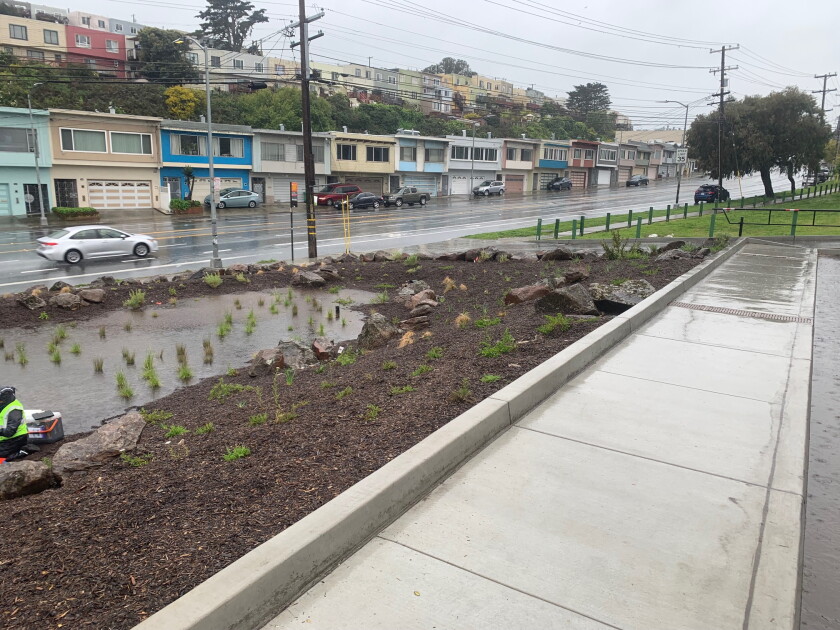
Rain gardens placed next to roadways and parking lots can capture runoff from these impermeable surfaces.
(San Francisco Estuary Institute)
A Benefit Among Benefits
Much of the land in San Francisco’s watersheds has been paved and developed over time. “That’s totally changed the ecological function of these spaces,” Logsdon says.
Rain gardens restore some of the pre-development services the land provided. In addition to their role in stormwater management, they bring green space to urban areas, create habitat for birds, pollinators and insects, and reduce heat island effects.
The website for Hopkins’ group includes a “calculator” that can spit out the potential benefits from a planned green infrastructure project. Beyond flood risk reduction, they include job creation, economic benefits and making walking and biking routes more attractive (and cooler, thanks to shade).
Hopkins intends to include the findings of the San Francisco study in this accounting. “It helps to make the case to anyone who may still be unpersuaded about green stormwater infrastructure that this is a really good idea,” she says.
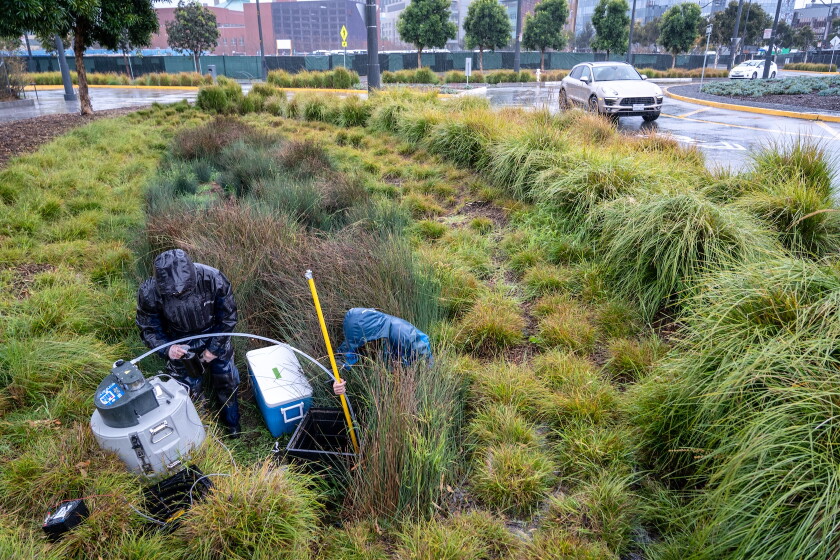
Sampling water from a rain garden outlet.
(Shira Bezalel)