
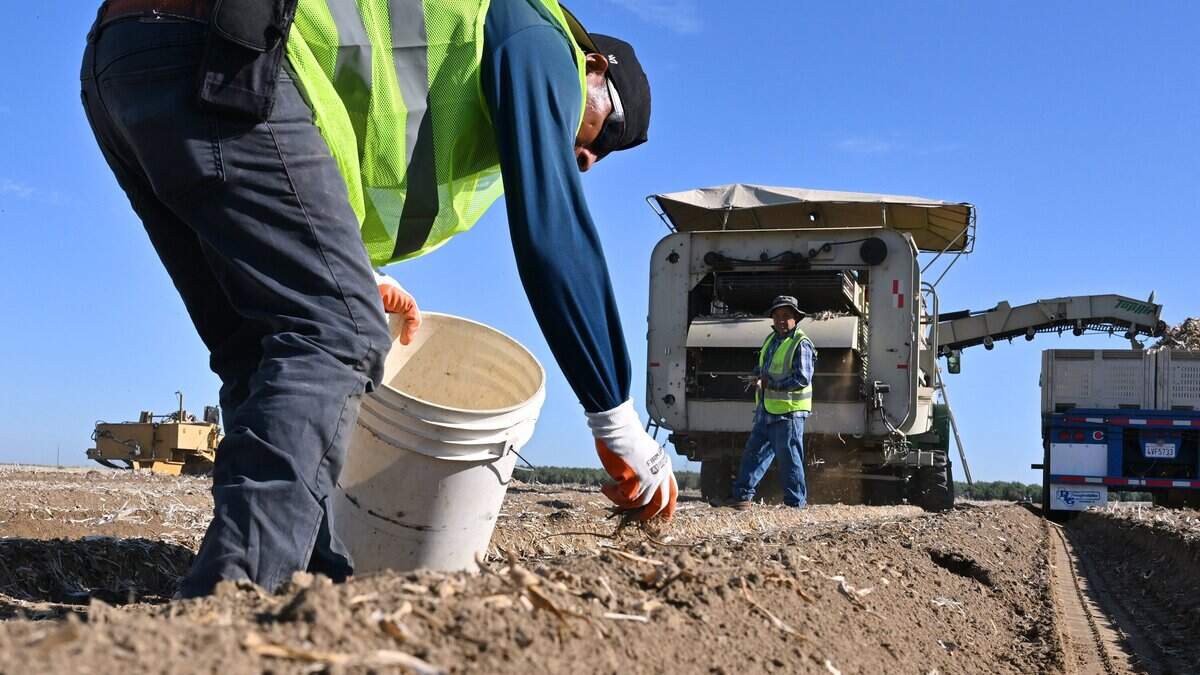
The Fresno metro ranks fourth in the nation for seasonal foreign labor demand, with 51 requested workers per 10,000 residents, according to a new study by Manifest Law. Analyzing U.S. Department of Labor data From April 2025 to March 2026, the researchers highlighted how the region’s economy remains deeply tied to temporary labor during peak agricultural periods. The study shows seasonal foreign workers play a significant role in helping U.S. employers address short-term labor shortages during periods of peak demand.
Fresno employers requested a total of 2,574 seasonal foreign workers during the study period, according to researchers. The majority of 2,409 positions were filled through the H-2A agricultural program, while only 165 workers were brought in via the H-2B non-agricultural program.
The H-2A program allows agricultural employers to hire foreign workers for seasonal farm jobs when there are not enough available U.S. workers, while the H-2B program serves employers with temporary non-agricultural labor needs in industries such as landscaping, hospitality, seafood processing, construction, and recreation.
As the Trump administration moves to end Temporary Protected Status for several immigrant groups and employers continue to warn about labor shortages, researchers at Manifest Law analyzed where businesses rely most heavily on the H-2A and H-2B seasonal worker programs—two legal pathways employers use to fill temporary jobs when domestic workers are unavailable.
Fresno County is home to 1.88 million acres of farmland with agricultural operations covering nearly half of its total land base. This immense production capacity led to a record-setting gross value of $9.03 billion in 2024, fueling the high demand for seasonal workers.
California and Washington depend more on Agriculture workers
Nationally, California, and Washington depend far more heavily on H-2A workers, resulting in some of the nation’s lowest shares of non-agricultural seasonal demand. Whereas Florida leads with 78,647 requests for seasonal foreign workers under H2-A in certified labor cases, followed by Georgia (42, 337) and California (38,377). Meanwhile, New England stands out as the region where employers rely most heavily on the H-2B program, with non-agricultural occupations accounting for the overwhelming majority of seasonal foreign labor requests.
Among large metropolitan areas, Tampa–St. Petersburg–Clearwater, Florida, saw the highest concentration of demand with 137 per 10,000 employees. Rochester, New York followed at 81, while Grand Rapids-Wyoming and Kentwood, Minneapolis shared the third position with 52, just ahead of Fresno.
Employers seeks 533,000 workers for crops
In the 12 months ending in March 2026, employers across the country sought more than 533,000 H-2A workers for crops, nurseries, and greenhouses, according to the research, but the demand through the H-2B program is similarly concentrated, although across a broader range of industries. Unlike H-2A, which has no annual numerical limit, H-2B is generally capped at 66,000 visas each fiscal year, though Congress and the Department of Homeland Security have regularly authorized supplemental visas in recent years as employer demand has exceeded statutory limits.
This analysis, conducted by Manifest Law—a Phoenix based immigration law firm specializing in immigration visas—uses the U.S. Department of Labor’s labor certification data to examine where demand for seasonal foreign labor is most concentrated across occupations, states, and metropolitan areas. The analysis compares both H-2A and H-2B labor certification requests to identify which industries rely most heavily on temporary foreign workers and where seasonal labor demand represents the largest share of the local workforce, highlighting regional differences in how employers meet seasonal staffing needs.
New England mostly relies on H1-2B visas
Rhode Island has the highest concentration of non-agricultural seasonal labor requests, with 98.9% of requested workers tied to H-2B occupations. Alaska follows at 95.6%, while Massachusetts (91.4%), New Hampshire (84.2%), Maine (82.5%), and Vermont (78.8%) also rank among the states where seasonal foreign labor is overwhelmingly concentrated outside agriculture. Many of these states have relatively small agricultural sectors but significant demand from industries such as tourism, hospitality, landscaping, forestry, seafood processing, and recreation, all of which commonly rely on H-2B workers during peak seasons.
At the other end of the spectrum, agricultural states account for the lowest shares of non-agricultural seasonal labor demand. Just 6.3% of Washington’s seasonal foreign labor requests are tied to H-2B occupations, followed by California at 7.7%, Georgia at 14.1%, New Mexico at 17.0%, and North Dakota at 19.6%. In these states, demand is driven primarily by H-2A requests supporting crop production and other agricultural operations, illustrating how regional industry specialization shapes employers’ reliance on the nation’s two seasonal foreign worker programs.
This story was originally published August 10, 2026 at 10:56 AM.
Related Stories from Fresno Bee