
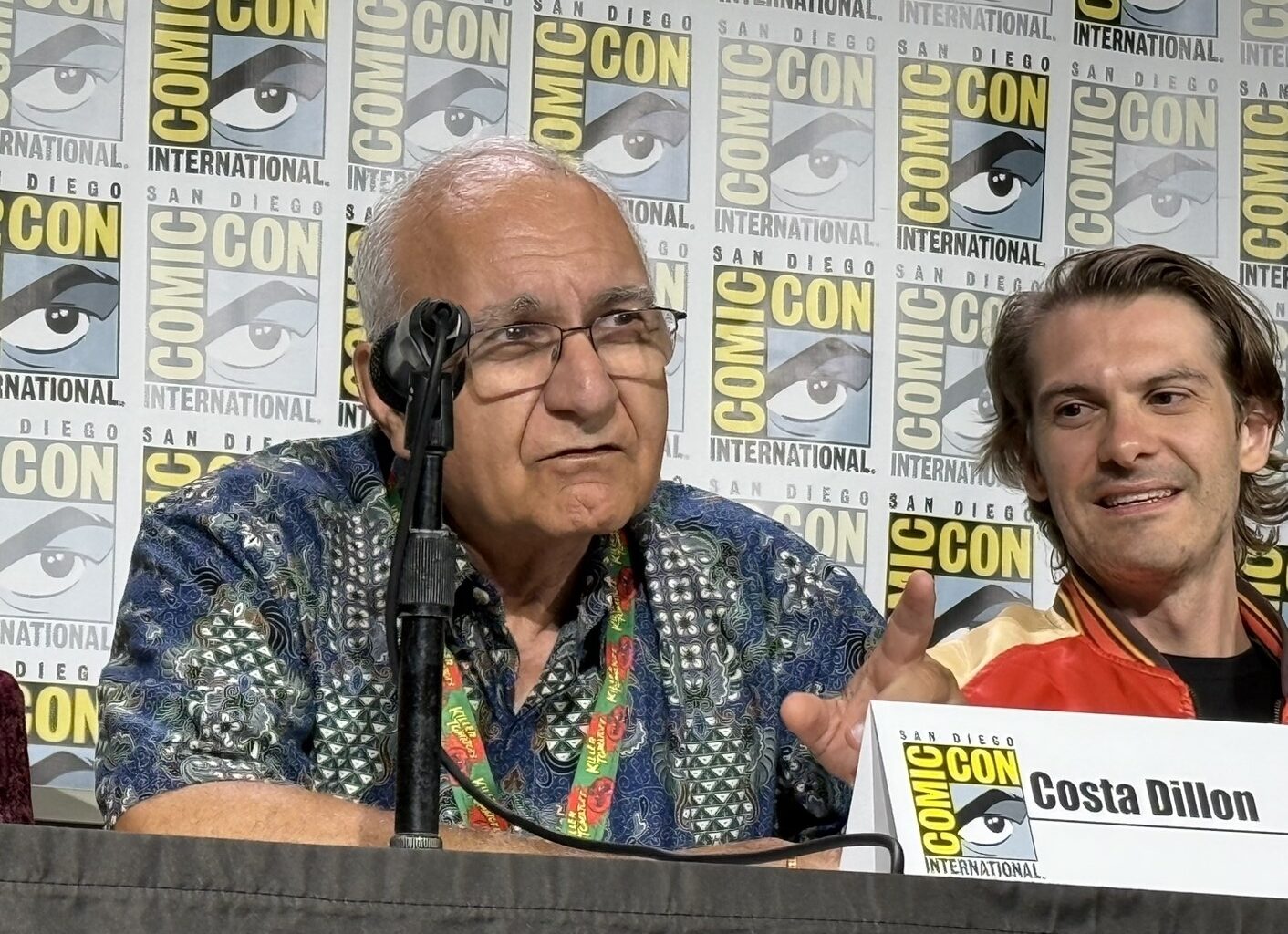
When Poway resident Costa Dillon came up with the idea of making a movie about killer tomatoes as a teen, he never dreamed that over 50 years later it would be a movie franchise with a cult following.
But 48 years after the 1978 horror comedy film “Attack of the Killer Tomatoes” debuted, the fifth installment — “Attack of the Killer Tomatoes: Organic Intelligence” — opened in movie theaters across the U.S. on Aug. 7.
Dillon was one of its two screenwriters and also had a couple of small acting parts.
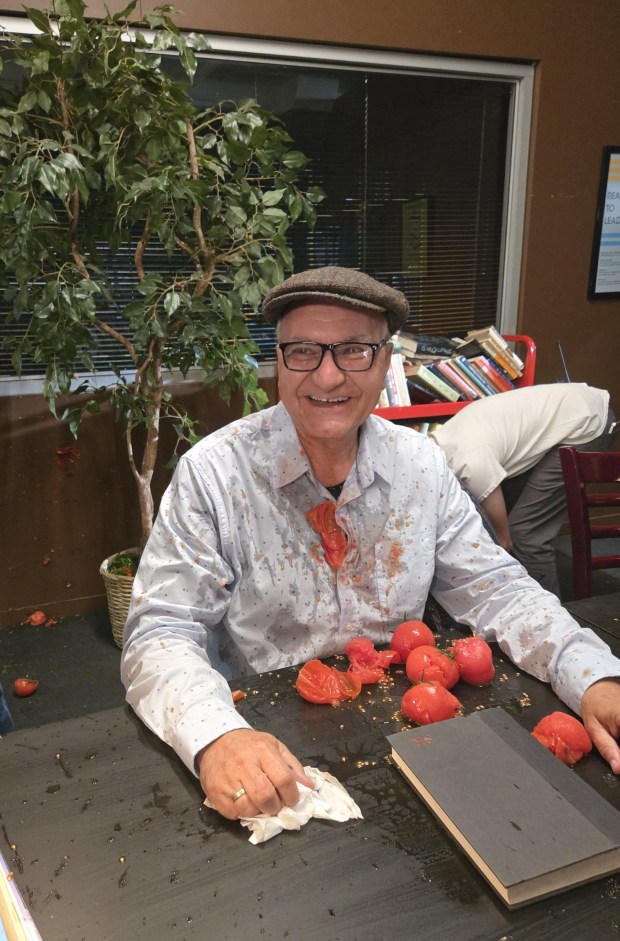 Poway resident Costa Dillon acting in the library scene during filming of “Attack of the Killer Tomatoes: Organic Intelligence” that opened in movie theaters on Aug. 7. (Courtesy of Costa Dillon)
Like its predecessors, much of the movie was filmed at recognizable locations throughout San Diego County. These included the USS Midway, the Embarcadero, downtown Chula Vista, Rady Shell and Mission Bay, Dillon said.
“We have a great community of filmmakers here and have never had road blocks when filming in San Diego,” he said. “We know the place and people know who we are and are very accommodating. We appreciate the cooperation of local governments. It’s great to film here.”
The plot for this movie acknowledges the first, he said, by saying it was not a comedy, but rather a documentary to warn the public about the danger of tomatoes and how they are behind some nefarious incidents in history.
“I mostly enjoy other people’s enjoyment of (the movies),” Dillon said. “I realize the concept is silly, but expect people to take the good-natured humor. There is not a message or political statement. People just go to the movie to sit and have fun.”
Dillon said he and his fellow filmmakers of the franchise intentionally make each film to get a PG or PG-13 rating so families can go see their tomato movies.
“You have just a handful, mostly Disney films and animation, because there are not many films where you can go as a family,” he said. “(With our films) the humor works for kids and adults.
“I enjoy hearing them laugh at what we put up on the screen,” he said.
While Dillon’s career as a filmmaker, writer and actor would be enough for many people, he actually pursued two very different careers simultaneously. The other was as a national park ranger.
“It’s been fascinating,” Dillon said. “I meet people who say they’d love to be a park ranger or to work in the movies. I had them both as two careers.”
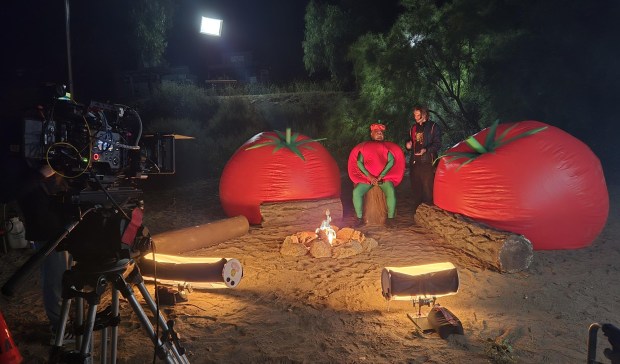 Costa Dillon, who has been a writer for all of the “Attack of the Killer Tomatoes” movies, took this photo of actor Paul Bates with director David Ferrino when the fifth movie in the franchise was filmed. It was released on Aug. 7. (Costa Dillon)
Constantine “Costa” Dillon was born in 1953 in Connecticut. When he was a year old, his family moved to Camp Pendleton due to his father being in the Marine Corps, he said. The family subsequently moved to several places, but when Dillon was in seventh grade his father, Capt. James Dillon, was stationed in San Diego and they stayed here for the remainder of his formative years.
Spending his teen years in Chula Vista, Dillon was among the first students to attend Bonita Vista High School from which he graduated in 1971. It was during his years there that Dillon became friends with John DeBello and Steve Peace.
“We started making little 8 mm films … what you used for home movie formats. These were silent movies,” Dillon said. “We made them in the summer after 11th and 12th grade. We put our friends and family in the movies.
“We were having fun making movies,” he said.
While moviemaking was mostly a hobby at the time for the teens, they also won awards. For example, they came in third at the 1971 National Kodak Teenage Film Festival and in 1972 won the Shasta Film Festival.
Despite this, Dillon did not plan to have a movie career. He attended the University of California, Davis as an electronics engineering major, but the required math courses led to him changing his mind, he said.
“The guy across the hall (in my dorm) was studying to be a park ranger and I had never thought of it,” Dillon said. “I thought I’d love to do that because my family visited parks and went camping. I loved the idea of working at national historic places. It was the right choice.”
But getting a job in the U.S. National Park Service after graduating with a bachelor’s degree in park management was a challenge when only around 100 park rangers were hired each year, he said.
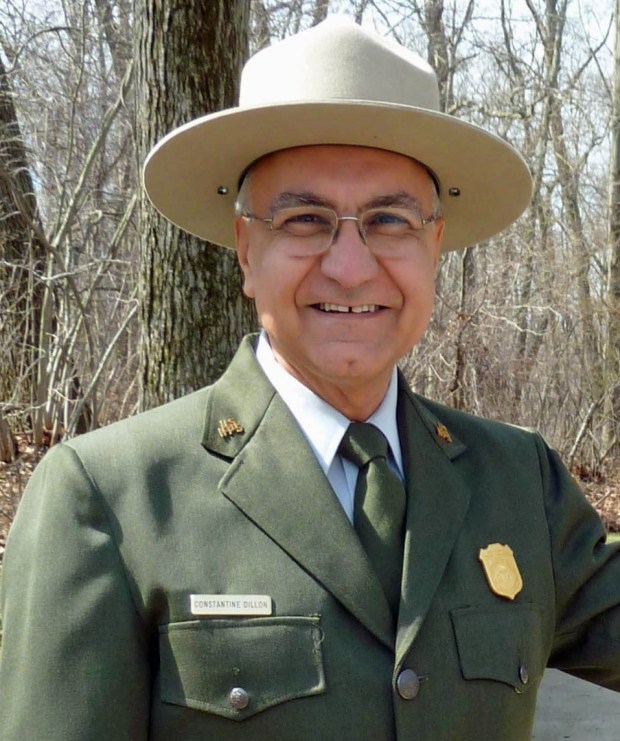 Costa Dillon wearing his U.S. National Park Service winter uniform. He retired in 2013 after 35 years. (Courtesy of Costa Dillon)
Dillon was eventually hired and had a 35-year career that had him living all over the United States until his retirement in 2013. He worked in such places as Gettysburg National Military Park, Independence Hall and Eisenhower National Historic Site (all in Pennsylvania), Yellowstone National Park and the Grand Canyon. He also worked at the Great Smoky Mountains National Park (North Carolina/Tennessee) and Hubbell Trading Post National Historic Site (Arizona).
He later became superintendent of the National Park Service Horace M. Albright Training Center (Grand Canyon, Arizona), Homestead National Historic Park (Nebraska), Fire Island National Seashore (New York) and Indiana Dunes National Park.
“I wanted to live in different places and you had to in order to get promoted,” Dillon said.
He also earned a master’s degree in public administration from the University of Colorado.
But while trying to get his career started in the National Park Service, Dillon said he was back in San Diego, where he founded a film company in National City with his high school friends. They made a lot of sports films, such as for San Diego State University football games and local high school games, he said. They also took on work for TV commercials and industrial films.
“In 1977, we decided to make a feature film and I had the idea to make it ‘Attack of the Killer Tomatoes,’” Dillon said, who first explored the topic as a short film during college. “It was a spoof of low-budget Japanese horror films.
“Tomatoes were something innocuous … we were poking fun at low-budget monster movies,” he said.
“Originally, it was a fun idea and we raised a minuscule amount of money,” he said. “To be famous is astounding. There were just serendipitous events.”
Dillon pursued dual career fields. DeBello became a leader in filmmaking, while Peace ended up with a political career in the California Assembly and state Senate, he said.
“John (DeBello) really wanted to be a filmmaker and we (Peace and Dillon) kept our hands in the feature film stuff,” Dillon said, adding he was never formally trained in filmmaking, but self-taught.
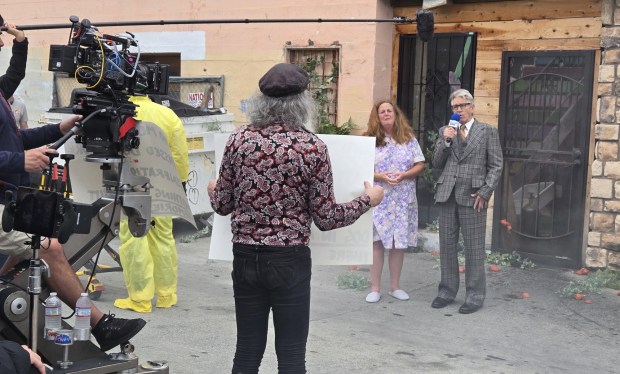 Screenwriter Costa Dillon took this photo of “Attack of the Killer Tomatoes: Organic Intelligence” actors Karly Rothenberg and Eric Roberts when they were filming in Chula Vista. The film was released on Aug. 7. (Costa Dillon)
The first film was far from being a box office success, but because of the film format they used, it was among the first 100 films available during the start of VHS and movie rentals in the early 1980s. That led to its cult following, he said.
“People started noticing it there,” Dillon said, adding that a clip about the movie on “Muppet Babies” also helped it grow in popularity.
“We had not planned to do another ever, but the popularity of the original film gained an audience so 10 years after the first we said OK,” he said.
That 1988 sequel, “Return of the Killer Tomatoes!” included in its cast George Clooney in one of his first movie roles. The film did not gain the admiration of critics, but its cult following continued to grow.
Subsequent films were the 1991 “Killer Tomatoes Strike Back!” and the 1992 “Killer Tomatoes Eat France!” Dillon has been a writer and actor in all of them.
“To make the third and fourth movies was just amazing,” Dillon said.
There was also a brief animated series on Fox Kids in the early 1990s, which had repeated airing in later years.
Dillon said he and his wife, Ellen, who is a wildlife biologist, decided to return to San Diego County after his 2013 retirement from the U.S. National Park Service.
They chose Poway for their home because “it’s a nice community … and very quiet,” he said, noting it does not have a freeway running through it.
They liked its “city in the country” vibe and the ease for them to enjoy nature, he said. In retirement, he teaches classes about parks and U.S. history at San Diego State University and California State University San Marcos.
Dillon said he also has more screenwriting projects in the early stages.
During the recent San Diego Comic-Con International Dillon was among those on the “Attack of the Killer Tomatoes” panel talking about the latest film.
“I’ve been to (Comic-Con) a few times and it is always surreal to have fans … because I’m not an A-list or B-list celebrity,” Dillon said, adding he is more like a letter much farther down in the alphabet. “I can’t imagine that … anybody wants to ask for my autograph.”