
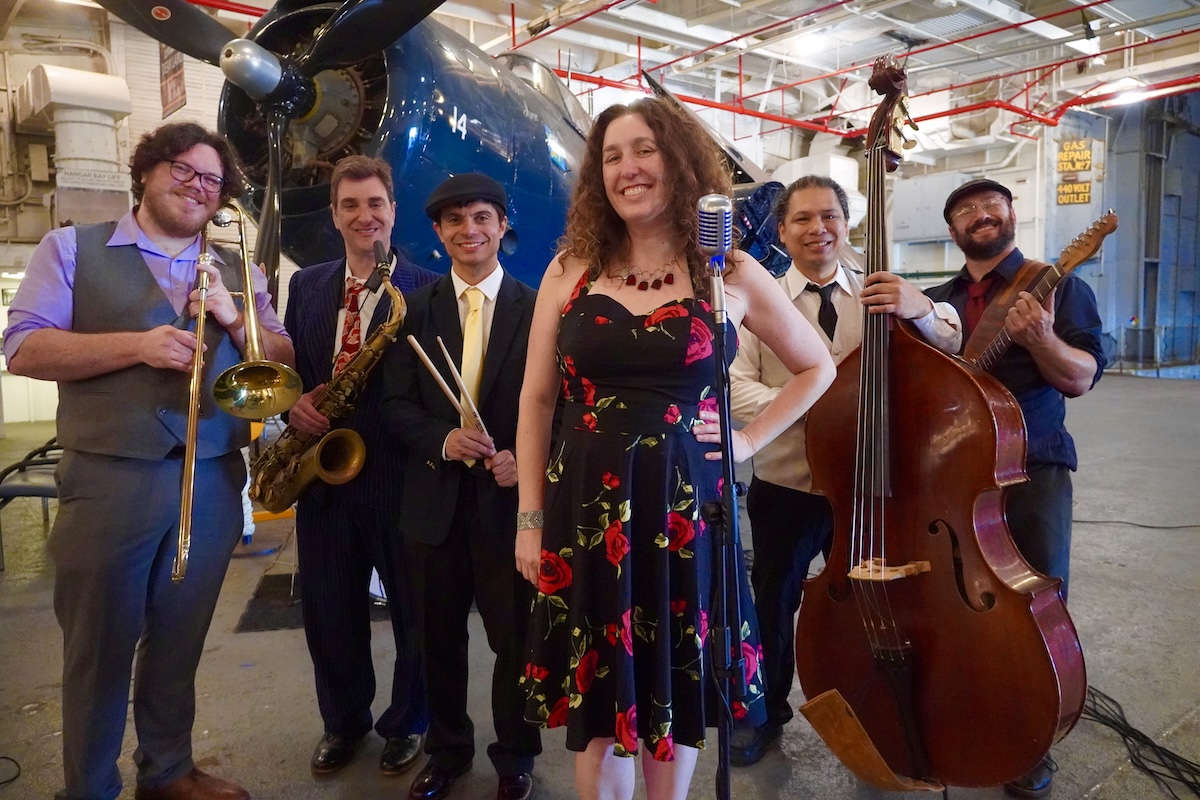
Time travel is possible when Death and Taxes Swing Band and guests grace the hangar deck on the USS Hornet Sea, Air and Space Museum. Joining forces Aug. 15 for a “South Seas Swing Dance” party, the evening aboard Alameda’s historic aircraft carrier includes live music, swing dancing, food catered by Pacific Fine Foods, a cash bar with tiki drinks and more.
The celebration harkens back to Harlem in the 1920s and ’30s, when the West Coast Swing, Charleston, Lindy Hop and other dances were all the rage. With big band jazz music grabbing attention, swing’s rhythms and performers laid the groundwork for the dance form’s popularity. From backstreet clubs to Main Street to Hollywood films, the art form captivated audiences eager for feel-good escapism following World War I.
The South Seas party on the USS Hornet is styled after the U.S. Navy tradition that had marines and their families sharing deck barbecues or picnics during Western Pacific deployments. Encouraged to dress in Hawaiian shirts and vintage 1930s clothing and dancing shoes, period attire is optional because anyone eager to take slow-slow-quick-quick steps or spin through simple turns is welcome.
Never learned a swing dance? No problem. The party begins with a short dance lesson taught by band leaders Rebecca Roudman and Jason Eckl. Roudman, a classically trained cellist and violinist, is the band’s lead vocalist. Guitarist Eckl is the main musical arranger. Other members of the band include Brandon Voss on bass, Bobby Rogers on clarinet/sax and Kevin Coleman on drums.
Roudman, in an interview, said she and Eckl first discovered their love for swing dancing in college. The couple, now married, were already heavily into music of all genres, including jazz. “We took dance lessons for a couple of years,” Roudman said. “I remember being intimidated at first, but found out it was easier than I thought it would be.” Eventually they graduated to turns, but the aerials performed by some swing dancers? “We left those for advanced dancers,” she said.
Roudman says people are attracted to swing’s “nostalgia-ness.” Cyclical popularity saw interest rising post-World War II and again in the 1990s. It waned until recently, she said, adding: “Things go in 20-year cycles. It’s long enough for people to feel it’s in the past. Ten years is too soon, but 20 allows people to think romantically—in this case, about the 1930s jazz era, whether what they believe is true or not.”
Couples in paired swing dancing stand facing each other. Holding hands rather than assuming the arm-waist-shoulder stance associated with waltzing and other dance forms, partners are on an equal platform. Even so intimacy is maintained, as two people must move in coordination with each other to avoid bruised toes.
Swing music differs from rock in that it’s equally danceable, but the rhythms jive more. A typical rock beat is even, often weighted. Big band jazz music follows a long-short-long-short pattern. Roudman said, “You can dance to rock, but there’s more of a feeling of bounce when you dance to swing music.”
Then there’s the effect of breaking the pattern with a full-stop fermata or a suspended note. “We come along, dah, dah, dah, and then boom. Everyone dancing holds a pose. People love that fermata … and then we go back into it. It’s like a push-and-pull in the music that we and the dancers do together,” Roudman said.
The roughly 21 songs on the playlist for the Hornet show include four Roudman agreed to comment on. “When I Get Low I Get High” is first up. “The melody is great, the words are fun,” Roudman said. “I like the title’s meaning: You can do what you want, but I’ll always take the high road. That’s a cool statement. And especially with the way things in society and politics are today, it feels good to not stoop to a low level. The easy thing is to go along. Taking the high road is saying, ‘this doesn’t affect me.’”
“Summertime,” often presented as a slow song, has the band scaling down from the zip of other pieces. “We do a version that’s still a good dance tempo,” Roudman said. “Plus, this song, almost everybody knows it. Is it the familiarity, how it builds or the melody that we love? I think it’s all things combined that makes it great.”
When singing “Route 66,” Roudman sometimes changes the lyrics to include the city where the band is performing. People can expect to hear “Alameda,” because Roudman admitted, “It’s always fun to change it up for the local crowd.”
When the opening riff of “In the Mood” begins, it takes only a few notes for everyone to get on their feet. The effect is universal, Roudman said: “Automatically, they know this song. Not just here in the United States, either. We played a swing gig in Portugal and people knew it—and danced.”
Death and Taxes Swing Band performs at South Seas Swing on Saturday, Aug. 15, at 7pm aboard the historic USS Hornet – Sea, Air and Space Museum, 707 West Hornet Ave., Alameda. uss-hornet.org/event/south-seas-swing-2026